Scooby Doodle Dooo!

So I have been following the blog, Hey Look a Writer Fellow, by Mike Allegra who describes himself as a friendly children’s book author. He has set up a contest to win one of his doodles. All you have to do is describe If you could have any fictional character as a pet, which character would you choose and why?

Atticus+&+Oberon's+Sausage+Fest+-+Best

I first said a flying pig because I could fly around on it and have it Poop Upon Mine Enemies, but he said it had to be a character from literature, so then I picked the wolfhound Oberon from Kevin Hearne’s Iron Druid series. The dog is telepathic and makes very funny commentary on human culture, loves action movies and SAUSAGE. He is much smarter than that other large dog of pop culture fame and probably larger.

image36%255B1%255D

Go visit his website to win a doodle! But I still love flying pigs…

Beware the Ides of March

crow

The death of the amazing author Terry Pratchett this week got me thinking about poetry that is used to say farewell. Eulogies remember the good in people who have died. Elegies lament sad things like death and war. But valedictions, as seen in high school valedictorian speeches, say farewell to good times and good people. So I thought I would remind us of John Donne’s classic poem that reminds us of how connected we are.

death

A Valediction: Forbidding Mourning

BY JOHN DONNE

As virtuous men pass mildly away,

And whisper to their souls to go,

Whilst some of their sad friends do say

The breath goes now, and some say, No:

So let us melt, and make no noise,

No tear-floods, nor sigh-tempests move;

‘Twere profanation of our joys

To tell the laity our love.

Moving of th’ earth brings harms and fears,

Men reckon what it did, and meant;

But trepidation of the spheres,

Though greater far, is innocent.

Dull sublunary lovers’ love

(Whose soul is sense) cannot admit

Absence, because it doth remove

Those things which elemented it.

But we by a love so much refined,

That our selves know not what it is,

Inter-assured of the mind,

Care less, eyes, lips, and hands to miss.

2000px-Terry_Pratchett_COA.svg

Our two souls therefore, which are one,

Though I must go, endure not yet

A breach, but an expansion,

Like gold to airy thinness beat.

If they be two, they are two so

As stiff twin compasses are two;

Thy soul, the fixed foot, makes no show

To move, but doth, if the other do.

And though it in the center sit,

Yet when the other far doth roam,

It leans and hearkens after it,

And grows erect, as that comes home.

Such wilt thou be to me, who must,

Like th’ other foot, obliquely run;

Thy firmness makes my circle just,

And makes me end where I begun.

 moist

This is a better poem for Prachett than Death, Be Not Proud, since that one foretells the death of Death, and anyone who has read the Discworld novels has a soft spot for this character.

The Eternal Joy of a Funny, Brilliant and Humane Mind….Sir Terry Pratchett!

A timely top ten!

cirtnecce's avatarMockingbirds, Looking Glasses & Prejudices...

As the world knows by now, that Sir Terry Pratchett had a recent visitation from DEATH and in his language has “moved on”. I mourn his loss as much as other Pratchett fans and know that life on the third planet from the sun, without his wisdom, humanity and funny bones would simply be not the same. However knowing him, I do not think he would have appreciated ‘mourning’ and would have found much hilarity at the professed grief of folks who have never read his work, let alone appreciating it. He would instead read his true fans a riot act for being cast down when he was simply “getting on with things”. Therefore instead of doing an obituary post, I thought of blogging about some of best reasons why we all adored Sir Terry Pratchett and his Discworld!

  1. The Great A’Tuin and Discworld – Why? Give me one good…

View original post 995 more words

The Problems of Non-Concrete Poetry Where Placement on the F^*%ing Page Matters in the Context of Electronic Publishing

Okay, so a while back I was talking about concrete poetry, a poem that looks like the subject it is about and I gave my pear poem as an example. That form translates off the page and into the world of electronic publishing with no problems because most platforms will allow you to center your text. Unfortunately, as I have been working to prepare my upcoming book, Icons & Action Figures (Batteries Not Included), for e-publishing this spring, I have come across some annoying problems.

sandy01

It turns out that although I rarely write concrete poetry, I do from time to time tab words and phrases away from the regular text line to suggest, say, fog or leaves or, in the example I am thinking of, foxes bouncing around a restaurant. “Fox Games” is one of my favorite poems because I achieved something that I love managing: conveying with words on the page the colors and dynamism and message and story that I see in a piece of visual art (ekphrasis).

sandy03

The poem is based on a photo of an installation of the same name by artist, Sandy Skoglund. I attach the whole picture and some close ups to show the details of this vivid masterpiece.

I originally wrote the poem in two styles, alternating between sections with regular lines and sections about the foxes, where words or phrases mimicked on the page what the foxes were doing all over the print. To reproduce the effect without being able to do anymore that left-justify or center the pieces is impossible; I might be able to manage that here in a blog post, but if you try messing with styles in an e-book, you end up with…well, a mess. So I am stuck with only left-justification. So I had to choose to go for only the sound of the action, rather than sound, look and feel. Sigh. But I still love the poem. Here is the second half of it:

He begins to speak of himself. She can’t help looking at him,

imagining his face in forty years of soft folds, his voice

crinkling newsprint. Time, she thinks,

fades us to this grey. Time,

she thinks, her face blank pink attention. There is never enough

time to learn to speak in color. There’s so much we can’t say

with our bodies. We need

these foxes

jumping

.

on tables

.

playing

at tearing out

each other’s throats

.

crimson

foxes

dancing

.

among grey tablecloths

grey baskets

grey bread

.

while we sit in our grey corner speaking of the blush

of the wine about to be poured out by our waiter in his grey vest,

wine that holds itself back, corked for rational inspection, grey

bottled up, wine that knows itself

crimson

playful

ready to bark

and bite.

Skoglund, Sandy. “Fox Games.” Cibachrome print. 1990.

Spilecki, Susan. “Fox Games.” Kimera. June 2001

More Damn Muses, But These are the BEST

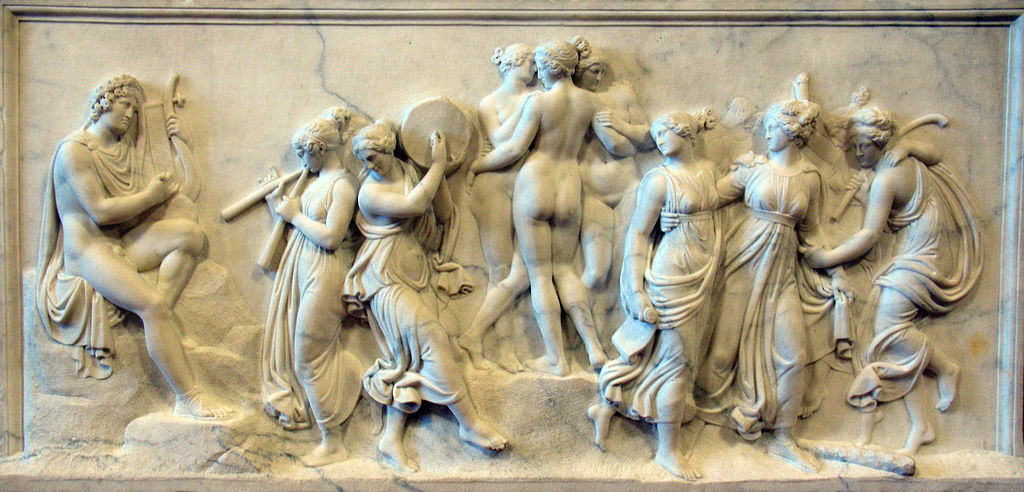
1024px-1807_Thorvaldsen_Tanz_der_Musen_auf_dem_Helikon_anagoria

So all this talk about Xena has made me realize that I know damn little about ancient Greece, and given that one of my friends actually teaches high school Latin and Greek (in 2015. I know.), I figure I should fix this grave lacuna in my knowledge. So I started messing about online, figuring that the interwebs would point me in the right direction. After getting sidetracked by a statue of Aphrodite having a bad hair day, I got down to business and found a translation of the The Theogony of Hesiod (Greek, ~700 BCE) translated by Hugh G. Evelyn White in 1914. And who do you think he starts out talking about?

(ll. 26-28) `Shepherds of the wilderness, wretched things of shame, mere bellies, we know how to speak many false things as though they were true; but we know, when we will, to utter true things.’

(ll. 29-35) So said the ready-voiced daughters of great Zeus, and they plucked and gave me a rod, a shoot of sturdy laurel, a marvellous thing, and breathed into me a divine voice to celebrate things that shall be and things there were aforetime; and they bade me sing of the race of the blessed gods that are eternally, but ever to sing of themselves both first and last. But why all this about oak or stone? (2)

(ll. 36-52) Come thou, let us begin with the Muses who gladden the great spirit of their father Zeus in Olympus with their songs, telling of things that are and that shall be and that were aforetime with consenting voice. Unwearying flows the sweet sound from their lips, and the house of their father Zeus the loud-thunderer is glad at the lily-like voice of the goddesses as it spread abroad, and the peaks of snowy Olympus resound, and the homes of the immortals. And they uttering their immortal voice, celebrate in song first of all the reverend race of the gods from the beginning, those whom Earth and wide Heaven begot, and the gods sprung of these, givers of good things. Then, next, the goddesses sing of Zeus, the father of gods and men, as they begin and end their strain, how much he is the most excellent among the gods and supreme in power. And again, they chant the race of men and strong giants, and gladden the heart of Zeus within Olympus, — the Olympian Muses, daughters of Zeus the aegis-holder.

Now aside from the fact that this is just awful darn pretty, it is still making out poets to be mouthpieces who just channel the Muses while the girls do the work. This old hat formula has, as I have asserted before, had a negative affect on wanna be poets who don’t get that writing is work.

Although, now that I think of it, this is the first hat…

“The Dance of the Muses at Mount Helicon” by Bertel Thorvaldsen (1807).

What the Eyes Want

gabqm36

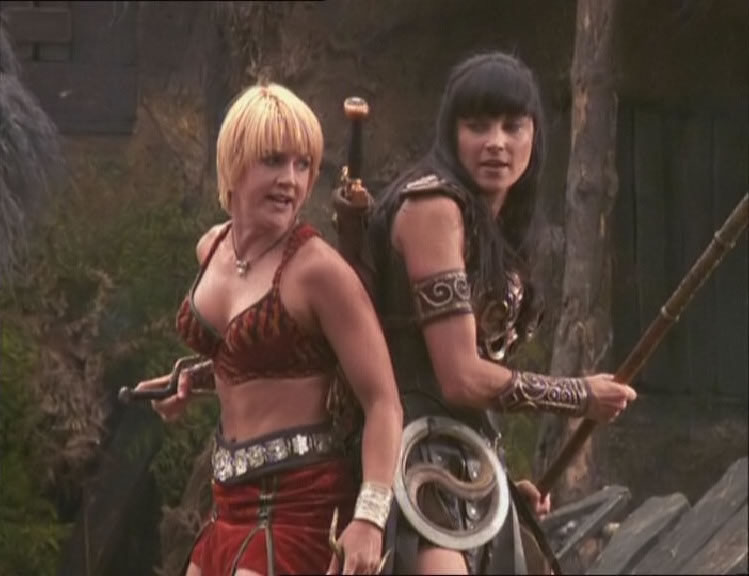
So I have once again been binge-watching Xena: Warrior Princess (XWP) on Netflix. Now I understand why I binge-watch Buffy the Vampire Slayer (BtVS); it is a fairly aesthetically complete show, the writers quickly came to write with a consistent voice (Joss Whedon’s), and they were always, always true to the characters (no mysterious evil babies, unless you count Dawn Summers, as many people do). The villains are compelling and the power relations between Slayer, Scoobies, victims and other non-Scoobies get worked out in interesting ways; this last probably is held together by the high-school-as-horror framework that is the series’ origin story.

In comparison, XWP ranged wildly from overblown operatic tragedy to high camp, often from one episode to the next. The writers wrote narrative arcs that fans twenty years later are still lamenting. And there was not just one mysterious and/or evil baby; there were TWO. And do not EVEN get me started on the final two episodes; although they were aesthically very pretty, and Renee O’Connor handled her katana fight scenes with tremendous aplomb, the story-runners basically broke every rule in the book, betrayed the fans, and put a stink on something so many of us loved. I have taken to my self-styled deconstructionist friend, Jenna Tucker’s way of handling this and I write those two episodes out of the canon. Kaput.

Also, although the Hong Kong style of fighting was always very high quality, sometimes the production value was a bit cut rate or cheesy (think of the Evil Egg Men in “Prometheus”). So here is me with my master’s degrees and my interest in High Quality Popular Culture. Why do I keep going back to this show as a thirsty woman back to sparkling fountain?

And what went through my mind as I wrote that question is one key to the answer. My internal image was the cartoon man crawling through a desert; I had to consciously choose to replace the man with a woman to represent myself in the metaphor more accurately. XWP went off the air in 2001. Fourteen years later, the vast majority of TV shows and films still don’t pass the Bechdel Test, which is that a show must:

  1. Have at least two women in it
  2. Who talk to each other
  3. About something besides a man.

(This is, one would think, NOT A HARD TEST TO PASS. And as other critics have noted it isn’t even the best test to see if a movie could be feminist, as a true feminist agenda has intersections with other groups striving for equality—race, class, LGBTQ, and disability are all groups who are institutionally under- or unrepresented in popular culture.)

So one simple answer is that XWP is still one of the best shows out there for showing strong women interested in a variety of things besides men—their work, their values, their artistic and redemptive goals, who catches the fish and who cooks it, and whether we ever owe the gods our allegiance. Male screenwriters would be surprised to find out what women ACTUALLY talk about, and that the large proportion of our thought really isn’t about them even if we are straight (and these two characters are arguably bisexual if you read the text and the subtext together). It is rare to see female friendship portrayed so richly (even if the two characters sometimes have epic fights, in part due to writerly manipulation To Heighten The Conflict).

Another reason might simply be the aesthetic appeal of seeing the beautiful and athletic Lucy Lawless, Renee O’Connor, and Hudson Leick doing this elaborate acrobatic fighting with the bad guys. And most writers enjoy seeing a writer as the maker of narrative within narrative, which Renee O’Connor’s Gabrielle the bard offers us, in both serious and humorous ways.

But what I think is more important is something I found in James Hillman’s book: The Soul’s Code: In Search of Character and Calling. In a preface made of epigraphs, he quotes Vladimir Nabokov, who says, “Neither in environment nor in heredity can I find the exact instrument that fashioned me, the anonymous roller that passed upon my life a certain intricate watermark whose unique design becomes visible when the lamp of art is made to shine through life’s foolscap.” (From Speak, Memory)

I like this idea of a watermark on the soul, an image that resonates when it meets like images in the world. Hillman claims that the “acorn” of a person’s “genius” (in the Roman sense) often shows itself early in childhood. So I think back to the earliest period of insomnia I can remember, around three, when I would lie in bed and retell myself stories like Cinderella or Sleeping Beauty, generally recast with myself as the princess with the sword and the horse, racing off to save the kidnapped prince. Sounds like a just woman warrior watermark to me.

And the fact that I have studied martial arts off and on for two decades and been a poet for more than three decades, have studied voice, and teach writing: So Xena is the big, tough woman warrior I always wanted to be and Gabrielle is the short blonde bard I have become. I begin to think I watch the show to help me figure out how to integrate these images/roles within myself.

Also, it makes me laugh.

latest

James Hillman. The Soul’s Code: In Search of Character and Calling. New York: Random

Political Poetry

So my brother just posted the text of President Obama’s speech at Selma, and reading through it, I was struck by how many poets he drew on to make his ideas clear and poignant. In particular, he is using them to tell us who we are as Americans, and although I feel very ambivalent about his championing the idea of American exceptionalism, I do like the idea of poets giving voice to the voiceless and telling truths that need to be told, strengthening people’s will to do good, necessary and difficult things. Here is a portion of the speech.lewis

We are storytellers, writers, poets, and artists who abhor unfairness, and despise hypocrisy, and give voice to the voiceless, and tell truths that need to be told…. We are the people Langston Hughes wrote of, who “build our temples for tomorrow, strong as we know how.”… We are the people Emerson wrote of, “who for truth and honor’s sake stand fast and suffer long;” who are “never tired, so long as we can see far enough.”… When it feels the road’s too hard, when the torch we’ve been passed feels too heavy, we will remember these early travelers, and draw strength from their example, and hold firmly the words of the prophet Isaiah: “Those who hope in the Lord will renew their strength. They will soar on wings like eagles. They will run and not grow weary. They will walk and not be faint.”

Shipping . . . Sort of

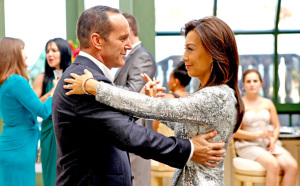
may-and-coulson-dancing-300x186

Okay, so I have really got a thing for what Frances Early and Kathleen Kennedy call Athena’s Daughters: the just woman warrior as portrayed in our popular culture. Buffy, Xena, Agent May. But as I pointed out when I talked about Tennyson’s Ulysses, one of the things I find most intriguing about these women is the relationships they are in with other women and sometimes with men. Generally, this is less about romance and more about Getting the Job Done, but I find I would love a working relationship (or the other kind) with the kinds of friends these women are portrayed to have. I especially like the chemistry between Agent May and Agent Phil Coulson. Some examples of their dialogue:

Phil Coulson: This is fun, right? Isn’t this fun? Look –
[Holds up his sleeves]
Phil Coulson: Cufflinks!
Melinda May: I will pay you $500 right now for a pair of flats.

Skye: [Hears a noise over the comms] Wait. What was that?
Phil Coulson: Yeah. That’s May.
Skye: Is-is she okay? Is everything okay?
Phil Coulson: Yes. She’s laughing. I think the worst of it’s over now.
Melinda May: [Walks up to Coulson] My face hurts.

Melinda May: Coulson, it’s a solid plan you’ve mapped out, but it hinges on a gamble – a big one.
Phil Coulson: And back up isn’t coming. It’ll be just the four of us. We’ll be outmanned and outgunned. But Fury always said… a man can accomplish anything when he realizes he’s a part of something bigger. A team of people who share that conviction can change the world. So, what do you say? You ready to change the world?
Melinda May: No. I’m ready to kick some ass.
Phil Coulson: That works, too.

Phil Coulson: Go ahead, say it.
Melinda May: I don’t do petty.
Phil Coulson: But you called it. I trusted my gut even though you said she was a risk.
Melinda May: When someone breaks into my house, I usually don’t invite them to stay. But that’s me.
Phil Coulson: That’s me too. Then that alien staff went through my heart.
Melinda May: Sure it didn’t go through the brain?
Phil Coulson: You really don’t do comforting either do you?

Dynamic Duo

a sestina for Agents May and Coulson

If we judge people by the company they keep,

Then what are we to say of you, trusting and calm

Through all of life’s calamities, explosions and

Betrayals? You have beside you someone to call

The shots or take the shot when she must, an agent

Willing to stand between you and whatever may

Come. Such partnerships are rare, not like May-

December, but more August-August. To keep

It going, you must respect each other’s agency,

Take advantage any time there is a brief calm

Before the next storm to rest and roll the dice. Call

Me an optimist, but I think your odds are good and

Solid, your chance to make it through alive and

Well, if not unworn. Who knows? You may

Even save the world for a little while. Your call

In this life, to shield the innocent and keep

The powerful honest, requires above all a calm

Head and a steady hand, like those of Agent

May. She is a rock in a spinning world, an agent’s

Agent, a superhero not in spandex, but in leather and

Aviator sunglasses. We only ever see her in black, calm

As midnight, or silver, hot as the heart of a star. May

Punches, kicks and flips her enemies, but keeps

An enigmatic stare for her friends. You could call

Her Chuang Tzu’s “uncarved block” or call

Her the Cavalry, but you know when you did Agent

May would bring the unvarnished truth to keep

You from getting yourself killed (again), and

Sometimes the truth is discretion…valor. May

Will retreat in good order to come back, calmly

Swinging, the next time. No wonder you’re calm.

With someone by your side you know you can call

Upon, day or night, from September to May

(But not during the summer hiatus when agents

Slumber and actors travel, smile for cameras and

Take long naps). You both know the drill. Keep

Hydrated, calm and poised under pressure: agents

on call, ready when the innocent need Agent Coulson and

Agent May, good friends and badasses playing for keeps.

Susan Spilecki © 2015

Frances Early and Kathleen Kennedy, ed. Athenas Daughters: Televisions New Women Warriors. Syracuse: Syracuse UP, 2003.

A Ming of Beauty

mingnawen

Thinking about heroes and kickass women on the day before Agents of S.H.I.E.L.D. comes back to TV from its winter hiatus naturally has made me think of another unusual piece of sheer poetry, the actor Ming Na Wen, who plays Agent Melinda May, also known as The Cavalry. You might recognize Ming Na’s voice from the Mulan movies and her face from The Joy Luck Club and ER, among others. But this gorgeous 51-year-old Chinese-American actor (and martial artist) is now playing the Best Role Ever. She gets to deadpan everybody and then shred the enemies and then say something terse, like, “Wheels up in ten.” And go off to fly the super cool black spy plane that now has cloaking.

Best yet was an episode last semester in which she danced with Clark Gregg and then fought a clone of herself. I have seen some cool martial arts choreography, but this fight totally rocks. She and her stuntwoman must have been EXHAUSTED afterwards, and probably a bit bruised.

Another great fight scene was at the end of the first season, when her casual love interest, fellow SHIELD Agent Grant Ward (played by handsome Brett Dalton) turned out to be a spy for HYDRA, a Nazi-originated secret organization out for, you guessed it, world domination. Thing is, you do NOT betray the Cavalry. She. Will. Waste. You. Possibly with a nailgun, among other things. The following video is a fan tribute video of May’s badassery.

Clearly a poem. Probably free verse.

One of My Favorite Poems

Although I rant a lot about old-fashioned poetry, particularly that which rhymes for no good reason, one of my favorite poems is blank verse (unrhymed iambic pentameter) by one of the most dead-white-male old-fashioned poets in English literature, Alfred Lord Tennyson (1809 to 1892). And the poem is about one of the most old-fashioned themes in European literature, ancient Greece. The poem, of course, is “Ulysses.”

I think the draw is the beauty of the language, the stateliness of the blank verse, and especially the topic: heroism. Throughout my life I have had difficulty sleeping from time to time. When I was little I amused myself in the dark hours by retelling myself the stories Cinderella and Sleeping Beauty, usually making these princesses ride around with their swords saving beleaguered princes. In Japan I studied kendo, and back in the states I have studied iaido, and also forms for the Chinese jian, straight sword, and dao, broadsword. I have not found a beleaguered prince to save, but I keep looking, because you never know, and at the very least my studies have given me great Halloween costumes.Samurai Sue

Meanwhile, I often find myself binge-watching Buffy the Vampire Slayer. Beyond the idea that a small blond wisecracking woman is kicking vampires in the face on a regular basis (did I mention I have also studied karate and kung fu?) and facing an apocalypse that regularly falls at the end of the school year, the thing I like best is the way the show constructs not just the lone hero (which is a very male construct) but the heroic community, a group of friends who study and fight together, who sacrifice for each other and keep each other accountable. Tennyson’s Ulysses describes his heroic community:

My mariners,

Souls that have toil’d, and wrought, and thought with me–

That ever with a frolic welcome took

The thunder and the sunshine… (l. 45-48)

library

Then there are times when I end up binge-watching Xena: Warrior Princess. This show, known as much for its camp style as its very stylized Hong Kong cinema martial arts, is a joy to watch. I like that while Xena sticks to her sword and chakram, her sidekick Gabrielle uses a staff for the first five seasons and sai for the last season. (Yes, I have studied the staff. The sai, not so much but I have a pair to use for wrist strengthening exercises. Us martial artists, we loves us our toys!) I like the partnership between the two main characters, which becomes more and more equal as the show goes on.

I am become a name;

For always roaming with a hungry heart

Much have I seen and known; cities of men

And manners, climates, councils, governments,

Myself not least, but honour’d of them all;

And drunk delight of battle with my peers,

Far on the ringing plains of windy Troy. (l. 11-17)

Lotcfightingtogether

I recently read an essay that suggested that the 130 or so episodes between Xena’s beginning and conclusion looked at her predicament as a tragic hero seeking redemption “from different perspectives while doing little to advance it” (Jones 165). I disagree. The heroic journey, like life, is its own point. As Ulysses says:

I cannot rest from travel: I will drink

Life to the lees: All times I have enjoy’d

Greatly, have suffer’d greatly, both with those

That loved me, and alone, on shore, and when

Thro’ scudding drifts the rainy Hyades

Vext the dim sea: (l. 6-11)

But getting back to the idea of useful poetry, I was thinking about how the best bit, the ending, was used a while back in the Bond movie, Skyfall. I have always loved Judy Dench and the chemistry between her and Daniel Craig is incredible. I was dismayed to find out that she was being replaced, presumably due to age. Certainly her age is highlighted in that film to a distressing extent. I think that may be why she gave her all to speaking the final lines of the poem: