Line Lengths and a Viking Bunny

LingonberryTreatsWaffles

So I have been thinking about line lengths lately. I am working on a set of poems loosely set in ancient Greece, which has led me to sorta kinda use iambic pentameter, which means ten syllables with an unstressed followed by a stressed syllable, times five. But sometimes for the sake of either a conversational sound or to end a line on a solid word (generally not a preposition, although I am not opposed to that), I add or take away a few syllables. The Alexandrine line, so called because it was frequently used by Alexander Pope, the misogynist bastard, is twelve syllables, and I recall my English teachers saying that he chose it because twelve syllables is about the maximum you can say on a single breath. But the poem I wrote today about the Roman criminal punishment of crucifixion (you have remember that all this has been inspired by Xena: Warrior Princess) has lines of fifteen or more syllables and I think the breath is fine. It might be that shorter syllables take less breath, I suppose, which would make sense if you set a poem to music and hold some notes longer, probably frequently the longer syllables.

I guess for the most part, I am looking for a line of three to four inches in Times New Roman 12 point font, though how I got that line length, I have no idea. The writer of the blog Optional Poetry uses extremely short lines, sometimes only a few words. What kind of line lengths do you use in your poetry?

Also, this Viking Bunny appeared in my email inbox today, so I am doing you the favor of sharing. Pass it on.

Process: Notes on Competing Priorities

WaterhouseUlyssesButt

Okay, so yesterday I wrote a poem for which I am using the working title Odyssey, because it ended up being about Odysseus and Penelope. Let me unpack my process.

Inspiration: Something my yoga teacher said, because, duh, Erica Magro Cahill. “The intimacy of a beating heart inside your beautiful skin…”

Part 1. The image of my heart peeking out from behind my sternum on an x-ray of my esophagus and larynx.

Problem: The point I want to make is about the heart but suddenly my larynx is involved.

Solution: When we sing, we don’t think about the bits of our body we are singing with, we think about the heart and what it does and wants. This leads to the idea of singing comfort to a “fearful, feral/cornered self within another body contained in skin, the reverse of Siren song.”

Part 2. The image of the skin as a map, marked by scars, wrinkles and ink. Using the concept I got from two separate students last semester that it helps when you suffer from depression to tattoo a message or symbol on your body to remind you that life is doable. This allowed me to use the line that Sir Terry Pratchett quotes in his recent nonfiction book, A Blink of the Screen, which he attributes to G.K. Chesterton, “Fairy tales do not tell children that dragons exist, for they already know dragons exist. Fairy tales tell children that dragons can be killed.” But of course, this is wordy and I already have the map, so:

Application: “Even tied to the mast, straining against our good sense,/We remember: Here be dragons. Reading our skin,/We recall, relieved: Dragons may be slain.”

Part 3. I need to get from Odysseus tied to the mast back to Penelope waiting on Ithaca, fending off suitors with her ten-year-long craft project. I start with the sail as a reminder of our fate as it is woven by the maiden, matron and crone: “We weave what they give us/Into something of use…” I transition to Penelope’s weaving. In the original, she tells the suitors that she cannot marry anyone until she finishes weaving her father-in-law’s shroud.

Feminist Revisionist Mythmaking: (Okay, here is the fun part!) I turn the shroud instead into a 1) tapestry of 2) Penelope herself as the matron Fate weaving and unweaving a tapestry of 3) Odysseus’s ship. “She turns its prow repeatedly/Back toward Ithaca. With each reweaving,/She brings the hero that much sooner home.” With this I take the power of the Fates and the Gods who are pissed off at Odysseus and give it to Penelope, making her thwart all of them and get her husband back sooner. Very meta.

Part 4. Now the first three parts have had relatively even stanza sizes: 1) 3 stanzas of 6 lines, 2) 4 stanzas of 4 lines, and 3) 4 stanzas of 5 lines. That is just the way that it worked out. When I started Part 4 I had a big long stanza that I did not know how to break. I had two ideas when I started the section: that all of us are all of the things I have discussed: “ship, map, compass, sail;/…the perilous waters and the sweet,/ Populous shores of home… ” But I also wanted to talk about fate and choices and somehow get some closure back to the x-ray. Further, although I did not hew the line, I was pulled in the first three sections toward blank verse, unrhymed iambic pentameter, I suspect because the topic is Classical Antiquity and Tennyson’s poem “Ulysses” (the Latin name for Odysseus) is in blank verse. But when I broke that first stanza of this section in half, I found that both of them started with a middle length line, followed by lines that got longer, followed by lines that got shorter: kind of like waves going in and out of shore! Nice… Then I noticed that the first was six lines and the second fifth: kind of like my verses were ebbing….

Solution: ALWAYS FOLLOW ARTISTIC SERENDIPITY. (Repeat after me: I meant to do that!) All I needed then were two more stanzas with a similar tidal/ebbing structure, so I ended with:

“How hardy this tremulous heart

Peeking around the mast, not deaf to these

Lyric-less singers, the waves assembling,

Disassembling, dissembling…

How impotent the gods

Who made us like themselves: willful,

Changeable, immortal.”

waterhouse_penelope_and_the_suitors

Waterhouse, John. Ulysses and the Sirens, 1891. Penelope and the Suitors, 1912.

The Eternal Treasure Hunt

200px-Dickin_Medal

Let me tell you about one of my yoga sestinas and how it illustrates something about me as a writer and, to an extent, writers in general. I started out knowing that I wanted to write about pigeon pose, in part because it is a good way to stretch out your hips, in part because kapotanasana is just fun to say, and in part because I had watched a YouTube video of my yoga teacher performing a song about going away to find yourself. She spent a month in Italy. I spent two years in Japan, so I knew what she was talking about. Also, I had recently gone to my college reunion in Middlebury, Vermont and had felt very much as if I had rediscovered my tribe: goofy people who speak multiple languages and have broadened themselves through travel.

For my six end words, I started with every heart finds its true north. Then I turned to Wikipedia to find out shtuffs about carrier pigeons. I learned a bunch of cool trivia; for example:

The PDSA Dickin Medal was instituted in 1943 in the United Kingdom by Maria Dickin to honour the work of animals in war. It is a bronze medallion, bearing the words “For Gallantry” and “We Also Serve” within a laurel wreath, carried on a ribbon of striped green, dark brown, and pale blue.[1] It is awarded to animals that have displayed “conspicuous gallantry or devotion to duty while serving or associated with any branch of the Armed Forces or Civil Defence Units.” The award is commonly referred to as “the animals’ Victoria Cross.” (Dickin Medal)

But I also found something I could use for the poem, that scientists have found that pigeons have large numbers of iron particles on their beaks, which allow them to sense the magnetic pole. Eureka!

This is, I think, one of the cool things about being a writer. I know there is going to be something out there, that I can find serendipitously, and that I can somehow use. The world can be a fascinating place after all, or, as a Japanese T shirt told me twenty years ago, The world is so full of things.

Yes, it is indeed. You just have to look. Writers, I believe, are people who constantly look. Here is the start of the poem:

The Earth’s white-hot iron center pulls every

magnet’s needle around to point to the heart

of the north, not so different from how a pigeon finds

her way home. They say pigeons have iron on their

beaks, tiny particles that act as a magnetic

guide, helping the birds discern south from north.

It is different for everyone, our magnetic north,

the paths and people who pull us. Not every

bird nests in the same tree or coop. What’s magnetic

to you may not be the thing that pulls my heart

around to face it, eagerly.

Dickin Medal. Wikipedia. 12 Jan. 2015. Web. Mar. 17, 2015

The Problems of Non-Concrete Poetry Where Placement on the F^*%ing Page Matters in the Context of Electronic Publishing

Okay, so a while back I was talking about concrete poetry, a poem that looks like the subject it is about and I gave my pear poem as an example. That form translates off the page and into the world of electronic publishing with no problems because most platforms will allow you to center your text. Unfortunately, as I have been working to prepare my upcoming book, Icons & Action Figures (Batteries Not Included), for e-publishing this spring, I have come across some annoying problems.

sandy01

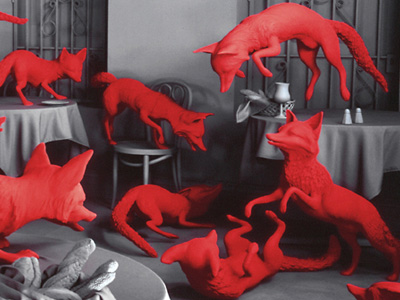
It turns out that although I rarely write concrete poetry, I do from time to time tab words and phrases away from the regular text line to suggest, say, fog or leaves or, in the example I am thinking of, foxes bouncing around a restaurant. “Fox Games” is one of my favorite poems because I achieved something that I love managing: conveying with words on the page the colors and dynamism and message and story that I see in a piece of visual art (ekphrasis).

sandy03

The poem is based on a photo of an installation of the same name by artist, Sandy Skoglund. I attach the whole picture and some close ups to show the details of this vivid masterpiece.

I originally wrote the poem in two styles, alternating between sections with regular lines and sections about the foxes, where words or phrases mimicked on the page what the foxes were doing all over the print. To reproduce the effect without being able to do anymore that left-justify or center the pieces is impossible; I might be able to manage that here in a blog post, but if you try messing with styles in an e-book, you end up with…well, a mess. So I am stuck with only left-justification. So I had to choose to go for only the sound of the action, rather than sound, look and feel. Sigh. But I still love the poem. Here is the second half of it:

He begins to speak of himself. She can’t help looking at him,

imagining his face in forty years of soft folds, his voice

crinkling newsprint. Time, she thinks,

fades us to this grey. Time,

she thinks, her face blank pink attention. There is never enough

time to learn to speak in color. There’s so much we can’t say

with our bodies. We need

these foxes

jumping

.

on tables

.

playing

at tearing out

each other’s throats

.

crimson

foxes

dancing

.

among grey tablecloths

grey baskets

grey bread

.

while we sit in our grey corner speaking of the blush

of the wine about to be poured out by our waiter in his grey vest,

wine that holds itself back, corked for rational inspection, grey

bottled up, wine that knows itself

crimson

playful

ready to bark

and bite.

Skoglund, Sandy. “Fox Games.” Cibachrome print. 1990.

Spilecki, Susan. “Fox Games.” Kimera. June 2001

More Damn Muses, But These are the BEST

1024px-1807_Thorvaldsen_Tanz_der_Musen_auf_dem_Helikon_anagoria

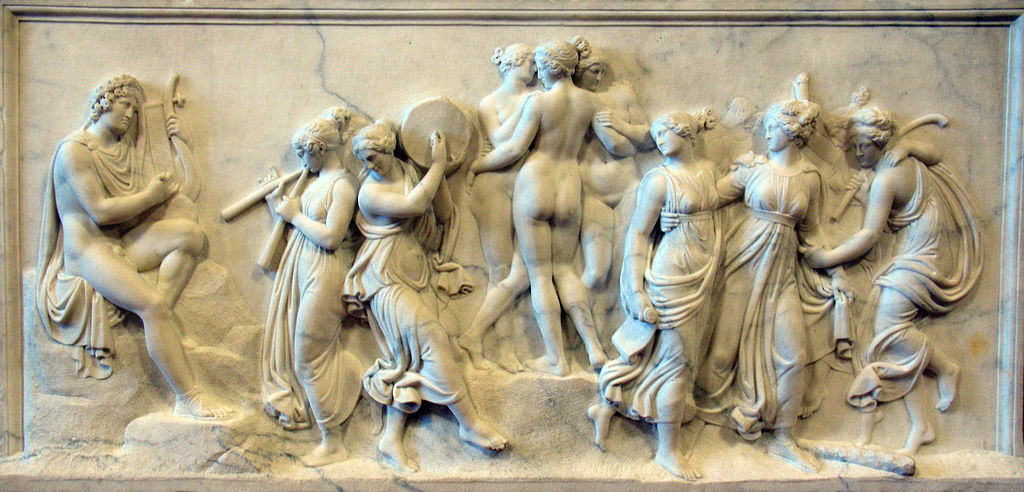
So all this talk about Xena has made me realize that I know damn little about ancient Greece, and given that one of my friends actually teaches high school Latin and Greek (in 2015. I know.), I figure I should fix this grave lacuna in my knowledge. So I started messing about online, figuring that the interwebs would point me in the right direction. After getting sidetracked by a statue of Aphrodite having a bad hair day, I got down to business and found a translation of the The Theogony of Hesiod (Greek, ~700 BCE) translated by Hugh G. Evelyn White in 1914. And who do you think he starts out talking about?

(ll. 26-28) `Shepherds of the wilderness, wretched things of shame, mere bellies, we know how to speak many false things as though they were true; but we know, when we will, to utter true things.’

(ll. 29-35) So said the ready-voiced daughters of great Zeus, and they plucked and gave me a rod, a shoot of sturdy laurel, a marvellous thing, and breathed into me a divine voice to celebrate things that shall be and things there were aforetime; and they bade me sing of the race of the blessed gods that are eternally, but ever to sing of themselves both first and last. But why all this about oak or stone? (2)

(ll. 36-52) Come thou, let us begin with the Muses who gladden the great spirit of their father Zeus in Olympus with their songs, telling of things that are and that shall be and that were aforetime with consenting voice. Unwearying flows the sweet sound from their lips, and the house of their father Zeus the loud-thunderer is glad at the lily-like voice of the goddesses as it spread abroad, and the peaks of snowy Olympus resound, and the homes of the immortals. And they uttering their immortal voice, celebrate in song first of all the reverend race of the gods from the beginning, those whom Earth and wide Heaven begot, and the gods sprung of these, givers of good things. Then, next, the goddesses sing of Zeus, the father of gods and men, as they begin and end their strain, how much he is the most excellent among the gods and supreme in power. And again, they chant the race of men and strong giants, and gladden the heart of Zeus within Olympus, — the Olympian Muses, daughters of Zeus the aegis-holder.

Now aside from the fact that this is just awful darn pretty, it is still making out poets to be mouthpieces who just channel the Muses while the girls do the work. This old hat formula has, as I have asserted before, had a negative affect on wanna be poets who don’t get that writing is work.

Although, now that I think of it, this is the first hat…

“The Dance of the Muses at Mount Helicon” by Bertel Thorvaldsen (1807).

Shipping . . . Sort of

may-and-coulson-dancing-300x186

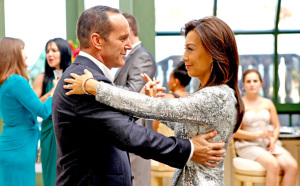
Okay, so I have really got a thing for what Frances Early and Kathleen Kennedy call Athena’s Daughters: the just woman warrior as portrayed in our popular culture. Buffy, Xena, Agent May. But as I pointed out when I talked about Tennyson’s Ulysses, one of the things I find most intriguing about these women is the relationships they are in with other women and sometimes with men. Generally, this is less about romance and more about Getting the Job Done, but I find I would love a working relationship (or the other kind) with the kinds of friends these women are portrayed to have. I especially like the chemistry between Agent May and Agent Phil Coulson. Some examples of their dialogue:

Phil Coulson: This is fun, right? Isn’t this fun? Look –
[Holds up his sleeves]
Phil Coulson: Cufflinks!
Melinda May: I will pay you $500 right now for a pair of flats.

Skye: [Hears a noise over the comms] Wait. What was that?
Phil Coulson: Yeah. That’s May.
Skye: Is-is she okay? Is everything okay?
Phil Coulson: Yes. She’s laughing. I think the worst of it’s over now.
Melinda May: [Walks up to Coulson] My face hurts.

Melinda May: Coulson, it’s a solid plan you’ve mapped out, but it hinges on a gamble – a big one.
Phil Coulson: And back up isn’t coming. It’ll be just the four of us. We’ll be outmanned and outgunned. But Fury always said… a man can accomplish anything when he realizes he’s a part of something bigger. A team of people who share that conviction can change the world. So, what do you say? You ready to change the world?
Melinda May: No. I’m ready to kick some ass.
Phil Coulson: That works, too.

Phil Coulson: Go ahead, say it.
Melinda May: I don’t do petty.
Phil Coulson: But you called it. I trusted my gut even though you said she was a risk.
Melinda May: When someone breaks into my house, I usually don’t invite them to stay. But that’s me.
Phil Coulson: That’s me too. Then that alien staff went through my heart.
Melinda May: Sure it didn’t go through the brain?
Phil Coulson: You really don’t do comforting either do you?

Dynamic Duo

a sestina for Agents May and Coulson

If we judge people by the company they keep,

Then what are we to say of you, trusting and calm

Through all of life’s calamities, explosions and

Betrayals? You have beside you someone to call

The shots or take the shot when she must, an agent

Willing to stand between you and whatever may

Come. Such partnerships are rare, not like May-

December, but more August-August. To keep

It going, you must respect each other’s agency,

Take advantage any time there is a brief calm

Before the next storm to rest and roll the dice. Call

Me an optimist, but I think your odds are good and

Solid, your chance to make it through alive and

Well, if not unworn. Who knows? You may

Even save the world for a little while. Your call

In this life, to shield the innocent and keep

The powerful honest, requires above all a calm

Head and a steady hand, like those of Agent

May. She is a rock in a spinning world, an agent’s

Agent, a superhero not in spandex, but in leather and

Aviator sunglasses. We only ever see her in black, calm

As midnight, or silver, hot as the heart of a star. May

Punches, kicks and flips her enemies, but keeps

An enigmatic stare for her friends. You could call

Her Chuang Tzu’s “uncarved block” or call

Her the Cavalry, but you know when you did Agent

May would bring the unvarnished truth to keep

You from getting yourself killed (again), and

Sometimes the truth is discretion…valor. May

Will retreat in good order to come back, calmly

Swinging, the next time. No wonder you’re calm.

With someone by your side you know you can call

Upon, day or night, from September to May

(But not during the summer hiatus when agents

Slumber and actors travel, smile for cameras and

Take long naps). You both know the drill. Keep

Hydrated, calm and poised under pressure: agents

on call, ready when the innocent need Agent Coulson and

Agent May, good friends and badasses playing for keeps.

Susan Spilecki © 2015

Frances Early and Kathleen Kennedy, ed. Athenas Daughters: Televisions New Women Warriors. Syracuse: Syracuse UP, 2003.

A Ming of Beauty

mingnawen

Thinking about heroes and kickass women on the day before Agents of S.H.I.E.L.D. comes back to TV from its winter hiatus naturally has made me think of another unusual piece of sheer poetry, the actor Ming Na Wen, who plays Agent Melinda May, also known as The Cavalry. You might recognize Ming Na’s voice from the Mulan movies and her face from The Joy Luck Club and ER, among others. But this gorgeous 51-year-old Chinese-American actor (and martial artist) is now playing the Best Role Ever. She gets to deadpan everybody and then shred the enemies and then say something terse, like, “Wheels up in ten.” And go off to fly the super cool black spy plane that now has cloaking.

Best yet was an episode last semester in which she danced with Clark Gregg and then fought a clone of herself. I have seen some cool martial arts choreography, but this fight totally rocks. She and her stuntwoman must have been EXHAUSTED afterwards, and probably a bit bruised.

Another great fight scene was at the end of the first season, when her casual love interest, fellow SHIELD Agent Grant Ward (played by handsome Brett Dalton) turned out to be a spy for HYDRA, a Nazi-originated secret organization out for, you guessed it, world domination. Thing is, you do NOT betray the Cavalry. She. Will. Waste. You. Possibly with a nailgun, among other things. The following video is a fan tribute video of May’s badassery.

Clearly a poem. Probably free verse.

One of My Favorite Poems

Although I rant a lot about old-fashioned poetry, particularly that which rhymes for no good reason, one of my favorite poems is blank verse (unrhymed iambic pentameter) by one of the most dead-white-male old-fashioned poets in English literature, Alfred Lord Tennyson (1809 to 1892). And the poem is about one of the most old-fashioned themes in European literature, ancient Greece. The poem, of course, is “Ulysses.”

I think the draw is the beauty of the language, the stateliness of the blank verse, and especially the topic: heroism. Throughout my life I have had difficulty sleeping from time to time. When I was little I amused myself in the dark hours by retelling myself the stories Cinderella and Sleeping Beauty, usually making these princesses ride around with their swords saving beleaguered princes. In Japan I studied kendo, and back in the states I have studied iaido, and also forms for the Chinese jian, straight sword, and dao, broadsword. I have not found a beleaguered prince to save, but I keep looking, because you never know, and at the very least my studies have given me great Halloween costumes.Samurai Sue

Meanwhile, I often find myself binge-watching Buffy the Vampire Slayer. Beyond the idea that a small blond wisecracking woman is kicking vampires in the face on a regular basis (did I mention I have also studied karate and kung fu?) and facing an apocalypse that regularly falls at the end of the school year, the thing I like best is the way the show constructs not just the lone hero (which is a very male construct) but the heroic community, a group of friends who study and fight together, who sacrifice for each other and keep each other accountable. Tennyson’s Ulysses describes his heroic community:

My mariners,

Souls that have toil’d, and wrought, and thought with me–

That ever with a frolic welcome took

The thunder and the sunshine… (l. 45-48)

library

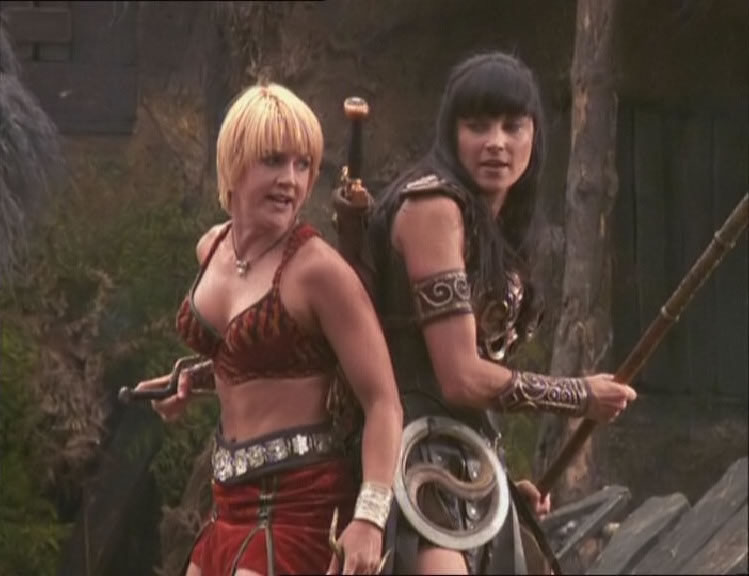
Then there are times when I end up binge-watching Xena: Warrior Princess. This show, known as much for its camp style as its very stylized Hong Kong cinema martial arts, is a joy to watch. I like that while Xena sticks to her sword and chakram, her sidekick Gabrielle uses a staff for the first five seasons and sai for the last season. (Yes, I have studied the staff. The sai, not so much but I have a pair to use for wrist strengthening exercises. Us martial artists, we loves us our toys!) I like the partnership between the two main characters, which becomes more and more equal as the show goes on.

I am become a name;

For always roaming with a hungry heart

Much have I seen and known; cities of men

And manners, climates, councils, governments,

Myself not least, but honour’d of them all;

And drunk delight of battle with my peers,

Far on the ringing plains of windy Troy. (l. 11-17)

Lotcfightingtogether

I recently read an essay that suggested that the 130 or so episodes between Xena’s beginning and conclusion looked at her predicament as a tragic hero seeking redemption “from different perspectives while doing little to advance it” (Jones 165). I disagree. The heroic journey, like life, is its own point. As Ulysses says:

I cannot rest from travel: I will drink

Life to the lees: All times I have enjoy’d

Greatly, have suffer’d greatly, both with those

That loved me, and alone, on shore, and when

Thro’ scudding drifts the rainy Hyades

Vext the dim sea: (l. 6-11)

But getting back to the idea of useful poetry, I was thinking about how the best bit, the ending, was used a while back in the Bond movie, Skyfall. I have always loved Judy Dench and the chemistry between her and Daniel Craig is incredible. I was dismayed to find out that she was being replaced, presumably due to age. Certainly her age is highlighted in that film to a distressing extent. I think that may be why she gave her all to speaking the final lines of the poem:

https://www.youtube.com/watch?v=fCjnCHvpLiM

Not Your Grandmother’s Poetry

images

So I just watched Guardians of the Galaxy. While you might argue that there is no real poetry in a superhero movie, I would point to the self-growing house plant, Groot, who saves the day many times, and the genetically-warped raccoon, Rocket, who masterminds most of their plans.

It may not be epic poetry, but it is poetry.

And also, I have now stuck in my head all week, “Stuck on a Feeling,” from Blue Swede 1974. I had always thought it was Tom Jones’s song. Whoops.

Thoughts on Confessional Poetry

confession

Last month, one of my colleagues commented, “I would love to hear your thoughts on the genre of confessional poetry. What is it, do you think that distinguishes the work of Sexton and Plath (for example) from the less-than-satisfying confessional poetry often encountered in writing workshops? Does producing good confessional poetry have more to do with depth of life experience or a careful study of the formal conventions of poetry (before making the conscious decision to break them)?”

Well, having sat down to reacquaint myself with Anne Sexton’s poetry (Sylvia Plath is harder to forget), I would say that my first answer is, Yes! We are teaching undergraduates students for the most part, who mostly have not had, as she says, depth of life experience, although some have (I include the woman asking this, as we first met when I was teaching creative writing). Formal conventions are helpful of course, but I think what may be even more important is a Really Good Vocabulary and a Musical Ear. These are things most people are not born with, but must learn, add to, hone, etc. over the years.

But reading contemporary literary criticism of Sexton’s poetry also brings up the issue of the time confessional poetry sprang from, the post World War II 1950s with a society that was desperately trying to put the genie of women back into the partriarchal bottle and beginning to use Freudian therapy for mental illness. Also it was happening in an academic/literary scene that was still predominantly made up of white males who saw the personal/political themes of women writers as problematic. Some of what made confessional poets interesting, if not notorious, was the shock value of actually talking about mental illness and sex and addiction a) at all and b) in poetry. Today, especially since the 1960s cultural shift, a lot of things that might have been confessed are now simply discussed. That normalcy also, I suspect, changes the kind of images people choose to express their feelings about it, and the use of more normal words can also leave us feeling as though what we are reading is really more just prose.

So there you go. That is my 2¢.

2cents