Badass Women in Combat Gear: Valentine’s Day Edition, Or, Dorothy Parker Was Wrong

((For those of you who, like me, were not Math Majors in college, I apologize. But this particular blog post seems to need a ridiculous number of parentheses and a rather surprising number of braces {curly} and brackets [square]. Be warned.))

There is a fairly famous rhyming couplet by the 1920s Algonquin Round Table wit, Dorothy Parker, that has been widely anthologized (and it suddenly occurs to me that a whole slew [this is a technical literary term] of the editors anthologizing this were {white} men], which says, “Men don’t make passes/At girls who wear glasses.”

I have been thinking about this since Mike Allegra (heylookawriterfellow) asked me to add to my BWCG series some BWCGs who wear glasses. I thought of this most recently after viewing a teaser for this coming Tuesday’s Agent Carter, in which Agent Sousa (the delightful Enver Gokaj) says to (an injured and therefore unavailable-for-the-mission) Agent Peggy Carter (the even more delightful Hayley Atwell) that what they need for the coming mission is someone who can “blend in with the glamour and throw down in the gutter.” Damn, Spanky, I LOVE the writers on this show!

anigif_enhanced-buzz-28965-1428618090-11_preview

Any Gentle Reader who has spent any time at all reading this blog will recognize that this is not only the dual nature of what I look for in my Female Leads of TV, Film, and Life, but also a micro-blueprint of who I would like to eventually be. I have to admit that the second part sounds much less painful to me than the first part, because as Agent Dana Scully admits in the most recent New X-Files episode, running/fighting in three-inch heels is no country for really anyone, but absolutely not Women, Older Men or Sane People of any Gender. Okay, she didn’t say that.

But as Jane Austen might have said, “It was nowhere said, but everywhere implied.” Come on. Amy Acker has said that at one point her only “stunt ability was running in heels” (Citation, as Wikipedia would point out, desperately needed. My guess? A ComiCon. San Diego? Maybe. Who knows?).

ackerglasses

My point here is simply that Dorothy Parker was wrong and Mike Allegra is right. (Full disclosure: I wear glasses. So sue me. {Twenty-odd years at MIT’s Writing Center (some of them more odd than others) has made me as blind as my cat Musashi, if not as a bat or a possum. [If M. were a little boy, he’d be wearing Coke bottle glasses and a bowtie]}.

81-2dep+8aL._SY355_

So in honor of a Sunday-facing Valentine’s Day (black Tuesday meets the Lord’s day), I offer you some of my favorite female actors (Nope, don’t call me a teacheress, professoress, editoress or martial artistess; I avoid calling them actresses for the same reason) in glasses.


I tried very hard to chase down the pics I have seen online of Lucy Lawless as herself, rather than Xena, wearing glasses, to no avail. Similarly, her soul-grandmother, Linda Carter (the always-and-everywhere Wonder Woman, despite DC’s brilliant work with Gal Gadot).

And because I believe it is important to look back and forward at the same time, I also give you Ingrid Bergman and Scarlet Johansson.

Also, the classic, brilliant, unimitatable Katherine Hepburn on a skateboard, because duh.

katehepskate

To my pal, Mike Allegra, men and women who love women in glasses or, you know, on skateboards: YOU’RE WELCOME. HAPPY VALENTINE’S DAY. NOW WE WILL LET THE WEATHER BECOME WARM AGAIN.

Mental Models

So yesterday I worked with an MIT engineer on his thesis about the Fukushima Daiichi Nuclear Power Plant that suffered a severe compound accident from the tsunami that hit eastern Japan on March 11, 2011. One of the theories of thinking and reasoning that underlies some of his research is the idea of mental models, “that the mind constructs ‘small-scale models’ of reality that it uses to anticipate events. Mental models can be constructed from perception, imagination, or the comprehension of discourse” (Johnson-Laird and Byrne). I used this idea when I was writing my theology thesis about environmental survival, and it often comes up in cases where survival is at stake: people have to make crucial decisions at high speed in real time and they rely on their picture of reality, which is itself a) a form of perception, b) usually an oversimplification (occasionally the reverse), and c) affected by language, custom, and other symbolic attributes in addition to our lived experience.

That perception reality is shown in part by research that shows how inaccurate eyewitness testimony can be in court. “Many people believe that human memory works like a video recorder: the mind records events and then, on cue, plays back an exact replica of them. On the contrary, psychologists have found that memories are reconstructed rather than played back each time we recall them. The act of remembering, says eminent memory researcher and psychologist Elizabeth F. Loftus of the University of California, Irvine, is ‘more akin to putting puzzle pieces together than retrieving a video recording’” Akowitz and Lilienfeld).

It is true public safety officers are trained to observe more accurately than the rest of us, and there are ways of retrieving testimony that are less likely to color the witness’s recall. However, for my purposes here, that is less useful simply because in an emergency situation—a nuclear accident, 9/11—what an individual will be doing is not recalling What Happened Then but rather What Could Possibly Be Happening Now. The former is based on a single instant of reality and the latter is based on All the Reality I Have Experienced Up To Now, taken together, sifted, and drawn on the blueprint in the person’s head.

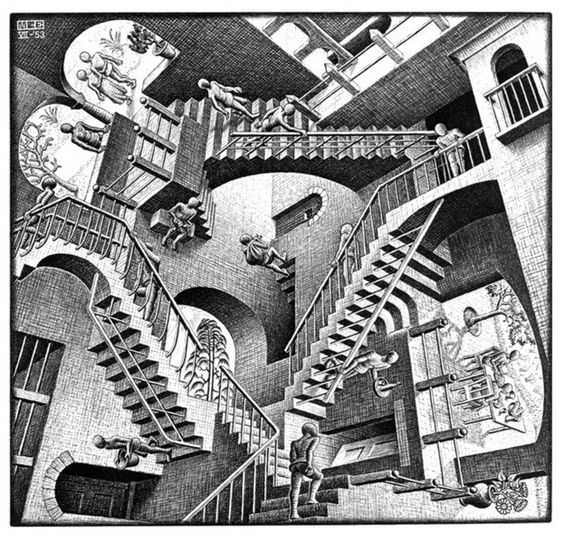
Think of the house you grew up in. Then think of all the houses you have ever seen from the inside or the outside. Then tell me what a house is. If you grew up in the suburbs, a three-story house or a Roman villa won’t be part of your picture. If you are M.C. Escher, this might be the house you draw for me.

36e856dacf47ec95ceb8042506c48920

With an overcomplicated mental model, you might withdraw from action—why try to get down 80 flights of stairs? I will never make it. Social problems, which are indeed multiply constructed, frequently face human inaction for this reason.

If you are a child, this might be the house you draw for me.

Childspaintingland

The trees out side the house will have brown bark rather than grey and green grass rather than winter yellow, even if you just ran across the yellow grass and climbed up into the grey-barked tree just yesterday.

I am not sure why I am even writing about this although I expect it has to do with Valentine’s Day. I have written before about the problems of love poetry for a writer who wants to be taken seriously, although I don’t think I specifically addressed the problem that poetry causes for us in our expectations about love. But I have a feeling that this is a thing.


Arkowitz, Hal, and Scott O. Lilienfeld. “Why Science Tells Us Not to Rely on Eyewitness Accounts.” Scientific American. 1 Jan. 2010. Web. 11 Feb. 2016.

“Child’s Painting Land.” MediaWiki. Web. 11 Feb. 2016.

Escher, M.C. “House of Stairs.”

Johnson-Laird, Phil, and Ruth Byrne. “Mental Models: A Gentle Introduction.” Mental Models Blog. July 2012. Web. 11 Feb. 2016.

Words are Meaningless and Forgettable. Say What?

Rose-thorn-580-1S

So I got on the train today only to see a pin stuck to the radiator at my feet. It said (with a picture of roses, for some reason) Words Are Meaningless And Forgettable. What an unkind thing to leave where a writer might stumble across it. Winter in Boston is bad enough with the unkind weather and existential dread. But to tell someone for whom words are her stock in trade that, nope, worthless, sorry! Cruel.

Now, given that we are coming up to Valentine’s Day, this might just be a bid by florists to get people to buy more flowers, although I guarantee you that any florists you may know will have several bandaged fingers on Monday. This is like how I always have chalkdust on my right sleeve and a stripe across the back of my jacket: occupational hazard. And as a writing teacher and professional poet, I can also guarantee that there is probably just as much blood on the love poem you get this weekend as there is on your roses. The difference will be the source.

A Made Thing before Valentine’s Day

“My Foucault-friend, who is now an ­anthropologist, observes that in the West we tend to think of made things as being false” (Biss).

Anti-Valentines-Day-Metal-Playlist

If the poem I make is a false thing, as made as my house,

As false as your eyelashes that you also made this morning,

As thing-like as your car that falsely carried you

To work yesterday and just as falsely, eventually,

Carried you home last night, then how am I to cultivate

Truth like a garden of earthy, homegrown delights?


If my poem, made from words, which presumably also

Have been made, in this case by our ancestors

Who agreed what the grunt would mean, and the hiss

And the slow accumulation of consonants, then how

Can beauty be real, since there too we simply have to

Agree on the symmetry and style of another face?


If the song you made from notes just lying around

The universe is false, if the story you told yourself

Of love and loss and, eventually, redemption and love

Again, if that too is made and therefore false, what hope

Do any of us have to find the real thing, the true and

The beautiful thing, the unmade heart beating to ours?


Biss, Eula. “‘The Folded Clock,’ by Heidi Julavits.” Review. New York Times. 27 Mar. 2015. Web. 10 Feb. 2016.

Maybe I Need an Art Buddy. Maybe I Just Need Backup.

tumblr_nme8uh3XTX1rh0u2ko3_250

Well, here I am back in the Writer’s Block, which kind of sounds like something you would find in a Communist prison. Yes, they really used to confiscate writers’ typewriters in the USSR and Poland. It was cost-effective. You don’t need to feed typewriters and they don’t bleed when you beat them up.

Here in the more or less democratic US of A, where we have Freedom of Font and also a whole lot more options for putting our ideas down and spreading them around, the problem tends not to be so much Tyranny that is rearing its ugly head as it is Woeful Lack of Imagination.

Part of this, I suspect, is because a blog is not exactly a Project in the same sense that a novel or, for want of a better example, a few hundred pages of poetry about a 1990s TV show are. There isn’t the compulsive pull of a few well-chosen characters whose voices need to be explored. There isn’t the narrative tension of a plot to resolve or of subplots to weave in artfully. On the flipside, there are more opportunities to use pictures of cats to make my points.

Sometimes, when procrastination takes the form of Radically Empty Brain Syndrome (REBS), I stare at the wall, vainly hoping for something to show up. But remember that “radical” comes from the Latin, radix, meaning “root.” If there is nothing at the root of the brain, there won’t be much to grow out of it. So maybe the solution is to find another brain to work with.

If I were an Igor in a Terry Pratchett Discworld novel, I suppose I would mean that literally: find a brain, go up to the top of a tall MIT building and wait for lightning to strike. Then do an evil maniacal laugh, etc. Problem solved.

Tempting…

Failing that, I suppose I need to find another brain the less old-fashioned way, by actually finding a writing buddy, a collaborator, or possibly some badass with a big gun or maybe a Frisbee. Some writing buddies each write their own work separately and then read each other’s work. This is different from collaborators who work on the same project. Personally, I was thinking more along the lines of someone to come to my rescue with a whole lotta firepower, or possibly an Iron Frisbee of Doom.

Then maybe I’ll get writing again.

Happy Birthday, Musashi


63bc1a6b1fac84d562cf95d60e66018e

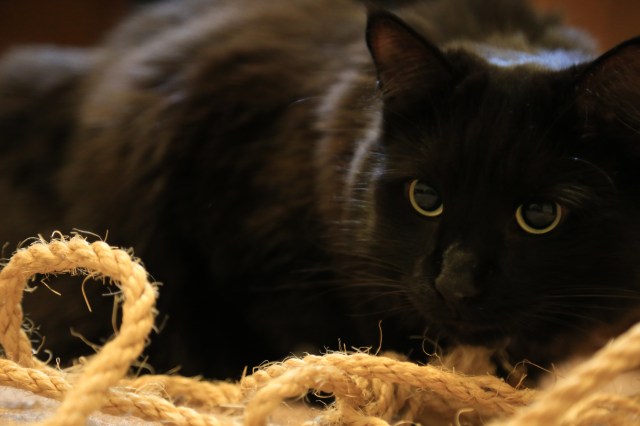
So today Musashi, my animal companion, turns eight years old. This is as old as he’s ever been, though he would be the first to tell you that I am “way olderer” than him, as in “like elebenty.”

Meanwhile, in other news, a blizzard has just come in on little cat feet and is threatening to drop a foot of snow on much of Southern New England, particularly our little part of it, Boston. Boston public schools, Northeastern University, Episcopal Divinity School, Emerson College, Brandeis University, New England Conservatory—just to name a very few—have closed for the day. But not MIT, in part because not Harvard. Sigh.

On His Eighth Birthday, Musashi Poeminates

Cry havoc! And let slip the dogs of war. –Shakespeare, Julius Caesar


Cry havoc! And let slip the cats of winter,

Chasing the icy wind across parking lots,

Down streets, up trees into the branches

That only months ago wore leaves like green

Fur. February, that month cruelest to those of us

Who never spell easily, tightens its grip,

With every flurry a kitten ready and willing

To ravage your toes with her tiny claws.


Havoc is coming. The schools all know it,

The big men who drive the snowplows all

Know it, the bus drivers for whom havoc is

A daily burden, they know it too. And I,

Lying reflectively in my turquoise catbed,

Contemplating the existential drift, I too

Know the true havoc that is the lack of my

Housekeeper, soccer partner, butler,


Just because she has mad writing skills

And her school, like a German Shepherd

Facing off with a Rottweiler, all growl

And lack of poetry, refuses to accept

How weather makes fools of us all

Sometimes. The snow comes down,

An unfurling of fluffy white cats, stretching,

Shedding, everywhere, and all day.

Mu with String

Photo by Jack Siberine.


Badass Women in Combat Gear, #5 ¾: Jessica Jones

November 20 marked an interesting moment in our popular culture: Marvel Comics released Jessica Jones, its first film/movie property with a female superhero. For the past two months I have been trying to write about it, to add Jessica to our list of Badass Women in Combat Gear, and it has been very hard. At first, I tried to blame my writer’s block on the fact that I had not finished watching all 13 episodes on Netflix. But on Groundhog Day, I had an epiphany that, like so many of my epiphanies, in retrospect seems outrageously obvious.

As one critic describes Jessica Jones, “A woman with superhuman strength, she eschews a costume or cape for a pair of jeans and a leather jacket. She lives in a busted apartment in Hell’s Kitchen where she conducts her business as a private investigator. It’s not necessarily part of the job that requires her special abilities, but they do come in handy” (Bendix). In the past, Jessica tried to use her super abilities as an “official” superhero, until she got mind-controlled into doing horrific things (including murder) by another “gifted” person, a man named Killgrave.

As another critic comments, “Jessica Jones pulls no punches when it comes to him or to other men on the show who try to rob women of their agency. The word ‘rape’ makes its way onto the screen in episode eight, but showrunner Melissa Rosenberg has no interest in showing sexual assault for shock value or as a way to make female characters more sympathetic. Rosenberg takes a swipe at politicians who would force women to give birth to their rapists’ babies. And she nods more than once at the idea that Killgrave is obsessed with making women smile at him. She doesn’t draw a direct line from allusions of street harassment to rape, but she doesn’t sidestep that conclusion either” (Hogan).

jessica-jones-150

MARVEL’S JESSICA JONES

And this is where Groundhog Day comes in, or should I say Groundhog Day, the movie. I went to see the film for the first time Tuesday evening, and about halfway through, as Phil the weatherman (Bill Murray) is spending several weeks of repeated days learning personal information about his colleague Rita (Andie McDowell), in order to get her to spend time with him, like him, love him and eventually sleep with him.

Had I watched this for the first time in the 1990s before conversations about the difference between rape culture (you must opt out) and the culture of consent (you must opt in) became common, I might have thought this behavior simply romantic pursuit as opposed to temporal stalking. But as I started to see where it was leading, I became increasingly uncomfortable as it became clear to me that such a dishonest and misleading “change” in her attitude toward him would not equal true consent, and I thought, “If she sleeps with him, I am walking out of the movie theater.”

groundhog-day-driving

Reader, she slapped him. Probably seven days in a row. Hooray. Then the movie improved as he started to change himself rather than her.

And this is what was so difficult about writing about Jessica Jones. Reviews have called the show “dark” and “gritty” and “grim,” which it is, but a lot of films and TV shows have been dark, especially ones on the topics of war, poverty, and injustice. But those topics are things we can discuss around the dinner table at home or in the lunchroom at work. Rape? Not so much. And the institutional sexism and violence that are the social matrix now being called rape culture? Good luck with that.

And this is one of the things I have learned about writing. The Rhetorical Situation of a piece of writing is Writer, Audience, Topic. If I think I am a bad writer or if I know I have a difficult audience, it is very obvious why I am having trouble with my writing. But I often forget that if a topic is simply difficult to talk about, it is also going to be difficult to write about.

But these difficult topics need to be written about, and so Jessica Jones not only serves as a show that empowers its women characters but also as a springboard for more of these conversations. As Lili Loofbourow wrote in a critical essay for the Guardian: “Jessica Jones is one of the most complex treatments of agency in the wake of victimhood that the small screen has seen yet seen.” And Loofbourow’s essay itself is an interesting critique of the very same issues.

So here is me putting in my 2 cents. We need to talk about these issues. We need to build a culture of consent. We need to tell stories that show people being strong for themselves and others—men and women—and we need to show victims helping each other be heroes. So, thank you, Krysten Ritter (and the other women on the show, who are all very strong, although, for example Carrie Ann Moss’s lawyer, Jeri Hogarth wears power suits as her combat gear), for giving us something meaty to watch, however much discomfort comes with it.

“Jessica Jones is a superhero show for those who don’t necessarily care for the heroics. It’s smart and sexy and dark and creepy; it’s queer-inclusive and focused on women who refuse to be victimized, even by someone who has the power to make them say or do anything he wants. Jessica Jones is about the struggle for power and control, and its lead is the kind of superhero that modern women will idolize. So much of her strength isn’t in her physical prowess, but in her will to survive and never relent to the man with the perceived upper hand.” (Bendix)


Bendix, Trish. “’Jessica Jones’ Is a Queer-Inclusive, Feminist Superhero Series.” Afterellen.com. 20 Nov. 2015. Web. 4 Feb. 2016.

Hogan, Heather. “’Jessica Jones’ Is an Awesomely, Agressively Feminist Superhero Series.” Autostraddle.com. 23 Nov. 2015. Web. 4 Feb. 2016.

Loofbourow, Lili. “Jessica Jones: Shattering Exploration of Rape, Addiction and Control.” The Guardian. 27 Nov. 2015. Web. 4 Feb. 2016.

Grr. Arrgh. More Writer’s Block

In J.R.R. Tolkien’s The Lord of the Rings, when the wizard Saruman, wears robes “woven of all colors” because he has fallen from the path of the wise, Gandalf (the Grey) says, “I liked white better.” This is Saruman’s reply:

“White!” he sneered. “It serves as a beginning. White cloth may be dyed. The white page can be overwritten; and the white light can be broken.”

Now here’s the thing for me a writer. Saruman is clearly evil here, because he is saying the white page can be overwritten like it’s a bad thing.

For me as a writer, constantly trying to produce, this is definitely not a bad thing. So this past week struggling to come up with blog posts, I have tried a variety of things, but today I actually just broke down and turned to Google Images to find pictures to express how I feel: tired, afraid, studious, interrupted. Clearly Person of Interest (and a little bit of Angel) are helping me out here.


Then I went and found pictures about how I want to feel: badass.


Well, it must have worked, because what we have here, children, is a blog post.

Weird Coincidence Number 37

So lately as I have been waiting impatiently for CBS to bring Person of Interest Season 5 back, or at the very least tell us when it is coming back—March? May? Honestly, CBS, you produce a kickass show and then you make the fans crazy by not giving it to us. They have all but cancelled it, making a short season and keeping it in somebody’s vault somewhere. So, to encourage them to bring it back, I have been heroically binge-watching Seasons 2-4 on Netflix, and just a few days ago, watched the episode where Finch (Michael Emerson) very precisely orders a complicated sandwich from a deli in Chinatown, which seems odd, because why would you order a pastrami sandwich (with two kinds of mustard and “enough pepperoncini to create digestion issues in even the strongest constitution” but with no mayonnaise because “if there’s even a trace, it will render the sandwich useless and we’ll have to start the whole process over again and I’m sure neither one of us want that”) from a Chinese deli?

tumblr_nusa4muxOY1qfhb5no6_250

And how do you render a sandwich useless? That is actually easier to answer, as it is meant to be a peace offering for a friendly former government assassin, Sameen Shaw (Sarah Shahi) whom the gang was forced to drug and handcuff to the bench to keep her from going off to help the gang after her cover has been blown and the Evil Artificial Intelligence could kill her if they find her. And nothing renders a peace offering useless like mayonnaise. Duh. Even I know that.

tumblr_nusa4muxOY1qfhb5no5_500

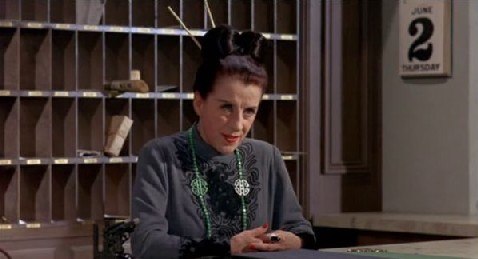
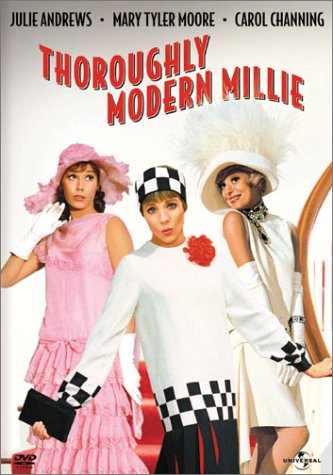
The thing about all this is that, as Wikia explains, “Finch refers to the sandwich he brings to Shaw as a ‘Beatrice Lillie.’ Beatrice Lillie was a comic actress. Her final role was in the 1967 film Thoroughly Modern Millie, where she played the house mother at a women’s rooming house who is actually the leader of a white slavery ring based in New York’s Chinatown, thus the name of the sandwich.” This isn’t a very good explanation, but that isn’t my point.

pic8

My point is that, not knowing this connection, I just watched Thoroughly Modern Millie last night and have the damn theme song stuck in my head, because of course anything Julie Andrews sings is going to be stuck in my head for life, especially if she sings it while dressed like a 1920s flapper.

Thoroughly Modern Millie

There are those
I suppose think we’re mad
Heaven knows the world is gone
To wrack and to ruin

What we think is chic, unique, and quite adorable
They think is odd and “Sodom and Gomorrable”
But the fact is everything today is thoroughly modern

Check your personality,
Everything today makes yesterday slow
Better face reality- it’s not insanity, says Vanity Fair
In fact, it’s stylish to raise your skirt and bob your hair

In the rumble seat, the world is so cozy- if the boy is kissable!
And that tango dance they wouldn’t allow?
Now is quite permissable!

Good-bye, good-goody girl, I’m changing and how?
So beat the drums cuz here comes thoroughly modern Millie now!

Everything today is thoroughly modern
Bands are gettin’ jazzier, everything today is starting to go
Cars are gettin’ snazzier
Men say it’s criminal what women’ll do
What they’re forgetting is, this is 1922!

Have you seen the way they kiss in the movies?
Isn’t it delectable?
Painting lips and pencil lining your brow
Now is quite respectable!

Good-bye, good-goody girl, I’m changing and how!
So beat the drums ‘cuz here comes
Thoroughly modern Millie now!

519A8QM6V8L

Someone on Facebook recently pointed out that the 20s are coming back and we should bring back the clothes and music. Well, maybe the music anyway. But watching this ridiculously (and casually) racist and sexist comedy, I think there are a whole bunch of things we will happily leave behind.