Narratives for Survival #3

hangg_heemskerck

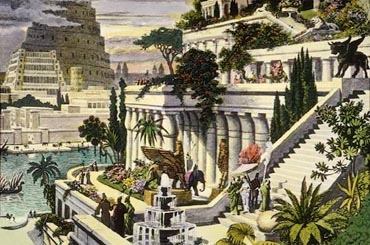
The first line of this poem comes from a poem by Trumbull Stickney. It got stuck in my head the other day, and since I was working on an oratorio or possibly musical about the Hanging Gardens allegedly built by Nebuchadnezzar, I thought I would play around with the ideas some more, and because I am a glutton for punishment, use blank verse (unrhymed iambic pentameter) to do it. If you are going to go classical antiquities, after all, go all the way.


“Be still. The Hanging Gardens were a dream,”

Just as Eden was a paradise

Where animals could frolic, never die,

And trees provided all the fruit for all

The hungry mouths who had not yet learned pain.

Such dreams are necessary for our hearts

To learn the blueprint of a truer world.


When Babylon, the center of the world,

Was young and shining in the desert sun,

The emperor, it’s said, once came upon

His consort, Amytis, just lingering

Alone and staring eastward toward her home

In far-off Persia–fair, beloved, and green–

And in that moment knew what pity was.


A moment only. (Though that moment was

Enshrined in history. Three thousand years

Have passed and carried with them this one tale,

The birthing of a wonder of the world.

We know such men as emperors do not

Amass empires in order to appease

The heartsick longings of a simple girl,


However regal her paternal price

In dowered lands.) A moment later, he

Envisioned legacy, his glorious name

Forever linked to this vast garden, tiered,

Wild, green and flower-blazoned (built by slaves

In exile, sons of Israel of old),

And fountains blossoming to ward off heat.


Herodotus recorded measurements–

How high the walls, how tall the topmost tree–

But archaeologists, who deal in truth,

The truth that lies in layers of dirt on dirt,

Tell us Herodotus did not see truth

The way we do, that history back then

Was story first and only afterward


A thing of facts. The poet was not wrong:

The Hanging Gardens were a dream. It’s true.

But then, what does it mean that this green dream

Has filled the sleeping minds of women, men,

A thousand generations sharing these

Wild, verdant tendrils of this single dream?

Through this, a need is answered, so be still.

The Rhino at the Tricycle Shop

rhinocercyclist

Well, today is Shakespeare’s birthday and possibly also the day he died, give or take fifty years, and in honor of the Bard of Avon, I am offering this poem written for Mike Allegra over at heylookawriterfellow for kindly drawing this picture for me. Some of the words even rhyme. And because this day also marks the beginning of Write a Love Poem Fortnight, it is a love story. As one of my sister’s exes used to say, “It’s spring. Love is in the air. If you’re not in love, you’re not breathing hard enough.”


Rudy the rhino was cycling to Judy’s house,

Planning to ask her out for a meal.

Rudy was psyched. He would wine her and dine her!

But all of a sudden he heard his wheels grind.

(Now before we go on, we should point out that Rudy

Was kind, eco-conscious, aware of his duty

To avoid fossil fuels: hence the red trike.)

But for all of his virtues, our friend is a rhino,

A big, heavy fellow. His trike was quite small

And all the wheels bent, both before and behind.

As he pulled into the tricycle shop and he stopped,

The squeal of the metal brought out Bertie Bunny.

“Oh, Bertie!” said Rudy. “Money’s no object!

Please fix my trike. I am late for my date!”


Bertie, laconic mechanic, wiped oil off

His paws with a rag as he paused to consider

The mangled Turbo Triangle detritus.

He sighed, “This will take me at least until Tuesday.”

Said Rudy, “Oh no! But my need is quite dire!”

Bertie pulled out his pliers and wires and a hammer

(His canvas workbag was really quite full)

And finally a skateboard with very thick wheels.

“Rudy,” said Bertie. “I hear you, my fine rhino.

But cry no more or your horn will turn red.

I’ll give you a loaner, my great lovelorn fellow.”

So Rudy skated off to his date with dear Judy

A little bit differently than what he’d planned.

And Bertie the bunny just sighed, “That was funny.

But I’m glad to do my small part. Ain’t love grand?”


Illustration by Mike Allegra.

Rooting for Root

Great thoughts by Cassandra on one of my favorite pop culture heroines! Thanks, Geeky Voyage!

Cassandra's avatarGeeky Voyage

Over the summer, I discovered a television series that blew my mind and changed my perception on modern television. Said series is Person of Interest.

Until I had subscribed to Netflix back in June, I hadn’t heard much about the series. I knew of the two main female characters, Root and Shaw (their portmanteau pairing name being the apposite “Shoot”) and that was as far as my knowledge on POI stretched. Sadly, the series receives next to no promotion in the UK so it is largely unknown to the majority of British audiences.

I had been fresh off an Angel binge at the time and I was dying for some more Amy Acker in my life. So when I saw an advertisement for POI on Netflix—its title card blown up in all of its deceptively subtle glory— I bit the bullet and loaded it up.

The first thing that I…

View original post 1,325 more words

Narratives for Survival #2

Ferdinand_Keller_-_Scheherazade_und_Sultan_Schariar_(1880)

Scheherazade Speaks


For nearly thirty-three months, I told an unfinished tale

To the king who had promised to kill his wife each night

So that she could never be unfaithful, then marry again

The next night. I who had spent my youth in the library

Of my father’s home, knew many tales, a thousand

And one in all. I secretly vowed to bend him to my will.


Painting by Ferdinand Keller, 1880.

Narratives for Survival #1

Screen_shot_2013-11-12_at_11.56.19_PM

So I found this meme on Facebook the other day, not long after Umberto Eco’s death, and I thought that it might just kick my writer’s block in the pants. “To survive, you must tell stories.” I tend to look at this blog as a “platform” for my books of poetry that I am going to be publishing in the next few years, a way to “build an audience,” and I imagine that many of my readers who are also bloggers feel a similar way.

But I often get dragged off course, usually by popular culture narratives with kickass women characters who lead, make choices and decisions, fight, kill, deal with the trauma, and work to balance the things and people they love with the things and people they have to deal with in often less than loving ways. These are the narratives I am magnetically drawn to.

Clearly, they are not the only important narratives. I have a shelf of books on World War II and the Holocaust because memory and testimony are crucial types of narratives for survival. I don’t write about these much because I don’t have firsthand knowledge, but I am going to be giving my writing students a speech by Elie Wiesel to read because they might take his thoughts on “The Perils of Indifference” better than they would take such thoughts from me.

There are also meta-stories: stories about how stories affected you, as we often hear when we start talking about representation in popular culture narratives. So Whoopi Goldberg has often talked about the galvanizing affect seeing Nichelle Nichols playing Lt. Uhura on Star Trek had on her when she was a little girl, suddenly realizing that a black woman could be a leader rather than just a servant. So clearly it is just as important to consider how we tell the stories we tell.

But there are other narratives too, the stories we tell ourselves when we are too tired to do the laundry or too hopeless to fall asleep at three in the morning, or too optimistic to consider consequences or too busy to separate the recycling. Sometimes they serve us well, reminding us to save our energy for the big things or to hold on to the small things until we have the resources to work for the bigger things. And sometimes they just get in the way. So maybe it is not only about what stories we tell and how we tell them, but also how we use them and how they serve us and others or do not.

Mental Models

So yesterday I worked with an MIT engineer on his thesis about the Fukushima Daiichi Nuclear Power Plant that suffered a severe compound accident from the tsunami that hit eastern Japan on March 11, 2011. One of the theories of thinking and reasoning that underlies some of his research is the idea of mental models, “that the mind constructs ‘small-scale models’ of reality that it uses to anticipate events. Mental models can be constructed from perception, imagination, or the comprehension of discourse” (Johnson-Laird and Byrne). I used this idea when I was writing my theology thesis about environmental survival, and it often comes up in cases where survival is at stake: people have to make crucial decisions at high speed in real time and they rely on their picture of reality, which is itself a) a form of perception, b) usually an oversimplification (occasionally the reverse), and c) affected by language, custom, and other symbolic attributes in addition to our lived experience.

That perception reality is shown in part by research that shows how inaccurate eyewitness testimony can be in court. “Many people believe that human memory works like a video recorder: the mind records events and then, on cue, plays back an exact replica of them. On the contrary, psychologists have found that memories are reconstructed rather than played back each time we recall them. The act of remembering, says eminent memory researcher and psychologist Elizabeth F. Loftus of the University of California, Irvine, is ‘more akin to putting puzzle pieces together than retrieving a video recording’” Akowitz and Lilienfeld).

It is true public safety officers are trained to observe more accurately than the rest of us, and there are ways of retrieving testimony that are less likely to color the witness’s recall. However, for my purposes here, that is less useful simply because in an emergency situation—a nuclear accident, 9/11—what an individual will be doing is not recalling What Happened Then but rather What Could Possibly Be Happening Now. The former is based on a single instant of reality and the latter is based on All the Reality I Have Experienced Up To Now, taken together, sifted, and drawn on the blueprint in the person’s head.

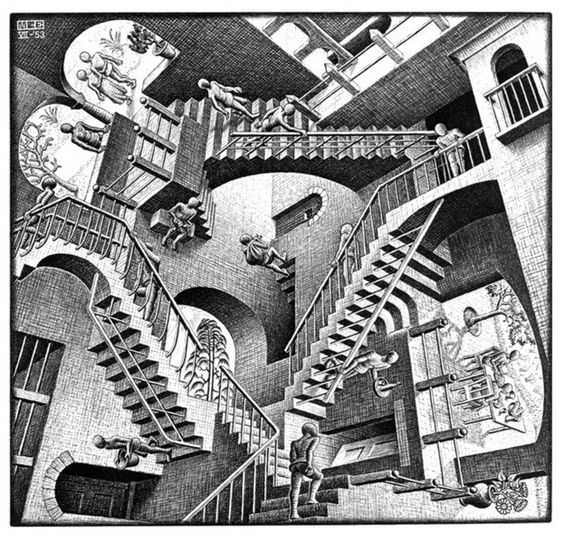
Think of the house you grew up in. Then think of all the houses you have ever seen from the inside or the outside. Then tell me what a house is. If you grew up in the suburbs, a three-story house or a Roman villa won’t be part of your picture. If you are M.C. Escher, this might be the house you draw for me.

36e856dacf47ec95ceb8042506c48920

With an overcomplicated mental model, you might withdraw from action—why try to get down 80 flights of stairs? I will never make it. Social problems, which are indeed multiply constructed, frequently face human inaction for this reason.

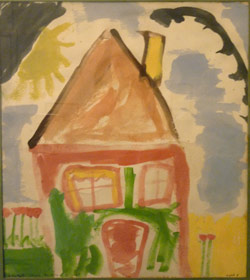
If you are a child, this might be the house you draw for me.

Childspaintingland

The trees out side the house will have brown bark rather than grey and green grass rather than winter yellow, even if you just ran across the yellow grass and climbed up into the grey-barked tree just yesterday.

I am not sure why I am even writing about this although I expect it has to do with Valentine’s Day. I have written before about the problems of love poetry for a writer who wants to be taken seriously, although I don’t think I specifically addressed the problem that poetry causes for us in our expectations about love. But I have a feeling that this is a thing.


Arkowitz, Hal, and Scott O. Lilienfeld. “Why Science Tells Us Not to Rely on Eyewitness Accounts.” Scientific American. 1 Jan. 2010. Web. 11 Feb. 2016.

“Child’s Painting Land.” MediaWiki. Web. 11 Feb. 2016.

Escher, M.C. “House of Stairs.”

Johnson-Laird, Phil, and Ruth Byrne. “Mental Models: A Gentle Introduction.” Mental Models Blog. July 2012. Web. 11 Feb. 2016.

My Boys, Wilbur and Orville

pic_giant_052715_SM_Orville-Wilbur-Wright

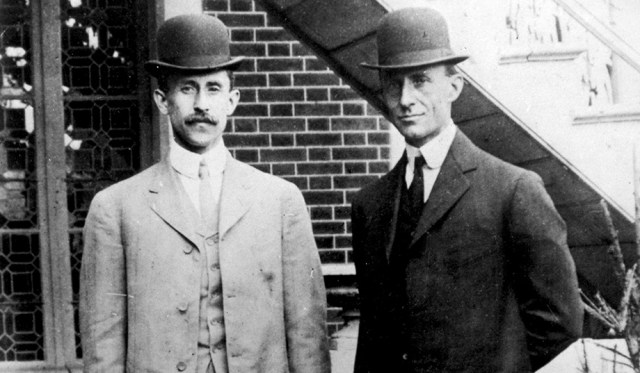
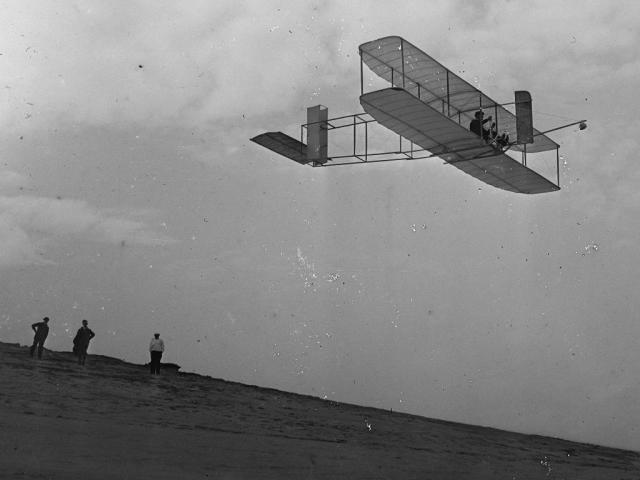
So 112 years ago the Wright Brothers made the first successful airplane flight near Kitty Hawk, North Carolina. A while back I wrote an oratorio about their process and I even had a composer who was working on it, but then we kept having our planned meetings go strangely awry—buses that were an hour late and the like—so I have actually never heard the music she wrote for it. Anyway, here is a taste of my attempt to capture their voices.


Finding Wind/Kitty Hawk Tango Baritone/Wilbur


When I sought for a safe place to practice

To learn the aeronautic riddles of flying,

They sent me to stand on a stretch of sandy land

In Kitty Hawk, North Carolina.


The abode of mosquitoes and buzzards,

A clime either roasting or raw,

A suitable location

Fraught with vexation:

I found it at Kitty Hawk.


I desired to make tests meticulous

In winds exceeding fifteen miles an hour,

Even quicker gales are here ubiquitous,

Enough to make a bold man cower.


The sand drives forth like an army

Over the hills and the flat.

The winds that rattle the tent

Are grand for experiments

But you’ll want to hold onto your hat!


If you desire a wind continual,

A place for vying with your flying machine,

The unbroken wind of the Kill Devil Hills

Will shrill and splinter your dreams.


I pity you, sir, for a coward,

If you dislike the picture I draw:

A land riddled with erosion

Betwixt Sound and Ocean:

Where I build my camp at Kitty Hawk?

1911_Wright_Glider

How the Birds Rise Tenor/Orville


Consider the owl,

The predator of night,

Who glides through the darkness,

Keeping the field mouse in his sight.

And then he dives down

Without disturbing the air.

The mouse is carried aloft

And never knew the owl was there.


And I am left to ponder

Mother Nature’s wonders:

How the owl glides,

How the stars sing,

How the birds rise.


Now consider the gull,

The scavenger of day,

Who sails across the morning

And her flying is play.

How she turns on a wingtip!

How she soars without a care,

Calling out her jubilation

Carried on ascending air.


And I am left amazed

At Mother Nature’s ways:

How the gull soars,

How the sand stings,

How the birds rise.


Now with the wind I sing,

I will learn to fly

As the owl glides,

As the gull soars,

As the birds rise.

In Which, Suddenly, I Nerd Hard

chris-evans-captain-america

I am not sure when it happened, the transformation from English teacher who likes smart action TV to nerd. People say you are a nerd when you like something unabashedly and a whole lot. I suspect it is a combination of Joss Whedon simply doing what he does—creating feminist TV and fun movies—and the social phenomenon of Netflix and bingewatching old and new TV shows. Suddenly I can immerse myself into something cool and pay really close attention to the details and catch the kinds of continuity elements that are obvious when you watch four episodes in an evening rather than over the course of four weeks. That leads to an admiration of the writers/actors/set designers, a kind of “I see what you did there” that otherwise would be unavailable to me. Then you add social media and discover that other people really love the same things that you really love, which then makes it even safer to really love it, a kind of reverse peer pressure.

So, yes, the Earth is going to hell in a handbasket, no question, but at least I have my Captain America.

The Weirdness of Precipitation. Also Umbrellas.

8d6781cf937172027dee33d74d831c33

So a friend has pointed out that I have been veering from the straight path of poetry and investigating all kinds of apparently nonpoetic things, and she is not wrong. At first I thought this was simply a result of my writer’s block, again, and to some extent it is. Then I thought about how I started this blog in part to figure out my poetics, that is, what the Princeton Encyclopedia of Poetry and Poetics defines as “a systematic theory or doctrine of poetry” (Preminger 636). What do I think counts as poetry and where do we draw the line? Is it enough to “not be prose,” i.e., to have lots of short lines, some of which may happen to rhyme? Is it likely to have more elegant language and imagery than non-literary prose generally uses? Must it be beautiful? And what do we mean by beauty?

And then I realized that some of what I have been unconsciously doing is figuring out my aesthetics, which oddly enough, Preminger does not define, although he does include aesthetic distance and aestheticism, this last of which he seems to define as art for art’s sake, although he takes several pages to do it. I think for me defining one’s aesthetics is about defining what one as an individual, artist and nonartist, find beautiful and not. What draws you, as the bagpipes drew me before my mind had realized that my legs were moving? What repels me, as the sonorous, groaning organ does, even though it has great symmetry and harmony and All The Things, and can move other folks to tears for Very Different Reasons?

And I have been fascinated by our recent popular culture projects, because they have been drawing me in a similar fashion. Some of what I like is the smart juxtaposition between apparent opposites that we often get, the mixing of deadly serious and light wit, or dark, almost Gothic environments mixed with warm companionship. Or just high school students reading 500-year-old texts in an actual library to learn about the demons they are about to face. These tinctures in the story-telling of our time fascinate me, and I hope are teaching me about how to tell a more beautiful story, whether I do it in poetry or prose or some other way.

But for those who came for the poetry, here is a poem from last Monday when I got soaking wet about three different times.

.

Suddenly the air

is awash front to back

with water, which once,

before today, used

to be ocean or cloud.

.

And walksign people

scurry and slosh across

sidewalks become rivers

for a moment or two

too long for dry shoes.

.

Only the dry ones, those

who planned ahead,

stay anywhere near dry

carrying their nylon roof

on a stick.

.

Preminger, Alex, ed. Encyclopedia of Poetry and Poetics. Princeton, NJ: Princeton UP, 1974.