Lost Things

keys

So I lost a poem the other day, because I typed it in a Word document, edited it all nice and pretty, and then, apparently, erased it. Somewhere in the universe of Other Socks, it still exists in a Platonic state, but I shall never see it again. Naturally, thinking about lost things, lost opportunities, my roommate’s lost keys, etc., made me think of Elizabeth Bishop’s famous villanelle, “One Art,” which made Bishop the first Master of Disaster.

One Art

By Elizabeth Bishop

The art of losing isn’t hard to master;

so many things seem filled with the intent

to be lost that their loss is no disaster.

Lose something every day. Accept the fluster

of lost door keys, the hour badly spent.

The art of losing isn’t hard to master.

Then practice losing farther, losing faster:

places, and names, and where it was you meant

to travel. None of these will bring disaster.

I lost my mother’s watch. And look! my last, or

next-to-last, of three loved houses went.

The art of losing isn’t hard to master.

I lost two cities, lovely ones. And, vaster,

some realms I owned, two rivers, a continent.

I miss them, but it wasn’t a disaster.

—Even losing you (the joking voice, a gesture

I love) I shan’t have lied. It’s evident

the art of losing’s not too hard to master

though it may look like (Write it!) like disaster.

Elizabeth Bishop, “One Art” from The Complete Poems 1926-1979. Copyright © 1979, 1983 by Alice Helen Methfessel. Reprinted with the permission of Farrar, Straus & Giroux, LLC. Source: The Complete Poems 1926-1979 (Farrar, Straus and Giroux, 1983).

If You Mix a Selfie with a Foodie

5237-v2

So I follow a bunch of blogs for the humor and some for the pictures of food. The Domestic Man is one that always makes me hungry, as does One Man’s Meat. But lately Art-Colored Glasses pointed out how it’s not always about making your food tastier as much as making it look tastier. I dunno. I have never made a meal that looked so good I just had to photograph it, and I feel like I am missing out. There is a poetry to pretty food, and I always recognize that at sushi restaurants, but normally I am so hungry that I just throw the food on a plate or in a bowl and nom, nom, nom. But maybe I am missing out?

Poetry, Food. Food Poetry

o

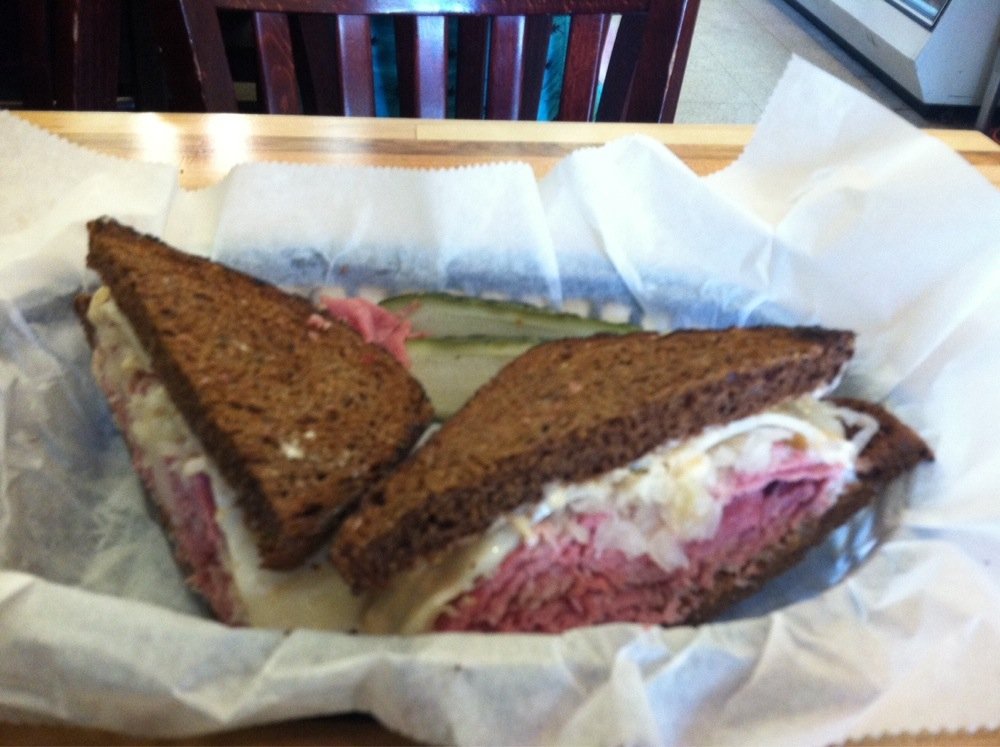
After living in the Boston area for more than twenty years, I finally went to Michael’s Deli in Coolidge Corner of Brookline and had their storied Reuben sandwich. That sandwich was bloody inspirational and when it is me that is talking, you know I mean that literally. So:

Ode to the Michael’s Deli

Reuben Sandwich

How perfectly heavy this

Pile of sweet corned beef,

How sour the kraut, how

Rough and soft the brown rye

Bread, the bed of this old marriage.

Even the cheese knows

Its perfect place, dripping out

On the dark edges, soft and

Hot, so utterly prodigal.

And the pickles? They

Keep their own secrets.

Velcro, Cottonballs, Muse

EMC over Boston

Okay, so I know I have written before about my yoga teacher, Erica Magro Cahill, and how she says things that get stuck in my mind like a cotton ball clinging to Velcro, which then leads to a poem. Or ten. Usually about yoga, because, duh, yoga teacher. But not always. One turned out to be about Odysseus and two are meta, being about the ways in which the things she says end up with me writing and/or changing. Here is the beginning of a sestina; note the end words, which come from something she said back in December:

In the crash and tumult of the year’s end, hearing the heart’s

Voice is difficult, especially if it is a shy, halting voice

Unused to asserting itself. So many other things are louder:

Car engines, sirens, the mind insisting it’s more important than

Everything else. As in an echo chamber reverberating, the mind’s

Insidious messages bounce back and forth against the bony walls

Of the skull.

And here is part of the Odyssey poem based on her phrase: “The intimacy of a beating heart inside your beautiful skin…” The phrase “muscle hugging to bone” also comes from her.

The percussion of the human heart, its calm

And agitation, how it pushes blood through

The body, emotions through the mind. Just as

The x-ray bypassed skin to show muscle hugging

Bone, to introduce me to my trembling heart,

So too, sometimes, do the songs we sing

Bypass the outer shell, however beautiful,

To speak quiet comfort to the fearful, feral

Cornered self within another body contained

In skin, the reverse of Siren song.

And this, which I wrote last week:

Because of You, I Carry the Sky Everywhere with Me

for EMC

your phrases like cirrus clouds

belie the true weather

grey, it may be, and

cold or raw or wet

and roaring

but inside my head the weather is

clear, the sky robin’s egg

blue, traced with fragile willow

buds and yellow and

clean, like early summer

almost a year I have listened to

your wisdom, your poetry

scudding across my wide blue

mind, chased by gulls

who also desire

outside, everything vibrates, frantic,

tidal: few sail through serene,

sails up, prow unwavering

few speak of these things

clearly, or at all

I have tried to learn to speak of that

particular wind that drives me

how to sail through

the roar, not

your way, but mine

to offer the wisdom and passion

I have for this one

thing: the words

and the heart facing

sky, our only ship’s compass

Occasional Poetry, Part 2

setsubun

As a working poet, I often have the opportunity to write for specific circumstances, as I mentioned a few days ago when I offered the poem I wrote for the wedding of some friends many years back. This is called occasional poetry. It is a more public poetry, in comparison with what might be considered the “more intimate … lyric” poem (Sugano 5).

Wikipedia tells us:

‘As a term of literary criticism, “occasional poetry” describes the work’s purpose and the poet’s relation to subject matter. It is not a genre, but several genres originate as occasional poetry, including epithalamia (wedding songs), dirges or funerary poems, paeans, and victory odes. Occasional poems may also be composed exclusive of or within any given set of genre conventions to commemorate single events or anniversaries, such as birthdays, foundings, or dedications.’ (Occasional)

Some occasions are not as obvious as those listed here. For example, many years ago a good friend ended up on the wrong end of a restraining order from her roommate and bunked on my couch for three days while she sorted it out. When the judge had thrown the roommate out of court and out of my friend’s apartment, and after all the dust had settled, my friend had an Exorcism Party, for which I wrote the following poems. The goal was not only to celebrate the end to an excruciating time but also what I think of as the prophetic task of reminding us to forgive our enemies eventually.

The Exorcism, First Movement: The Beans

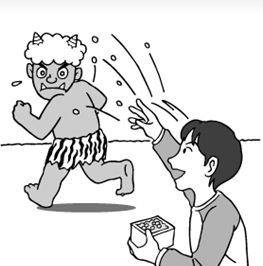
oni wa soto, fuku wa uchi

(out with the devil, in with good fortune)

In this place, we rise and shout:

Good luck in and demons out!

To darkness that has gathered here,

We now demand: Go! Disappear!

In foreign lands, where now sunlight

Is rising silver on beached stones,

Many-colored demons wrapped

In deerskins wander winter night

Free. They fear one thing alone.

They tremble when they hear beans tapped

Together, gathered for the rite

Of Setsubun, Bean-Throwing Fest,

Which, every February, means

The end of winter-darkened fright.

All folk have ways to expel the Beast;

There they drive it out with beans.

But here no Oni stalk our night,

Steal our rice, upset our shelves

Or walk the night to work us ill.

It’s with each other that we fight:

The dark fire is within ourselves

To stoke or extinguish as we will.

Now in this place, we rise and shout

To darkness that has gathered here,

Forgiveness in and anger out!

We eat the beans. It disappears.

The Exorcism, Second Movement: The Book

The book proclaims

that God’s voice

strips the bark from trees

standing in the wilderness

arms raised–

Your money or your life–

How long O Lord–

How long can I stand

here without skin. The wind is cold;

the thunder cracks through; each layer

around layer cowers.

The book reminds

that wilderness is wild

but not empty.

Look!

the voice shouts,

you do not stand alone:

all around you I have planted

my people, whose arms reach out.

Now

the voice whispers

Now

I will sing you

into new skin.

We Speak of Exorcism, Yet

demons never lived here. Just a woman

surrounded by light, who ground the heels of her

palms into her eyes, a woman surrounded

by the spirit, who steadfastly refused

to inhale. We must know the spirit; like a child-

woven paper chain, it rises and falls

here between us, these people you have

called to your side in trouble. We all have

breathed, these forty days, its freshening wind.

The spirit is the only part of God

I trust: out of darkness, invisible eyes see us

in our frailty. We skitter below like woodmice

cowering alone–we think–waiting,

praying for the spirit to swoop down,

not a dove but a hunting owl: accurate,

terrifying, saving us.

When She Has Finally Moved Out

After the room has emptied, you weigh

the air between winter-locked windows

with your kitchen scale: lighter, easier

to breathe now. You take a sip

of tea, the saucer in your left hand as

you wander, a sacrament. Liberated

like this air, like this room’s white door

now you are swinging

wide

open–

setsubun-1

Occasional Poetry. Wikipedia. 9 Jan. 2015. Web. 25 April 2015.

Sugano Marian Zwerling. The Poetics of the Occasion. Stanford: Stanford UP, 1992.

Occasional Poetry, Part 1

cecelia

On Her Fifty-Somethingth Birthday, Greater Boston Rejoices

Lo, the Amazing C. Musselman has been

On the Earth these last five decades and we,

Waving our hands and dancing with our feet,

Are grateful. So we show our gratitude

With colored banners, cakes and ale, broad cheers,

And songs (probably in Finnish) and small bonfires.

We light up the bay. The tourists likely think

It must be some local holy day but we

Know better. Having had the mission furniture

In our brains rearranged by her speeches

Over the preparations for every dinner,

We know that holy is not the word for it.

The word is knowledge, or wisdom perhaps,

The domain of Athena. What they both bring

The world is yearning for knowledge,

That sudden spark that lights the conflagration

That annihilates all we thought we knew

To make room for what we never thought

Possible. This is their gift to us, ever being

Offered, ever received. And so the fireworks

(Fireflowers, the Japanese call them) erupt

Across the skies of the world this night

In their honor, in the honor of her chariot

Pulled by cats, that she won from Freya

When Apollo decreed that he liked Cecelia’s

Pottery better, in honor of her baked

Mac & Cheese that Thor decreed could make

A warrior weep, in honor, in short, of her birth.

And though those who do not know the woman

Might think this paean overwrought because

They have never seen the shine of her mind or

Eaten the food she offers with such love, I, who

Know her, tell you it is not. As with many we know

And underestimate for their size or quietness,

Though she is but tiny, she is fierce.

Discovering the Cento

Eagle-morning-strike-Robert-OToole-Photography-2014

So the other day, I was reading Robert Okaji’s poetry blog and he gave an example of a form of poetry I had never before heard of, the cento, a patchwork poem made from the lines of other poems. Naturally, I immediately wanted to do this, and today I sat down and did. I picked out some of my favorite volumes by some of my favorite writers on my main poetry shelf (the one I can reach without a ladder or chair) and went to work. My cat jumped up on the table, settled himself under his tanning lamp with his feet on my wrist and watched. So here it is. I have listed the poem each line is from below. They are in reverse chronological order because I moved from A to Z and put the stack down backwards. Sigh. See what you think.

Cento

Ah, the shining pastures of salt:

Flames bouncing off the river’s back,

A photograph of an eagle just setting down,

Bright fog reaching over the beaches.

How poignant and amplified the world before me seemed.

In this condition I write extraordinary love poems,

Strengthening our embrace.

I mostly chose lines that had roughly similar rhythm and length and ended with a short line, as that feels more musical. I like it because it is sort of representative of the inner geography of my mind when I sit down to write: the inside reality is bigger and grander than the outside reality. And I have been writing love poems of a sort lately; I am not actually in love myself, it is only part of a project. Then again, May Sarton would say that all writing is a love poem because love is attention to details.

Willard, Nancy. Missionaries among the Heathen. Water Walker.

Troupe, Quincy. Snakeback Solo #2. Avalanche.

Piercy, Marge. What Goes Up. Stone, Paper, Knife.

Ursula K. LeGuin. Incredible Good Fortune, Incredible Good Fortune.

Collins, Billy. Marginalia, and Purity. Sailing Along around the Room.

Boland, Eavan. VII. First Year, Against Love Poetry.

OToole, Robert. Eagle Morning Strike. Photo.

The Stories We Tell and Live Into

As a writer who is also a Christian, I find I think about Passover and Easter as being about the Story. We tell the stories of Exodus and the Passion of Christ at this sacred time of year to remind ourselves of who we are. That is what ritual is for: we eat specific food and tell specific stories and sing specific songs and we know ourselves as a people descended from the people who chose those foods, stories and songs, gathered or invented them and gave them meaning.

I think of this in the context of the popular cultural narratives that have been occupying my thoughts these last few weeks, in particular, the two separate and very different first century CE localities of ancient Greece and Rome, brought to us by Renaissance Pictures, Rob Tapert and Lucy Lawless, Spartacus: Blood and Sand and Xena: Warrior Princess. The more recent Spartacus (2010 to 2013) was about men (and women) bound to the gladiatorial arena. It was about despair and meaningless death. In contrast, the earlier XWP (1995 to 2001) was about changing one’s way and rising from death into something better.

images

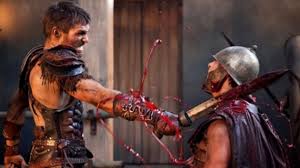
I have binge watched XWP more than once. I rented the DVDs of Spartacus once; while the half naked gladiators were nice, there is no way I would watch those shows again. They are too much like Quentin Tarantino’s Kill Bill, in that when blood sprayed across my computer screen, I automatically found myself throwing up my arms to keep the blood from splashing across my face.

Yep. That bad.

I think about all this now because of the two major interpretations of Christ’s death and resurrection. There are people who talk about Christ’s dying for our sins, as if God was so pissed off with humans that he (it is always he in these readings) needed to kill his own Son to make up for our sin. Weird shit, that. In contrast, a more liberal reading says that humans killed Jesus, but God the Father/Creator/Mother resurrected him to prove to us lame humans that death is not the end, that God can overcome this enormous problem.

So when I look at the stories I use to constitute my identity, I often choose the ones that are not about characters trying to see how much they can get away with but about characters engaged in rescue and redemption, rather like the Jewish idea of tikkun olam, the repair of the world. It is an ongoing project, a battle that never is entirely won. All you can do is stay on the road, take good friends with you for the journey, and keep telling yourselves the stories that remind you who you are, and how strong you can actually be.

fal8

Let Me Sing You the Song of My People

ckll

One of the downsides of having a very productive month is that Normal People do not understand how amazing this is and ignore you and Writer People, who do understand, yes, my pretty, they understand All Too Well, resent you. Some of this divergence comes out of a misunderstanding about the creative process. I believe that Sustained Creative Productivity (SCP) requires a shitload of work and self-discipline, for a given value/definition of self-discipline. The word disciple simply means learner. So the kind of self-discipline I am talking about is really learning about yourself and your rhythms, motivations, inspiration. It can be scary, when you identify as a Writer People, to fall into a period of writers block or creative constipation. Like real constipation, it is painful. What is worse, it also threatens your identity. Like a bad knock-knock joke, you ask yourself, How can I Be a Writer if I am not writing? And the only answer you have is either, “Oooh, ooh, I know this one! The sound of one hand clapping!” or “I guess I am not.”

It feels a bit like that moment in Superman II when Clark Kent, who has thrown off his superpowers to be with Lois Lane, suddenly realizes that without his power, he is nothing. It is a crap feeling. (And can I just point out here something I have learned from a friend: if somebody ever tells you that the only way you can have love is to give up your super power, that person is singing the song of Patriarchal Oppression. Invite them out of your life. Then carry on loving and using your super power. Thank you, Jenna Tucker.)

I have often found that I get to the end of the academic year and I am so burnt out from teaching all year that I have nothing to work with. It is so frustrating because I have generally great weather and lots of time and nothing to show for it. And given that I did not always get a lot done during the two semesters, since I basically grade student papers two weeks out of every three, it meant I was not getting much done for the whole frigging year.

But lately, I have noticed that I am getting more done during the semester. This is due to a few things. First, from 2008 to 2012 I was teaching at two schools and doing a second Masters degree at a third (cuz it turns out the Masters degrees are collectible: get the whole set!). Ironically, I was doing this because I had gotten so burned out teaching. It was often a gruelling process to balance all that stuff, but, much like getting hit over the head with a baseball bat, it felt GREAT when it stopped. Suddenly I had extra time to do things, like write, or like watch old TV shows or read novels or pop culture textual criticism (cuz as an English teacher, I nerd hard).

Second, all those papers? There is a trick to using the thing you would rather not be doing as a counterbalance to what you do want to be doing. I can get any amount of writing done if I am staring at a pile of 38 student papers. Grade some, write some, grade some, write some. Lather, rinse, repeat.

Finally, if next month turns out to be One of Those Mays, dry, barren, devoid of writerly hope, etc., I will try not to worry about it and just call it a vacation. Read some light novels. Kick back for a change. Failing that, I can sing you the Song of My People:

I am not writing!

I am not writing!

I will neeeeeeeeever write again!

Woe betide me!

As the block rides me!

I will neeeeeeeeever write again!

It actually sounds a lot like the Darth Vader theme, now that I think about it, or possibly Wagner…

Epigrams, War, and Madness

krj

You know how in wintertime, your hands grow rough, so that, when you go to pick something up, a sweater, say, it snags and forces you to look at it more closely? That is I think the usefulness of an epigraph, a phrase or sentence you come across in one place that then serves as a springboard for you, the writer, to go off in another direction with it. I have written before about how the poet Simon Perchik has frequently provided me with springboard lines of this sort, such as “or perhaps your shadow spilling over again,” which blows my mind every time I read it.

And while not all my epigraphs are about or lead me to write about mental health problems, the quote on the file card I came across this morning (thank you, Musashi, for walking across my dresser at 5 a.m.) is by Kaye Redfield Jamison, from her memoir about being a psychologist with bipolar disorder, An Unquiet Mind. (Yes, Amy Carleton, go read it. You will thank me.) I think her line will be my own Trojan Horse, a way into the set of poems about Troy that I have been contemplating writing.

The line comes from the end of a chapter about Jamison’s work at Bellevue Hospital’s psychological emergency room. Previously we have read about what happened when Jamison went off her meds and had to be hospitalized so she is humbly aware of the mirroring she feels when a bipolar patient in the grips of the manic state is wheeled in, fighting against the straps that cuff her to the gurney. As Jamison says, “We all move uneasily in our own restraints.” I can think of no better way to springboard into a series of small poems subverting an epic poem about a ten year long siege.

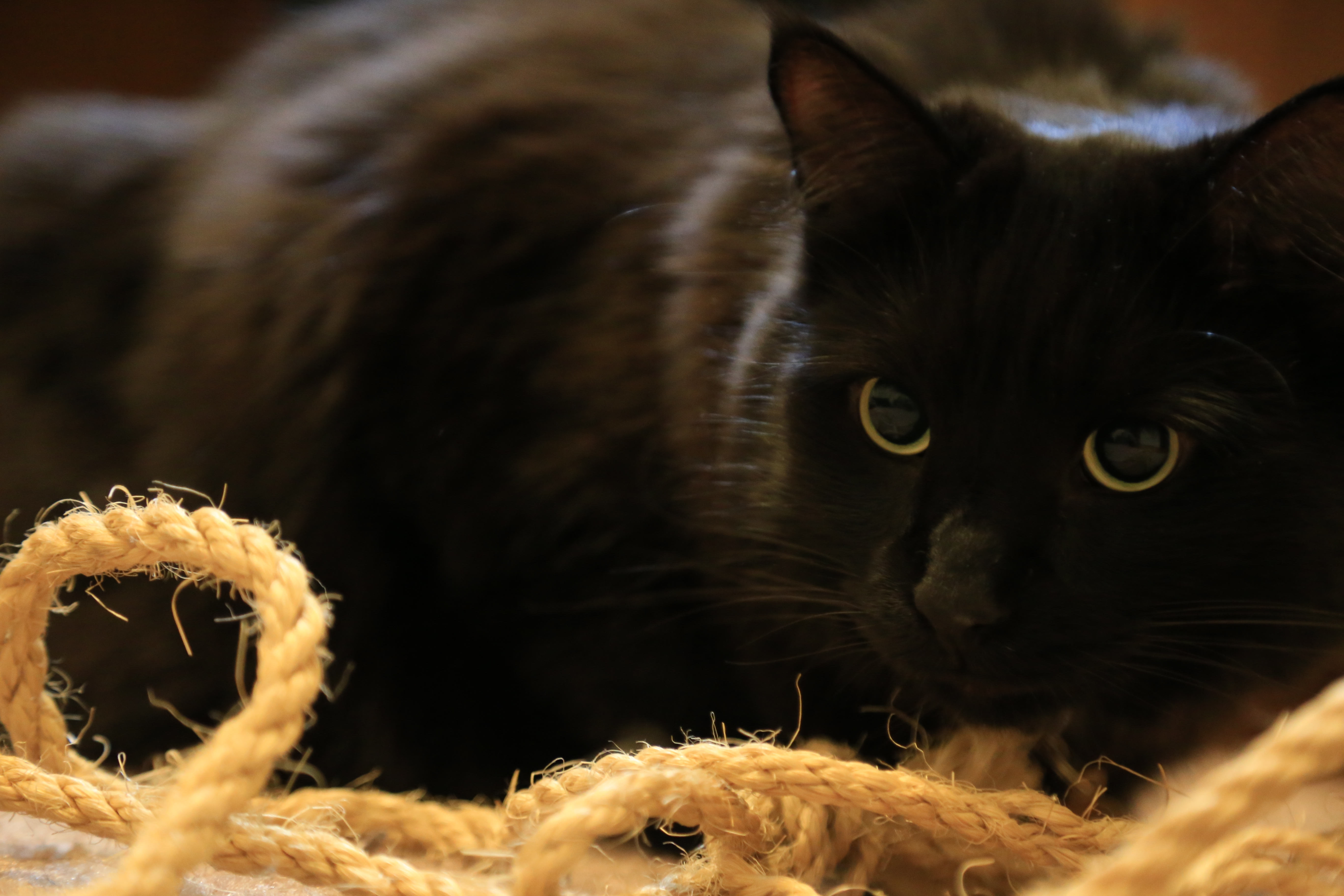
Mu with String

Siberine, Jack. Musashi with String. 2014.