Not Your Grandmother’s Poetry

images

So I just watched Guardians of the Galaxy. While you might argue that there is no real poetry in a superhero movie, I would point to the self-growing house plant, Groot, who saves the day many times, and the genetically-warped raccoon, Rocket, who masterminds most of their plans.

It may not be epic poetry, but it is poetry.

And also, I have now stuck in my head all week, “Stuck on a Feeling,” from Blue Swede 1974. I had always thought it was Tom Jones’s song. Whoops.

Literary Cross Training, Part 1: Genres

pensive writer kitteh

Well, lately it seems that cross training is getting very big at local gyms. The idea is to use a different sport or style of training, such as running or weights or boxing, to enhance your own playing of a sport or style of training. I think this works well in writing too.

Novelists can learn from plays how to make the unit of a scene (time and place with characters dealing with a conflict) in a tight way. Fiction writers can learn from screenwriting how to use natural, concise dialogue. Nonfiction writers can learn about description from fiction writers. And everybody can learn about precise and musical language from poetry.

And presumably what we learn from the blogosphere is how to be opinionated in 100 to 1000 words, preferably with amusing pictures of cats.

Poetics #2: Nature vs. Nurture

800px-MIT's_Stata_Center

Again we bring you a tiny bit of the submission goals of the journal Crazyhorse: “[W]e read with a discerning eye for poems that demonstrate a rhetorical and formal intelligence—that is, poems that know why they are written in the manner that they are.”

What I find interesting here is the language; the focus is on the poem knowing why it is written in a certain way, rather than on the poet. Sure, ideally the poet should know for example, why s/he ends his/her lines they s/he does, but it is something else again to ascribe mind to the poem. I do not think of this so much as a problem of anthropomorphism as it is a kind of meta-communication. As the father of skyscrapers, Louis H. Sullivan, said, “Form follows function.”* When you look at a building, you can probably get an idea of what it is used for.** So too, looking at a poem and listening to its music should communicate to us not only the content and ideas of the poet, but also a sense of the inevitability of its structure. Now as writers we know that bloody nothing about writing (or life) is actually inevitable; there are too many problems, too many words, too many strokes of genius just caught or just missed for that. And revisions can take a very long time.

But by gum, it should feel inevitable! And that comes both from art and from craft. A friend recently shared with me a line from John Keats: “If poetry comes not as naturally as the leaves to a tree, it had better not come at all.” Of course he would say that. He was a Romantic Poet, after all! But I think we have some wiggle room with the word come. It sounds as if he means there should be no work in the inception of a poem, work as humans think of work as hard labor, something not natural (and often with the Romantics, natural = Edenic). Yet we know that in its own way the tree labors too. It just doesn’t show us itself doing the work. The work is silent and slow, just as writing a poem is mostly behind the scenes work.

So you have the first rush of inspiration and the quick scribble. But then you also have new word choices, better metaphors, a clearer journey, a tighter ending. You decide whether your lines should be a uniform length or not. And how long will your stanzas be? Will there be an identifiable rhythm? Internal or external rhyme? And what about the damn title? How about an epigraph? So you take the seed and you hammer out the tree, with as much work as it takes.

And then, in the end, all the reader sees is leaves, everywhere.

fall

*There I go again, using architecture to talk about poetry. I do that a lot.

**Unless it is a Frank Gehry building, in which case all bets are off. For example, I worked in the basement of the Stata Center, pictured above for several years, and I can tell you definitively that nobody uses it to wipe their butts.

Thoughts on Confessional Poetry

confession

Last month, one of my colleagues commented, “I would love to hear your thoughts on the genre of confessional poetry. What is it, do you think that distinguishes the work of Sexton and Plath (for example) from the less-than-satisfying confessional poetry often encountered in writing workshops? Does producing good confessional poetry have more to do with depth of life experience or a careful study of the formal conventions of poetry (before making the conscious decision to break them)?”

Well, having sat down to reacquaint myself with Anne Sexton’s poetry (Sylvia Plath is harder to forget), I would say that my first answer is, Yes! We are teaching undergraduates students for the most part, who mostly have not had, as she says, depth of life experience, although some have (I include the woman asking this, as we first met when I was teaching creative writing). Formal conventions are helpful of course, but I think what may be even more important is a Really Good Vocabulary and a Musical Ear. These are things most people are not born with, but must learn, add to, hone, etc. over the years.

But reading contemporary literary criticism of Sexton’s poetry also brings up the issue of the time confessional poetry sprang from, the post World War II 1950s with a society that was desperately trying to put the genie of women back into the partriarchal bottle and beginning to use Freudian therapy for mental illness. Also it was happening in an academic/literary scene that was still predominantly made up of white males who saw the personal/political themes of women writers as problematic. Some of what made confessional poets interesting, if not notorious, was the shock value of actually talking about mental illness and sex and addiction a) at all and b) in poetry. Today, especially since the 1960s cultural shift, a lot of things that might have been confessed are now simply discussed. That normalcy also, I suspect, changes the kind of images people choose to express their feelings about it, and the use of more normal words can also leave us feeling as though what we are reading is really more just prose.

So there you go. That is my 2¢.

2cents

Transgressive Poetry

I was just reading a post about limericks and it reminded me of one that I wrote in high school:

True Story

We once had a test in French class

That everyone failed en masse.

Madame had a fit.

We did better in Lit

’Cause at least there, everyone passed.

Apparently the form has little to do with Limerick, Ireland, although some people speculate the verse form might have been built on an old song, “Come to Limerick.” According to Wikipedia, most limericks are at least slightly obscene. “From a folkloric point of view, the form is essentially transgressive; violation of taboo is part of its function.”

I like the idea that poetry can be used to transgress societal taboos. We should also remember that one of the jobs of the Celtic bards was to use their songs not just to commemorate their patrons’ activities but also to mock or shame patrons who had acted unjustly or with a lack of hospitality. Perhaps editorial cartoonists are filling that role now along with political comics such as John Stewart or John Oliver. Then I just Googled political limerick and came up with 261,000 results, so maybe things have not changed as much as I thought.

“Limerick (poetry).” Wikipedia. 6 Feb. 2015. Web. 16 Feb. 2015.

The Problems of Love Poetry

roses

Let me share with you an exchange of emails from 2004, and my later thoughts about the problems inherent in writing/reading love poetry.

To: PJS

From: SPIL

Re: Poetry

The good news: I am writing poetry again.

The bad news: It’s love poetry.

The other bad news: I can’t tell if it’s working.

Help!

I recently (2005) came across a blurb for Irish poet Eavan Boland’s new book Against Love Poetry. Without knowing anything about it, I cheered. I have always respected Boland’s work, and the fact that she is tackling one of the ever-present problems of poetry—how do we write about love?—offered me hope because I too write poetry for publication (poets who don’t are likely to face different problems) and I recently fell in love.

What are the problems?

It seems to me that the three issues that arise are 1) defining poetry—its purposes and mechanisms; 2) considering the possible audiences—writer, general readers, critical readers, and the beloved; and 3) understanding the work of love in the creative process.

Defining poetry—condensed attention expressed in the most appropriate, elegant, and/or musical way possible, for the purpose of offering (to ourselves, to others) a clearer insight into human experience. This will do as a working definition for now.

Considering audiences is important because different audiences with different expectations (often expressed through or caused by “education”) will read the same thing in different ways. I think that the four main audiences for a contemporary love poem that might be published are the writer, general readers, critical readers, and the beloved.

Writers, I believe, write first and foremost for themselves. As a poet, I want to understand my own thoughts/feelings/experience, to express it for myself alone. Elegance, music, artistry, may or may not help at this level. General readers want a way to say what they have experienced, particularly if they don’t know how to express it themselves. Concrete details and sensory imagery (the heart of any poem) are the most important elements at this level. Critical readers expect a high level of intentional structure, style, craftsmanship, and artistry. They don’t just want to know how an experience was, they want to read the best possible, most clearly expressed, version of how that experience was. Only the beloved, the recipient, generally has no expectations, except that I don’t lie about him or to him, that I don’t embarrass him, and that I don’t make it so obscure that he doesn’t understand it.

Understanding the work of love in the creative process is probably the most difficult, in part because it is the most subjective. What is love? What is work? What is the creative process and why do we engage in it?

Poet and Novelist May Sarton wrote, “[A]ll poems are love poems…the motor power, the electric current is love of one kind or another. The subject may be something quite impersonal—a bird on the windowsill, a cloud in the sky, a tree” (Sarton 125). I think she is right on the money, and I might even add that all good writing is, in some way, love poetry, because the attention we pay to the details of the beloved, in this case whatever your subject is, leads to the kind of precise word choice that good writing always entails. You cannot write a love poem about someone you do not know well. You might end up writing an infatuation poem, because the details in the poem probably will say more about what you WANT the person to be than about what s/he really is.

In contrast, poetic attention can become a kind of communion. As our old friend Basho said, “Go to the pine if you want to learn about the pine, or the bamboo if you want to learn about the bamboo. And in doing so, you must leave your subjective preoccupation with yourself. Otherwise you impose yourself on the object and do not learn. Your poetry issues of its own accord when you and the object have become one—when you have plunged deep enough into the object to see something like a hidden glimmering there. However well phrased your poetry may be, if your feeling is not natural—if the object and yourself are separate—then your poetry is not true poetry but merely your subjective counterfeit” (Basho, qtd. in Yusa 33).

To: SPIL

From: PJS

Re: Poetry

SPIL WROTE:

The good news: I am writing poetry again.

            great!

The bad news: It’s love poetry.

            uh-oh

The other bad news: I can’t tell if it’s working.

            Uh-oh again. If not, there’s always voodoo! (Siska)

In the end, that particular relationship went the way of the Dodo, and I decided that even Voodoo was not going to save it. But my friend was not wrong when she interpreted a working poem as being like ritual devotion/magic. As the artist Peter London wrote, “For the primal image-maker, craft was not in the service of beauty in and of itself. Instead, craft was in the service of power. The more carefully wrought the object was, the more powerfully the object would serve as an instrument of transformation and…the gods would be inclined to honor the supplication” (London 9).

Happy Valentines Day, folks. Especially if you are not in a relationship. Hell, we need it more.

mqdefault

London, Peter. No More Second Hand Art. Shambhala, 1989.

Sarton, May. Mrs. Stevens Hears the Mermaids Singing. New York: Norton, 1965.

Siska, Pamela. “Re: Poetry.” E-mail to the author. 9 Sept. 2004.

Yusa, Nobuyuki. Introduction. The Narrow Road to the Deep North and Other Travel Sketches. By Basho. Trans. Nobuyuki Yusa. Baltimore: Penguin, 1966.
Not So Pathetic After All

salinger

So it seems that nothing cuts into your writing time like actually having to go to work, rather than sitting around watching your neighbors try to shovel their cars out of six feet of snow, pointing, and mocking, with the cat. But it is a) the weekend again and b) There Will Be Snow (but only 8 to 10 inches, or possibly 16 to 18). Frankly, most people in New England are numb to the numbers. Or maybe that is just windchill.

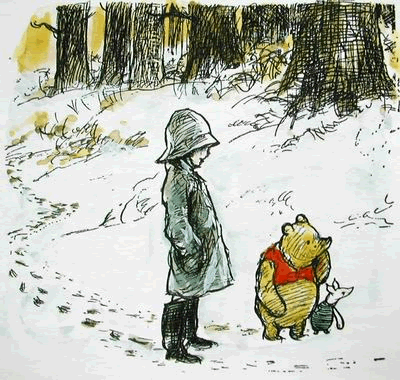
When I think of the Great Poets, I do not only think of Homer, Chaucer, and Shakespeare; I also think of Elizabeth Bishop and Billy Collins. But at times even these pale in the shadow of the truly great. Below I give you Winnie the Pooh, my vote for Bard of Snowpocalypse 2015:

The more it snows

(Tiddely-Pom)

The more it goes

(Tiddely-Pom)

The more it goes

(Tiddely-Pom)

on snowing

And nobody knows

(Tiddely-Pom)

How cold my toes

(Tiddely-Pom)

How cold my toes

(Tiddely-Pom)

are growing

If you believe Facebook, poets are not the only ones who take the weather personally, but for me, writing about weather often serves as a good metaphor for the inner life, serene or chaotic. In literature, the so-called pathetic fallacy is the idea that nature mimics human emotion; we see it in anthropomorphisms like “the sky wept.” We like them so much because in fact human emotion often mimics the weather: grey skies make us gloomy, and the sun lifts our gloom.

So what are we to say about six feet of snow in three weeks and another two feet on the way? Now you understand why I like Pooh so much.541

Milne, A.A. I do not remember which book. Illustration by E. Shepherd.

Poetics #1: Multiple Poetries

Canterbury-Tales

The Princeton Encyclopedia of Poetry and Poetics defines poetics (conceptions of) as “a systematic theory or doctrine of poetry. It defines poetry and its various branches and subdivisions, forms and technical resources, and discusses the principles that govern it and that distinguish it from other creative activities.” I think that a big part of what I am doing in this blog is figuring out my own poetics. What is poetry, anyway, and why do I write it?

I thought of this recently when I was looking at literary journal calls for submissions. I have mentioned before how these calls can be a little annoying. But sometimes the descriptions of what the editors are looking for can be insightful and interesting. Here is the start of one I like: “Crazyhorse aims to publish work that reflects the multiple poetries of the twenty-first century.” Poetries, plural. Yes.

When we look at the history of poetry in different cultures, or even just in our own, we see that poetry has had different purposes at different times and places, and for different groups of people. I think that these purposes are a kind of spectrum, or circle dance: poems sing, teach, remind, entertain, instruct, show, express or funnel emotion, and/or exalt. We should also remember that a single poem can do any number of these things. The longer the poem, the more likely this is true: just take Chaucer’s Canterbury Tales, for example.

What do your poems do?

Preminger, Alex, ed. Princeton Encyclopedia of Poetry and Poetics. Enlarged ed. Princeton, NJ: Princeton UP, 1974.