April is the National Month of Poetry!

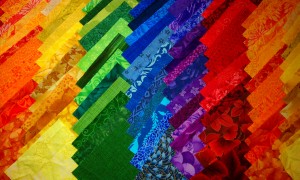
April is National Poetry Month. What that means is that a whole shitload of folks are going to be trying their hands at poetry for the next 20 days. That is a fantastic thing because 2% of them are going to make great art and discover a talent they didn’t know they had and their lives will turn into a frenzy of rainbows because of it. Like this:

rainbow_patches-300x180

And for that reason I will not, I swear, complain about the other 98% who are going to attempt 1) rhyme, 2) paragraphs cut up into three to seven word chunks per line, and 3) stabs at profundity.

I will not complain! I will not! Much.

Instead, I will try to be a bigger person and simply point to the poets who have shown me the way. Like the poem by Eliza Waters:

color was how
the world
sprang to life

to which I responded: “I love your poetry. You cut away everything that isn’t poetry and leave us with just the explosion of meaning. Thank you for that. We need you now more than ever in National Poetry Month, when a whole lot of people will be using all the other words you cut away and calling it ‘poem.'”

Another Poem Commemorating My Writer’s Block

The block on my desk, gargantuan piece of

Imaginary marble, streaked through with veins

Of imperial purple to show the unwary


Just how important! how crucial! such a lack

Of ideas can be to a quarry artist, to a master builder,

To a poet with a tiny little bit of vacations time


On her hands and absolutely no topics

For potential discussion. Such is the way of the rhinocerous-

Skinned writer. Cut yourself. Write truth in blood.

Constructive Procrastination

Calvin-Brain-Dump

Recently one of my Gentle Readers commented on my post about writer’s block. She says, “When I procrastinate I don’t write. … When I am unsure what to write, I might troll the Internet (procrastinate), which always puts me onto tangents and then an hour or more will go by and BOOM! I haven’t written a thing. So for me procrastination causes a block.”

I would argue that procrastination doesn’t cause the block any more than a stuffy nose causes a cold. We procrastinate because we need something and the style of procrastination can tell you something about what it is you need to get in a more effective way so that you stop procrastinating and start writing. I would also argue that Procrastination Isn’t Bad any more than water is bad, even though water—hot, cold or in between—can kill you. And yes, you can quote me.

The Internet is an interesting place, full of information, pictures and people. When we look for information on the internet because we don’t know what to write, it is possible that we haven’t narrowed down the “what” yet. I should have asked our friend what kind of writing she does, but I know for myself the rabbit’s hole of story leading to story ad infinitum the Internet can be. This is one case where a kitchen timer is your friend. Actually, when it comes to procrastinating constructively, a kitchen timer is almost always your friend. Do the procrastination behavior for a predetermined amount of time, say twenty minutes (as Francesco Cirillo, the developer of the Pomodoro Technique* would say). Then do some writing, also for a predetermined amount of time. Alternate back and forth between writing and one or more other activities. Over the course of an afternoon, you can get a lot done.

The Internets pictures (and videos) and people also are temptations for writers in particular. If I am bored with my writing topic, watching a cat video or reading a web comic might wake my brain back up. Facebook in particular is helpful for writers because, let’s face it, writing is lonely. So give yourself the opportunity to “socialize” in the virtual environment of your choice for, you guessed it, a predetermined amount of time. Then get back to work.

Our friend also says, “It’s like walking the dog or playing with the cats (‘for their sake,’ but I’m really procrastinating), and again nothing gets done, except some exercise for me and the pets.” Hey, don’t knock the exercise for you and them. Exercise increases blood flow to the brain, oxygenated blood flow, which has got to improve the thinking. And socializing with your animal companions also helps allay the lonelies.

“With a real writer’s block, not caused by procrastinating—“

But again, I would argue that procrastinating is a self-defensive technique that we use in an attempt to fulfill needs that the writing can’t fulfill…

“—if a deadline looms or just blocked, I put my but in a chair and push through because it (deadline) must get done. When there is no deadline looming and I’m blocked, I do the time-tested technique of just writing for five minutes without lifting the pen (yes, on paper) and no censoring my thoughts. Sometimes it will show me what the problem is; other times it gives me ideas. Once in a while, I get both, which is wonderful, but rare.”

Free-writing! Woohoo! I have only met one person in twenty years of teaching who could not write for several minutes (I usually go for ten or twenty), and he was seriously ADHD. Natalie Goldberg’s Writing Down the Bones (a book that I imagine has saved lives) relies heavily on timed free-writing to get stuff Out of Head and Onto Paper (or, for those of you young whippersnappers, on your screen). Don’t judge; just write. Eventually your brain gives up and gives you what you are asking it for. And the more you do it, generally, the easier/quicker the process goes.

Lastly, our friend says, “Sometimes I think my problem is thinking too much.”

Heaven forbid, girlfriend! Thinking? Too Much? How is that even a thing? We’re WRITERS fer cryin’ out loud. Thinking is what we DO. Day and night. Personally, I think about writing 24/7. Yes, my dreams are very strange.
Yelling “Theater!” in a Crowded Fire

images

Writer’s block is a thing like when you sit down on the train and realize that you have just stepped (in your brand new shoes) into the sticky residue of someone’s spilled soda. And you think, well, heat melts sugar, right? So if only the curtains of my imagination were on fire, I could pull myself out of this urban transit tarpit and actually create something.

Writing in the Body: A Feminist Reminder

31tapkPvrML

Working at MIT, I meet a lot of people who seem to think they are brains with big Mickey Mouse gloves: the ideas go zip-zap straight from the synapses in the grey matter to tippetty-tap on the keyboard. This is, unfortunately, not the case. Ergonomics matter because we write in the body. If your body is uncomfortable, then your brain will be uncomfortable and distracted, and that will affect your writing. If your seat is too low or too high, or worse yet, if you are doing that laptop in your lap thing, then you are in a suboptimal position. You can sustain that for a little while, sure, the same as you can sign a form on someone else’s back, but that doesn’t mean you want to write a novel that way.

This probably sounds obvious if all you are looking at is biokinetics, the body working as a machine for productivity. If you treat a machine better, then you will probably get a better product, and possibly even a more consistent product. That is the capitalist, patriarchal way of looking at this subject. I prefer a more ecological, feminist way of looking at it.

Rather than thinking of writing as production for some kind of profit, let’s think about it as reproduction, pulling the seeds out of ourselves to let them bloom and flower in the world, to encourage other people to do the same. Perhaps this metaphor is on my mind because yesterday was Veteran’s Day and that reminded me of the phenomenal art installation constructed at the Tower of London last year to commemorate Britain’s entrance into World War I: Blood Swept Lands and Seas of Red. Art doesn’t have to imitate other art to be inspired by it.

800px-Blood_Swept_Lands_And_Seas_Of_Red_IMG_1745

More importantly for me as a feminist, the idea of writing in the body and from the body is a way to revise (literally, re-see) a problematic trope in Western culture, that (mental) discipline equals (physical) suffering and that this is potentially a good idea. St. Paul wrote about the “thorn in the flesh” (2 Cor. 12:7-10), the pain that keeps us from getting above ourselves, the pain that keeps us from hubris, pride, equating ourselves with the gods or G-d.

This started with the Greeks and the Christians took it and ran with it. And while in certain cases, human pride is absolutely a major problem, particularly when it is coupled with anthropocentric economic policy and action, for a lot of people (especially members of marginalized communities) the real problem isn’t pride so much as shame. The history of overvaluing the mind and denying and devaluing the body is deeply entwined with the oppression of women, minorities, nonhuman animals and the Earth. So when we take care of ourselves while we write, when we treat our bodies with respect and gratitude despite whatever hellish deadlines we are up against, we are engaging in a feminist practice that we can take out into the world in other ways.

The Weirdness of Precipitation. Also Umbrellas.

8d6781cf937172027dee33d74d831c33

So a friend has pointed out that I have been veering from the straight path of poetry and investigating all kinds of apparently nonpoetic things, and she is not wrong. At first I thought this was simply a result of my writer’s block, again, and to some extent it is. Then I thought about how I started this blog in part to figure out my poetics, that is, what the Princeton Encyclopedia of Poetry and Poetics defines as “a systematic theory or doctrine of poetry” (Preminger 636). What do I think counts as poetry and where do we draw the line? Is it enough to “not be prose,” i.e., to have lots of short lines, some of which may happen to rhyme? Is it likely to have more elegant language and imagery than non-literary prose generally uses? Must it be beautiful? And what do we mean by beauty?

And then I realized that some of what I have been unconsciously doing is figuring out my aesthetics, which oddly enough, Preminger does not define, although he does include aesthetic distance and aestheticism, this last of which he seems to define as art for art’s sake, although he takes several pages to do it. I think for me defining one’s aesthetics is about defining what one as an individual, artist and nonartist, find beautiful and not. What draws you, as the bagpipes drew me before my mind had realized that my legs were moving? What repels me, as the sonorous, groaning organ does, even though it has great symmetry and harmony and All The Things, and can move other folks to tears for Very Different Reasons?

And I have been fascinated by our recent popular culture projects, because they have been drawing me in a similar fashion. Some of what I like is the smart juxtaposition between apparent opposites that we often get, the mixing of deadly serious and light wit, or dark, almost Gothic environments mixed with warm companionship. Or just high school students reading 500-year-old texts in an actual library to learn about the demons they are about to face. These tinctures in the story-telling of our time fascinate me, and I hope are teaching me about how to tell a more beautiful story, whether I do it in poetry or prose or some other way.

But for those who came for the poetry, here is a poem from last Monday when I got soaking wet about three different times.

.

Suddenly the air

is awash front to back

with water, which once,

before today, used

to be ocean or cloud.

.

And walksign people

scurry and slosh across

sidewalks become rivers

for a moment or two

too long for dry shoes.

.

Only the dry ones, those

who planned ahead,

stay anywhere near dry

carrying their nylon roof

on a stick.

.

Preminger, Alex, ed. Encyclopedia of Poetry and Poetics. Princeton, NJ: Princeton UP, 1974.

Refrigerator Poetry, Stealth and Otherwise

IMG_6590

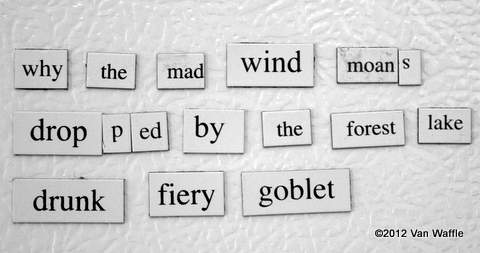
One of the great inventions of the 20th century is Refrigerator Poetry, little boxes of magnetized words with which anyone with a rudimentary understanding of grammar can make unfathomable stabs at Poetic Meaning or at least Colorful Descriptions of Nothing Much. For those of us with decades of practice and training, we can make (with enough words, including articles, prepositions and S’s) Art Sublime, or At Least Almost.

It is one thing to do this on one’s own refrigerator. In that case, you are the person responsible for all the lost articles and S’s, so if you can’t make it work, you have no one to blame but yourself (and possibly your roommates).

Much more fun is Stealth Refrigerator Poetry, which is when you go to a party and, when your Host is off Hosting, you steal into the kitchen and rearrange their words to be something sublime, humorous, useful, or at last resort, unfathomable. When it is someone else who is to blame for too much penury and not enough the, you can claim to be Tragically Limited by your Medium, with which You Did Your Best. It can help, if you know in advance that the party will have magnetized words, to wear a beret to the party. This is called Priming your Audience.

1f7147d17ee4e0c8d66b2eb09d23e9d4

Calvin Was Wrong, Mostly

bda93a302b5e01300649001dd8b71c47

While Hobbes was the Tiger of Reason, Calvin had the option to be the 8-year-old of Middle School (Il)Logic, hence his ideas about what made good writing. One of the most troubling things about teaching young people (and the younger they are, the worse it is) is that what you teach is not the same as what they learn. Hence, college freshman are still wedded to the Dread Five Paragraph Essay (like the Dread Pirate Roberts, except it actually does kill you in the morning. Every morning when you hand in a paper after fifth grade.)

As I face the hard fact of Fall Semester 2015, after having taught writing for longer than my incoming students have been alive, I hope to find a Hobbes-like way around the Calvin-like assumptions of my freshmen. Wish me luck, or, failing that, a really fast sled that can take the curves of the coming snow mounds!

Liebster Award!

I am honored to have been nominated for the blogging Liebster Award by Nicole from How to Fangirl for Adults. Go check out her blog! The Liebster Award is an award by bloggers for bloggers that is passed forward, and it has some other cool bells and whistles too!

liebster_zpsa4w1efp9

The Rules:

  • Thank the person who nominated you and post a link to their blog on your blog
  • Display the award on your blog–by including it in your post and/or displaying it using a “widget” or a “gadget”. (Note: The best way to do this is to save the image to your own computer and then uploading it to your blog post)
  • Answer 11 questions about yourself, which will be provided to you by the person who nominated you.
  • Provide 11 random facts about yourself
  • Nominate 5 – 11 blogs that you feel deserve the award, who have less than 1,000 followers (Note: You can always ask the blog owner this since not all blogs display a widget that lets the readers know this information!)
  • Create a new list of questions for the bloggers to answer
  • List these rules in  your post (You can copy and paste from here).
  • Once you have written and published it, you have to inform the people/blog that you nominated that they have been nominated for the Liebster award and provide a link for them to your post so that they can learn about it (they might not have ever heard of it!)

Nicole’s Questions

  1. If you had unlimited resources and time, what would be your dream cosplay or costume? Buffy the Vampire Slayer. I’d have said Xena: Warrior Princess but I am way to short to carry it off.
  2. Your current favorite song? “On the Road of Experience”
  3. Do you have any pets? If not, what kind of pet would you like to have? Yes, a tuxedo cat named Musashi.
  4. What is a movie everyone needs to have seen in their life? The Princess Bride. Crazy quotes for ever occasion.
  5. When did you write your very first blog post? Late last November.
  6. Do you write outside of blogging? If so, what do you write? If not, what do you like to do outside of blogging? Mostly poetry these days.
  7. Where is your favorite place to write? Coffee shops.
  8. What is your guilty pleasure TV show? Like that really bad reality TV and TLC type of stuff? Xena: Warrior Princess and anything Joss Whedon does.
  9. What is your number one fandom? (yes, you have to pick one) Xena, but I really want to BE Agent Carter.
  10. In one word how would you describe your blog? Diverse.
  11. What is the absolute best type of ice cream out there? Starbucks coffee almond.

11 Facts about Myself

  1. I lived in Japan for two and a half years, teaching English and studying kendo.
  2. On a good day I can write a sestina in one sitting.
  3. I have a mini Stonehenge in my office at MIT.
  4. I never know what to do with Kale.
  5. I still have a dumb phone.
  6. I went on Pottermore and got put into Ravenclaw.
  7. I alternate months of ridiculously productive writing with months like a vast Desert of No Writing Ideas.
  8. I have almost four octaves when I sing.
  9. I have never owned a car.
  10. I have never had a cavity.
  11. I looooooooves Boston.

My Questions

  1. What is your favorite book to reread?
  2. If you could be any hero, who would you be?
  3. What is the hardest part of writing for you?
  4. How do you avoid writer’s block?
  5. What movie would you watch if you were feeling down?
  6. Do you speak/read a second language? Which one?
  7. What do you like best about blogging?
  8. Spartans or Ninjas? Why?
  9. Captain America or Ironman?
  10. What is your favorite summer drink?
  11. What weird writing rituals do you have, if any?

My Nominations

  1. The Insightful Panda
  2. Bookminded
  3. Pop Cultured Randoms
  4. Pop Cult HQ
  5. Like Mercury Colliding

Teaching Writing

latest

So tomorrow I have to go to MIT and teach about clear writing. We are using a piece by Samuel Delaney about the difference between good writing, which can be learned by anybody, and talented writing, which is much harder to achieve. We also have a piece on writing for business and it talks about topic sentences and coherent paragraphs and all the thing one hopes they learned in fifth and six grades, but these days, who knows.

This is not the way I normally teach about writing as it feels very mechanical and I tend to feel more organically about writing. I also believe that most good writing happens during the second and third drafts of anything. People who get hung up about these sentence-level infelicities often have problems with their writing process, and trust me when I tell you that perfectionism is already a huge problem for MIT students. That’s how they got in. I spend an awful lot of my time explaining that they’ll never get out if they don’t give up that bad habit as soon as possible.

One of my mottoes is “Anything worth doing is worth doing badly the first time.” It’s true about cooking. It’s true about sex. It’s true about writing. Make a mess. Write crap sentences. Doodle in the margins when you don’t know what to write. Scribble notes to self like “brilliant transition goes here.” Take a break and make a sandwich. Get peanut butter on your hard copy of the draft. Lick it off. Read your work out loud, even if it makes you wince. Then go back in and fix the problems, over and over and over.