What You Always Cut

may

So yesterday I was talking to my MIT colleague Jane about–you guessed it–writing! I know you were expecting anything else from me, to wit:

  • My plan to join S.H.I.E.L.D. so I can learn to be a badass from Agent Melinda May
  • My cat, Musashi’s, plan to learn to play pingpong soccer like Pele
  • Our joint plan for world domination

It’s true, I have many plans. But mostly when I am not thinking about such things I am thinking about writing. One of the things I thought about quite a lot a while back was how annoying it is especially when I am writing nonfiction (insert loud sucking noise here), it always seems that there is a huge chunk that I end up having to cut before the end. Many writers I have worked with at MIT also experience this and they always want to know how to avoid what appears to be the wasted time of writing and then cutting this stuff.

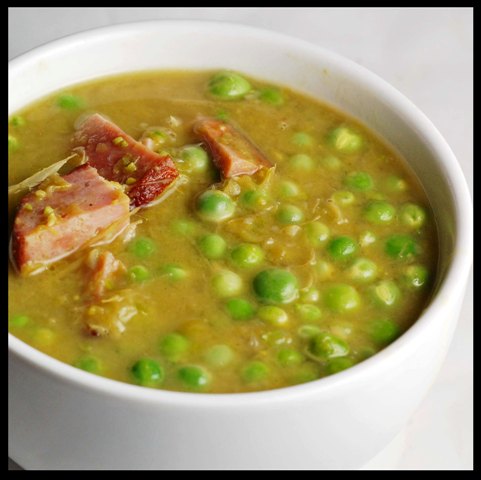
After a great deal of soul searching, cuz yeah, I apparently write at least in part with my soul, don’t know what that’s about, I finally realized that this part of the process, though it sucks in lo these many ways, is probably unavoidable. But then I think about my mom’s pea soup. See, she always puts a hambone in as it’s cooking. It adds a meaty, smoky flavor that I have never been able to replicate when I have made vegetarian pea soup. But when she serves the soup, she takes the hambone out. I figure that those annoying bits in the writing are like the hambone: they get you, the writer, to the ideas you need to keep but then no longer serve your readers and have to get cut.

????????????????????????????????????

That’s my two cents, anyway.

Words that only a writer could love

A brilliant set of fun words from Writer Chick! Which convenient, because I am short on ideas!

writerchick's avatarAnita Rodgers Mystery Writer

words
I’ve always thought that words were the coolest thing. As a kid (and now as an adult) my idea of a good time was reading dictionaries. For me, discovering new words – the weirder the better – was more fun than a box of bunnies.

I suppose that’s not much of a surprise – I don’t know any writer who doesn’t love words. Readers love words too. There’s a certain magic, a certain power in a well placed word – even if most your friends have no idea what you’re talking about when using it. In fact, maybe some of your friends and family have word shamed you – accused you of using a $20,000 word when a $3 word would do, right?

Following is a list of a few of my favorites:

Discombobulate: Don’t you just love the sound of that word? It conjures up pictures of machines deconstructing…

View original post 356 more words

JUST SO YOU KNOW…

I am working hard on a Brilliant Blogpost for the Soon, while being distracted by Emergency Disseration Proposal Editing Clients (EDPEC). I am saving a teeny tiny portion of the world in between epic-heroic poems and mildly amusing blogposts.

Because, as it turns out, yagottamakealivin’.

Who knew?

Negative Traits, Or, Is That What I Was Doing with That Character?

photo-31

So I was just reading Author Matt Bowes and the Dogs Breakfast blog (and I still have not figured out how the dog comes into the picture) and lately he has been talking about how you make characters more well rounded by, duh, giving them negative traits. This is an aspect I have never really given much thought to because I just find my characters fully formed in my head most of the time, so if they have those traits I run with it and often they do not and are unconvincing, but when you are writing fantasy, as I did for many years, we expect characters to be a bit larger than life, so you can get away with it.

But now that I am writing about Not My characters, e.g., Xena Warrior Princess, the negative traits come with the fully formed character. The thing I have been noticing is that it is the other characters who discuss the negative traits. Face it, especially during the first season, Xena is dismissive of anybody who is not an actual warrior. And throughout the first few seasons she has, as the characters in the Buffyverse would say, really honed her brooding skills. She often speaks in monosyllables and pretends the emotional things do not matter.

So my job is to somehow highlight those traits, which are for the most part lacks or absences with the possibly more positive traits of talkativeness and emotional availability/frustration in the other characters and, by contrasting those things, show the whole relationship. The cool part about poetry rather than fiction is you get to write lines like these from Gabrielle:

Life on the road is better. Even when

Whole days go by without her talking,

More is said than in weeks of talk back home.

Versus this from Xena:

And after, it was hard for us to speak

Of any of it. The silence between you and me

Crashed through the trees behind us like a kite.

Because, oh, the glory of the metaphor and abstraction to describe the bone deep emotions we all feel when the relationship is a struggle.

Inhabiting Homer

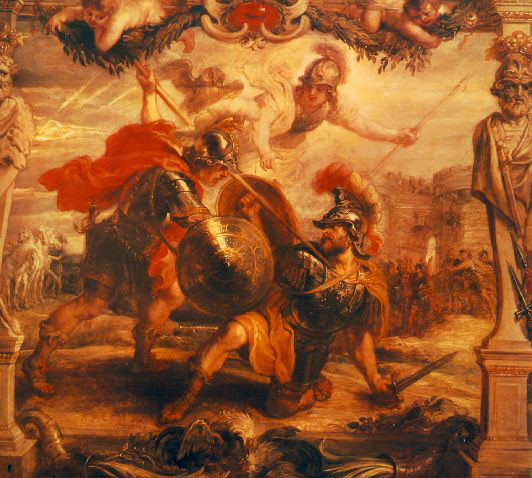
So I am thinking about writing about Troy, and I want to do it in a way that avoids pretty much everything Homer did with it. Who cares about the Muses, Agamemnon and Achilles? I want to figure out what Helen was thinking, and all those normal soldiers killing and dying in the shadow of the Great Hero Guys. I want to know what the Trojan horse was thinking and how the people of Troy had anything left to eat after the first two years.

Iliad_VIII_245-253_in_cod_F205,_Milan,_Biblioteca_Ambrosiana,_late_5c_or_early_6c

Also, I want to make it beautiful and dignified, so, yeah probably back to blank verse, that go-to meter of English poetry. And I want to say something about beauty and war and femininity and masculinity. And if I want to ever have the chance of getting published, it will probably need to be less than 50 lines long.

Slays_Hector

Easy peasy.

The Eternal Joy of a Funny, Brilliant and Humane Mind….Sir Terry Pratchett!

A timely top ten!

cirtnecce's avatarMockingbirds, Looking Glasses & Prejudices...

As the world knows by now, that Sir Terry Pratchett had a recent visitation from DEATH and in his language has “moved on”. I mourn his loss as much as other Pratchett fans and know that life on the third planet from the sun, without his wisdom, humanity and funny bones would simply be not the same. However knowing him, I do not think he would have appreciated ‘mourning’ and would have found much hilarity at the professed grief of folks who have never read his work, let alone appreciating it. He would instead read his true fans a riot act for being cast down when he was simply “getting on with things”. Therefore instead of doing an obituary post, I thought of blogging about some of best reasons why we all adored Sir Terry Pratchett and his Discworld!

  1. The Great A’Tuin and Discworld – Why? Give me one good…

View original post 995 more words

Political Poetry

So my brother just posted the text of President Obama’s speech at Selma, and reading through it, I was struck by how many poets he drew on to make his ideas clear and poignant. In particular, he is using them to tell us who we are as Americans, and although I feel very ambivalent about his championing the idea of American exceptionalism, I do like the idea of poets giving voice to the voiceless and telling truths that need to be told, strengthening people’s will to do good, necessary and difficult things. Here is a portion of the speech.lewis

We are storytellers, writers, poets, and artists who abhor unfairness, and despise hypocrisy, and give voice to the voiceless, and tell truths that need to be told…. We are the people Langston Hughes wrote of, who “build our temples for tomorrow, strong as we know how.”… We are the people Emerson wrote of, “who for truth and honor’s sake stand fast and suffer long;” who are “never tired, so long as we can see far enough.”… When it feels the road’s too hard, when the torch we’ve been passed feels too heavy, we will remember these early travelers, and draw strength from their example, and hold firmly the words of the prophet Isaiah: “Those who hope in the Lord will renew their strength. They will soar on wings like eagles. They will run and not grow weary. They will walk and not be faint.”

The Problems of Love Poetry

roses

Let me share with you an exchange of emails from 2004, and my later thoughts about the problems inherent in writing/reading love poetry.

To: PJS

From: SPIL

Re: Poetry

The good news: I am writing poetry again.

The bad news: It’s love poetry.

The other bad news: I can’t tell if it’s working.

Help!

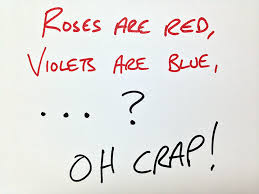
I recently (2005) came across a blurb for Irish poet Eavan Boland’s new book Against Love Poetry. Without knowing anything about it, I cheered. I have always respected Boland’s work, and the fact that she is tackling one of the ever-present problems of poetry—how do we write about love?—offered me hope because I too write poetry for publication (poets who don’t are likely to face different problems) and I recently fell in love.

What are the problems?

It seems to me that the three issues that arise are 1) defining poetry—its purposes and mechanisms; 2) considering the possible audiences—writer, general readers, critical readers, and the beloved; and 3) understanding the work of love in the creative process.

Defining poetry—condensed attention expressed in the most appropriate, elegant, and/or musical way possible, for the purpose of offering (to ourselves, to others) a clearer insight into human experience. This will do as a working definition for now.

Considering audiences is important because different audiences with different expectations (often expressed through or caused by “education”) will read the same thing in different ways. I think that the four main audiences for a contemporary love poem that might be published are the writer, general readers, critical readers, and the beloved.

Writers, I believe, write first and foremost for themselves. As a poet, I want to understand my own thoughts/feelings/experience, to express it for myself alone. Elegance, music, artistry, may or may not help at this level. General readers want a way to say what they have experienced, particularly if they don’t know how to express it themselves. Concrete details and sensory imagery (the heart of any poem) are the most important elements at this level. Critical readers expect a high level of intentional structure, style, craftsmanship, and artistry. They don’t just want to know how an experience was, they want to read the best possible, most clearly expressed, version of how that experience was. Only the beloved, the recipient, generally has no expectations, except that I don’t lie about him or to him, that I don’t embarrass him, and that I don’t make it so obscure that he doesn’t understand it.

Understanding the work of love in the creative process is probably the most difficult, in part because it is the most subjective. What is love? What is work? What is the creative process and why do we engage in it?

Poet and Novelist May Sarton wrote, “[A]ll poems are love poems…the motor power, the electric current is love of one kind or another. The subject may be something quite impersonal—a bird on the windowsill, a cloud in the sky, a tree” (Sarton 125). I think she is right on the money, and I might even add that all good writing is, in some way, love poetry, because the attention we pay to the details of the beloved, in this case whatever your subject is, leads to the kind of precise word choice that good writing always entails. You cannot write a love poem about someone you do not know well. You might end up writing an infatuation poem, because the details in the poem probably will say more about what you WANT the person to be than about what s/he really is.

In contrast, poetic attention can become a kind of communion. As our old friend Basho said, “Go to the pine if you want to learn about the pine, or the bamboo if you want to learn about the bamboo. And in doing so, you must leave your subjective preoccupation with yourself. Otherwise you impose yourself on the object and do not learn. Your poetry issues of its own accord when you and the object have become one—when you have plunged deep enough into the object to see something like a hidden glimmering there. However well phrased your poetry may be, if your feeling is not natural—if the object and yourself are separate—then your poetry is not true poetry but merely your subjective counterfeit” (Basho, qtd. in Yusa 33).

To: SPIL

From: PJS

Re: Poetry

SPIL WROTE:

The good news: I am writing poetry again.

            great!

The bad news: It’s love poetry.

            uh-oh

The other bad news: I can’t tell if it’s working.

            Uh-oh again. If not, there’s always voodoo! (Siska)

In the end, that particular relationship went the way of the Dodo, and I decided that even Voodoo was not going to save it. But my friend was not wrong when she interpreted a working poem as being like ritual devotion/magic. As the artist Peter London wrote, “For the primal image-maker, craft was not in the service of beauty in and of itself. Instead, craft was in the service of power. The more carefully wrought the object was, the more powerfully the object would serve as an instrument of transformation and…the gods would be inclined to honor the supplication” (London 9).

Happy Valentines Day, folks. Especially if you are not in a relationship. Hell, we need it more.

mqdefault

London, Peter. No More Second Hand Art. Shambhala, 1989.

Sarton, May. Mrs. Stevens Hears the Mermaids Singing. New York: Norton, 1965.

Siska, Pamela. “Re: Poetry.” E-mail to the author. 9 Sept. 2004.

Yusa, Nobuyuki. Introduction. The Narrow Road to the Deep North and Other Travel Sketches. By Basho. Trans. Nobuyuki Yusa. Baltimore: Penguin, 1966.

A Turn in the Conversation

convo

Well, I have been rereading my previous posts and I feel a little like you sometimes do at a party when some poor innocent stranger asks what you do and, in your enthusiasm, you talk their ear off until that blessed point (from their point of view) when you suddenly notice the glazed look on their face and you turn the conversation to them (this also allows you to take a bite of your canape or a sip from your drink: enlightened self-interest).

So I know the things I would like to talk about in this blog and I have a list of other things I want to cover eventually, but here is a question for you, O GENTLE READERS: What questions do you have about poetry? What topics make you curious or annoyed? What forms are you interested in? What poets have you read? What kind of poets would you like me to recommend (or warn you about)?

Let me know in the comments section, and I will squeeze in requests between my small, humble, illustrated rants.