My Boys, Wilbur and Orville

pic_giant_052715_SM_Orville-Wilbur-Wright

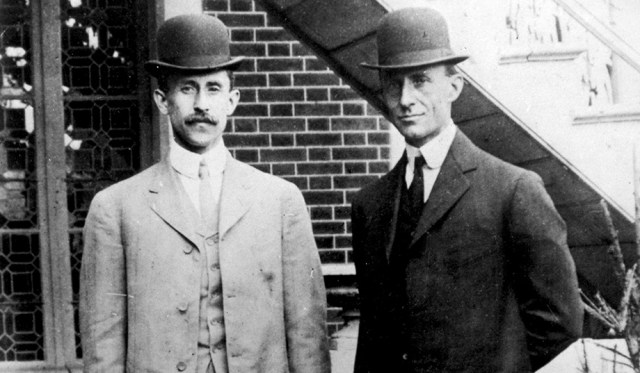
So 112 years ago the Wright Brothers made the first successful airplane flight near Kitty Hawk, North Carolina. A while back I wrote an oratorio about their process and I even had a composer who was working on it, but then we kept having our planned meetings go strangely awry—buses that were an hour late and the like—so I have actually never heard the music she wrote for it. Anyway, here is a taste of my attempt to capture their voices.


Finding Wind/Kitty Hawk Tango Baritone/Wilbur


When I sought for a safe place to practice

To learn the aeronautic riddles of flying,

They sent me to stand on a stretch of sandy land

In Kitty Hawk, North Carolina.


The abode of mosquitoes and buzzards,

A clime either roasting or raw,

A suitable location

Fraught with vexation:

I found it at Kitty Hawk.


I desired to make tests meticulous

In winds exceeding fifteen miles an hour,

Even quicker gales are here ubiquitous,

Enough to make a bold man cower.


The sand drives forth like an army

Over the hills and the flat.

The winds that rattle the tent

Are grand for experiments

But you’ll want to hold onto your hat!


If you desire a wind continual,

A place for vying with your flying machine,

The unbroken wind of the Kill Devil Hills

Will shrill and splinter your dreams.


I pity you, sir, for a coward,

If you dislike the picture I draw:

A land riddled with erosion

Betwixt Sound and Ocean:

Where I build my camp at Kitty Hawk?
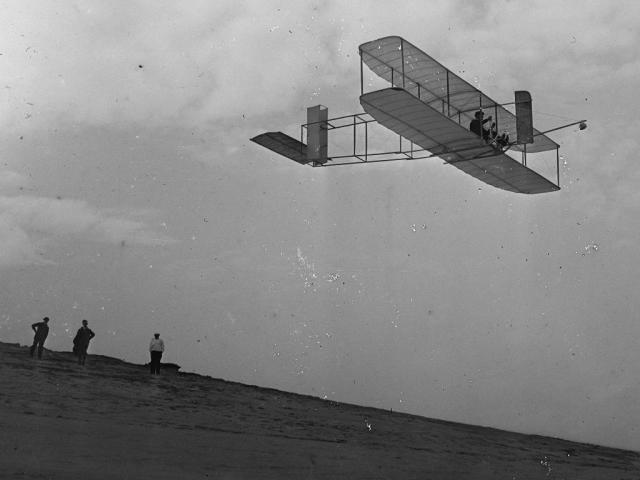
1911_Wright_Glider

How the Birds Rise Tenor/Orville


Consider the owl,

The predator of night,

Who glides through the darkness,

Keeping the field mouse in his sight.

And then he dives down

Without disturbing the air.

The mouse is carried aloft

And never knew the owl was there.


And I am left to ponder

Mother Nature’s wonders:

How the owl glides,

How the stars sing,

How the birds rise.


Now consider the gull,

The scavenger of day,

Who sails across the morning

And her flying is play.

How she turns on a wingtip!

How she soars without a care,

Calling out her jubilation

Carried on ascending air.


And I am left amazed

At Mother Nature’s ways:

How the gull soars,

How the sand stings,

How the birds rise.


Now with the wind I sing,

I will learn to fly

As the owl glides,

As the gull soars,

As the birds rise.

Truth and Truths

In his book, The Things They Carried, Tim O’Brien writes about the Vietnam War (because he almost never writes about anything else). He discusses the difference between factual truth (the things that really happened in Vietnam) and emotional truth (the story of what happened that readers can actually take in). I think of this because I have been thinking about Emily Dickinson’s poem:


Tell all the truth but tell it slant —

Success in Circuit lies

Too bright for our infirm Delight

The Truth’s superb surprise

As Lightning to the Children eased

With explanation kind

The Truth must dazzle gradually

Or every man be blind —


I also think of this because of all the writers I love who have used fantasy or science fiction or even comedy/horror to tell truths that are difficult to communicate directly in a straight documentarian kind of way. Fantasy frequently helps us talk about religion and moral values: good vs. evil. Science fiction interrogates our fears about the uses and abuses of technology. Horror can illustrate a more manageable or more laughable version of social fears: vampires demonstrate class warfare, werewolves our discomfort with the wild vs. the domestic, zombies our feelings of incipient chaos. Perhaps all of literature is in part telling the truth at a slant so that it catches the light in a more meaningful way.


Emily Dickinson, “Tell all the truth but tell it slant.” The Poems of Emily Dickinson: Reading Edition. Ed Ralph W.  Franklin. The Belknap Press of Harvard University Press, 1998,

All I Want for Christmas, or Mrs. Claus Has Her Work Cut Out for Her This Year

15353939253_7ddfdf25b2

My two front teeth. Check. 1978

Somebody to lean on. Check. 1985

Just a little more time. Check. 1992

You.

The abolition of imperialist white supremacist capitalist heteropatriarchy.

A self-cleaning litter box.

A hard-boiled egg.

And a cup of coffee.

keep_calm_by_focusing_on_hard_boiled_eggs_11_oz_magic_heat_color_changing_coffee_mug-rfd722f4875cf44f88ebe438d17484883_x7j1x_8byvr_324

Preparing for Christmas in a Changing Climate

plain door wreath 450

Fall has been lingering this year. Normally, cold weather in Boston starts at the beginning of November, and by “cold” I am thinking below 40 degrees Fahrenheit, the temperature at which I begin to consider locating my long Johns. The first (usually uneventful) snowfall tends to be between Thanksgiving and the start of December. Not this year.

I’ve heard people say how “lucky” we’ve been with the mild weather, but in my book if the weather is routinely 20-30 degrees different than the usual temperature not for a day or a week but for (so far) a month and a half, that has got to be a bad sign. It also means that I have had a hard time accepting that Christmas is really on the way. I keep forgetting to pick up the wreath I usually put on the inside of our main door (trees don’t work in a small apartment with a large cat).


Now as the high glaciers melt into green

Ocean water, rising, rising, now when we look up

Expecting the water to fall in flakes for hungry tongues,

Now the sky is grey and strangely warm.


Unseasonal, that’s what it is. The nights are long

Just as you might expect, but the air lacks crispness,

The blue of the afternoon sky lacks snap. I cannot say

I feel lucky. Even after nine feet of snow in Boston,


Which only finally melted six months ago, I fear

What might be coming: either ten feet this winter, or,

Possibly, none at all. Either way we lose. Already

Polar bears are drowning for lack of arctic ice.


Already small Pacific islands are losing ground

The way an old man loses hair: a little at a time,

Then all at once. It’s the opposite with the stores,

Switching the candy and hangings from one holiday


To the next overnight and at least three weeks early.

I cannot make that transition at all this year. So much

Worry about the Earth, not enough glad tidings.

Too much grey and drear, not enough merry and bright.


In the face of this, I force myself to find a small, green

Wreath for the inside of my door, to dangle small golden

Pigs—for abundance—a red bow to remind me to take

The bull by the horns and face the absence of winter


And the endless presence of winter, both living in me

As I move through the warming world feeling colder

Now than I ever felt as a child in a snow fort. Courage,

Says the angel in the branches. Embrace hope.

Yelling “Theater!” in a Crowded Fire

images

Writer’s block is a thing like when you sit down on the train and realize that you have just stepped (in your brand new shoes) into the sticky residue of someone’s spilled soda. And you think, well, heat melts sugar, right? So if only the curtains of my imagination were on fire, I could pull myself out of this urban transit tarpit and actually create something.

Badass Women in Combat Gear, #5 1/2

So last month when I put our Eliza Dushku as our BWCG #8, our buddy Heylookawriterfellow commented, “Is it wrong for me to request a badass woman who wears glasses? Ahem. Perhaps I am revealing too much about myself.”

At the time, I thought, well, in both the DC and Marvel comic-verses, mainly the heroes wear glasses when they are undercover. Diana Prince and Clark Kent take off their spectacles to be come Wonderwoman and Superman.

Agents of SHIELD and Agent Peggy Carter also put on their glasses when they don’t want to be recognized, and we all know how effective that is. And the Dushku also wore glasses in the pilot for Dollhouse as a part of her new persona.

dushku_dollhousepriemiere_featured_photo_gallery

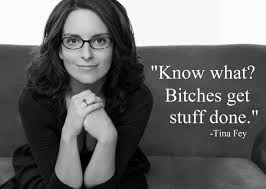
So I thought and thought until I came up with an actual badass woman in combat gear superhero who actually wears her glasses as a superhero. Heylookawriterfellow, I have found one at last: Tina Fey. You’re welcome.

images-1

Writing in the Body: A Feminist Reminder

31tapkPvrML

Working at MIT, I meet a lot of people who seem to think they are brains with big Mickey Mouse gloves: the ideas go zip-zap straight from the synapses in the grey matter to tippetty-tap on the keyboard. This is, unfortunately, not the case. Ergonomics matter because we write in the body. If your body is uncomfortable, then your brain will be uncomfortable and distracted, and that will affect your writing. If your seat is too low or too high, or worse yet, if you are doing that laptop in your lap thing, then you are in a suboptimal position. You can sustain that for a little while, sure, the same as you can sign a form on someone else’s back, but that doesn’t mean you want to write a novel that way.

This probably sounds obvious if all you are looking at is biokinetics, the body working as a machine for productivity. If you treat a machine better, then you will probably get a better product, and possibly even a more consistent product. That is the capitalist, patriarchal way of looking at this subject. I prefer a more ecological, feminist way of looking at it.

Rather than thinking of writing as production for some kind of profit, let’s think about it as reproduction, pulling the seeds out of ourselves to let them bloom and flower in the world, to encourage other people to do the same. Perhaps this metaphor is on my mind because yesterday was Veteran’s Day and that reminded me of the phenomenal art installation constructed at the Tower of London last year to commemorate Britain’s entrance into World War I: Blood Swept Lands and Seas of Red. Art doesn’t have to imitate other art to be inspired by it.

800px-Blood_Swept_Lands_And_Seas_Of_Red_IMG_1745

More importantly for me as a feminist, the idea of writing in the body and from the body is a way to revise (literally, re-see) a problematic trope in Western culture, that (mental) discipline equals (physical) suffering and that this is potentially a good idea. St. Paul wrote about the “thorn in the flesh” (2 Cor. 12:7-10), the pain that keeps us from getting above ourselves, the pain that keeps us from hubris, pride, equating ourselves with the gods or G-d.

This started with the Greeks and the Christians took it and ran with it. And while in certain cases, human pride is absolutely a major problem, particularly when it is coupled with anthropocentric economic policy and action, for a lot of people (especially members of marginalized communities) the real problem isn’t pride so much as shame. The history of overvaluing the mind and denying and devaluing the body is deeply entwined with the oppression of women, minorities, nonhuman animals and the Earth. So when we take care of ourselves while we write, when we treat our bodies with respect and gratitude despite whatever hellish deadlines we are up against, we are engaging in a feminist practice that we can take out into the world in other ways.

Five Fascinating Facts about War Poetry

Some fascinating tidbits on war poetry from our friends at Interesting Literature.

InterestingLiterature's avatarInteresting Literature

Facts about the war poets and their poetry, as well as other links between poetry and war

1. The link between poppies and war remembrance dates from the Napoleonic wars, when a writer noted that they flourished over soldiers’ graves. As The History Press website notes: ‘there are several anonymous documents written during the Napoleonic wars which noted that following battle, poppies became abundant on battlefields where soldiers had fallen. These same sources drew the first documented comparison between the blood-red colour of the poppies and the blood spilt during conflict.’ The association would be popularised during the First World War, especially by John McCrae’s poem ‘In Flanders Fields‘ in 1915.

View original post 597 more words