Testosterone Thursday

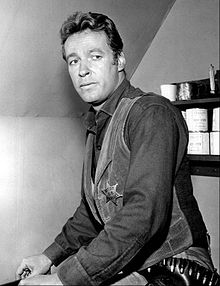
220px-Russell_Johnson_Black_Saddle_1960

So looking back at my blog today I realize that it has gotten rather estrogen-soaked, which is a shame, since it is summer, which is Buff Men Jogging Without Shirts Season (and you know how loosely I define poetry), and we really ought to take advantage of that. I was thinking about the evolution of my taste over the years, as portrayed in popular culture. As a girl, I watched Wonder Woman and Gilligan’s Island, so I had huge crushes on Lyle Waggoner (Steve Trevor) and Russell Johnson (The Professor): square-jawed American men, hard-working and smart.

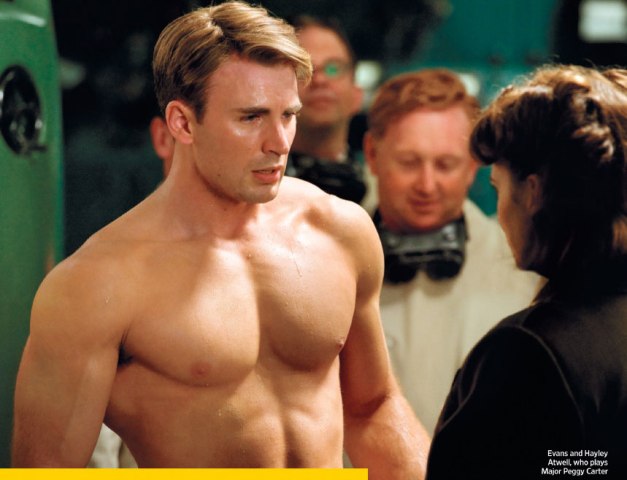
More recentimagesly, I appreciate eye-candy like Daniel Craig (James Bond, etc.) or Chris Evans (Captain America). Strictly speaking, I suspect this is actually devolution. Apparently I was focusing on the right things back then and have gotten away from it since. Although the new Bond isn’t the sexist pig that most of the others have been, and Cap still has some of the better of the 1940s values (“Language, people!”) while also being a feminist.
daniel-craig-2

That’s what I am going with anyway…captain america 29oct10 02

My Apparent Thing for Rhetorical Questions in Poetry

xena+meme

So I am still working on my epic poetry about Xena: Warrior Princess, and I have started to notice some patterns, which I have noticed in my work before, but since this is (so far) a 260+ page project on a single subject, I am noticing them more now. One of these patterns is the use of rhetorical questions, which I think I use to show how the character of the speaker of a particular poem is either wrestling with a problem or coming to a solution, or just my capturing their voices. These I took just from the (so far) 54 pages I have written about Season 5.

.

Eli (Read: Jesus/Gandhi)

You let me heal the broken,

But what good is that gift if I cannot stop them from being

Broken in the first place? How does fixing the problem

Afterwards solve the problem? Why did you give me this

Troubling gift and what do you expect me to do?

.

Gabrielle

How can we live in a world in which

Fear is stronger than love? But how can we protect love

Without fighting for it?… She says, “Why don’t we all

Just walk away?” But is that even an option anymore?

.

Ares

Remind you of any particular Roman warlord? Yes, I do use this

Line on all my warlords, but it’s true I used it on you first.

.

Talia

Why are we never prepared for the surprise,

For the consequences of dalliance or domination?

Why are we never prepared for love and its confusion?

.

Xena

Her easy smile, her trust, how will I win those back?

.

Xena

I could pretend to be humble, but

What purpose would that serve?

.

Xena

What is it about rabbits?

What is it about her and these young men?

.

Gabrielle

You don’t think after four years as her sidekick

I would not recognize the heroic moment when it comes?

How many times now has her soul left her body?

How many times have I had to fight to keep her safe?

.

Athena

But how could a single god take care of all your needs?

How can a god that preaches love manage a world

At war? How can a foreign god come to our Greek soil

And reign over our people?

.

Ares

Mongolia? The Battle of Corinth?

I was always a fan.

.

Athena

Hestia, as always, focuses on the wrong

Thing, muttering in despair, “Isn’t anybody a virgin?”

And the family, as always, ignores her.

.

Xena

Why not fruit? Why not my body?

Why can’t I use both as weapons of opportunity?

suicidal

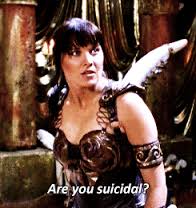
So talk to me, peoples, how do you feel about rhetorical questions in poetry? And also, this, because it’s one of Lucy Lawless’s cuter expressions.

dowhat

One True Pairing

lady-liberty

Mercy and truth are met together; righteousness and peace

have kissed each other. Truth shall spring out of the earth; and

Righteousness look down from heaven. Yes, the Lord shall give

that which is good and our land shall yield its increase.” Psalm 85: 10-12

Yesterday the streets of America rejoiced, our streets running red,

Orange, yellow, green, blue and purple. In San Francisco and

Provincetown, in Boston and Chicago, and in the center of Times

Square, Liberty and Justice kissed. Though long denied, denigrated,

Marginalized and ostracized, our brothers and sisters, children

Of God, have finally come to stand in all their long dignity beneath

The banner of Love. Justice, long blinded, was surprised, I expect;

She probably didn’t see this one coming. But Liberty, leaping down

From her pedestal where she usually stands firmly on the broken

Chains of slavery, knew it was time for rejoicing. Every victory

Of Justice deserves celebrating. Every victory of Love requires some

Token. Only thus can we keep on with the battles that still lie before

Us: so many others pushed away from the table, so many others

Handcuffed and beaten, so many others hungry and held down.

So yes, let us celebrate this victory, this One True Pairing, with joy

For all the loves and lovers redeemed, and gather our strength.

That a Woman Can Stand Up

carter

In Ester Forbes’ classic young adult novel, Johnny Tremain, the protagonist, Johnny overhears a meeting of the Sons of Liberty in 1773, where James Otis says, “We give all we have, lives, property, safety, skills . . . we fight, we die, for a simple thing. Only that a man can stand up.” Though I read that book for the first time maybe 35 years ago, that line has stayed in my head ever since. I thought about it recently, when I read the two blogs I reposted about Agent Peggy Carter.

I have been lucky not to have to deal with much overt sexism throughout my life. I recognize that as an overeducated middle class white woman doing a relatively “female” job (teaching English), I may have an advantage that other women don’t have. As we have seen with the recent tale of the Nobel Prize-winning sexist idiot who called women in the lab “distractions,” sexism hasn’t gone away and probably won’t any time soon. But it is another reason why we need shows like Agent Carter, to remind us of the time when women had to put up with that kind of bullshit all the time. We remember what our mothers, grandmothers, great-grandmothers, etc. fought for and we sign on for the fight too.

Because it isn’t only sexism. It’s racism, classism, homophobia, me-first politics and religion, and all the other intersecting forms of institutional oppression. And the people most hurt by each of these problems, and that may well include us too, need us to stand up and fight so that others may stand up. But how do we do that? Well, when I went to seminary the first class we took was on anti-oppression, and it required us to face our own isms and untangle them, admit to them, and start habits that would help us stop doing some of the things, having some of the thoughts, that lead us into participating in the oppressions. It’s hard work. You will disappoint yourself more often than not.

keepcalmcarter

So how do we find the strength to fight this battle? Well people like King and Gandhi found religion/God helpful. That can be good for some, although for others sometimes religion has only taught them to be ashamed of themselves, not to respect themselves. So I also like how popular culture heroes, and the writers behind them, offer us a line here or there that is just jam-packed with wisdom. In the last episode of the first season of Agent Carter, we see Peggy jump all the hurdles with her many skills: hand-to-hand fighting, code-breaking, shooting, parachute jumping, and most of all a crack brain and a big heart.

At the end, when one of her so-called “superiors” at work takes all the credit for Peggy’s efforts, another colleague asks her, “How can you just sit here and take that?”

She says, “I don’t need a congressional honor. I don’t need Jack Thompson’s approval or the president’s. I know my value. Anyone else’s opinion doesn’t matter.”

value

And that could just be a single line in a single episode in a single season of a single show. But it is going beyond that. Because when Hayley Atwell goes to ComiCon and other nerd-fest conventions and people ask her for advice on being strong, facing sexism and other oppressions, she tells them, “Know your own value.” And I just bought a T-shirt with her image on it and the phrase, I know my value, because although I do often know my value (thank you, many years of therapy), I also often forget and need a reminder. And this is what characters like Xena, Buffy, and Agent Carter fight for, inside the stories that transfer from TV to our heads: that a woman also can stand up.

Tribal Connections

tribe

Somewhat appropriately for Mother’s Day, I was going back to something Writer Chick wrote in her blog a while back that interested me. She said:

“The idea here is that a writer or otherwise creative entrepreneur type person needs a tribe. A group of people so dedicated to them that they spread the word. Offer support. Pledge undying loyalty to the person, their products and/or their brand. Now aside from family, which I think is actually a tribe of sorts, isn’t this a little bit weird? Even your group of friends could be a tribe, I guess. Or your co-workers. But like total strangers?”

To my mind what she describes here is not a tribe. It is a fanbase. A tribe does not promote you; it supports and protects you, perhaps, or shares your particular brand of weirdness, or loves what you love or speaks a shared language. So Middlebury College alumni, who speak at least two languages and have traveled abroad and let it change them, broaden their minds, etc., are one of my tribes. Whedonistas (lovers of Joss Whedon’s prolific oeuvre) tend to be one of my tribes. Peaceful martial artists are one of my tribes.

For my money, your tribe is not there to promote you like a rock star. They are there to understand you when no one else does, to finish your sentences even when you think you are not communicating clearly, and to love you for your oddities, not despite them. Anyway, that’s what I think. What do you think?

Sticking the (Stylized) Landing

the landing

So the other day I wrote about my poetry midwife, Pamela, and how she has helped me, particularly in learning to pay close attention to the endings of my poems. I remember being at the Bread Loaf Writer’s Conference way back in August 1988, back when I was just a Writer Niblet, the poet Nancy Willard said, “Poetry is like bread. You can smell when it is done.” That may very well be true. But that is also assuming that you mixed the dough correctly and that all you need to do is add heat for a specified amount of time. Sometimes the ending comes out messed up because you messed up the start, so you can’t simply do a closure-style ending like a circle. Or you messed up the middle, which I think of as the Airplane Mistake, because if an airplane pilot is only one degree south of where she should be on her trip from Boston to Oregon, she may well end up in Los Angeles or worse.

I think of this in particular because I have been watching Agents of SHIELD lately and awaiting Joss Whedon’s Avengers: Age of Ultron. One thing I have noticed about the Marvel Cinematic Universe is how stylized a lot of the action is, in particular the dramatic landings. The person you see this most clearly with is Scarlet Johansen’s Black Widow, but you also sometimes see Agent May do this too.

may landing

The Urban Dictionary defines sticking the landing as meaning to “execute flawlessly from the beginning through the end. Follow through.” (“Stick”). The phrase originates from gymnastics. “When a gymnast lands a tumbling pass, vault, or dismount without moving his/her feet, it is called a stuck landing. The aim of every gymnast is to stick–if the gymnast moves his/her feet at all it is a deduction” (Van Deusen). More generally, it has come to mean “to finish an athletic, gymnastic, or other sports performance with an ideal pose or stance, especially after a jump or leap; (hence, also outside of sports) to do or finish well; to win” (Barrett).

I like the idea of an ending that is stuck solid to its foundation, unwavering. I also think that finishing well should not by necessity entail winning. Think about the 35,000 people running the Boston Marathon last month. Four won and 34,996 did not, but I imagine the goal for all but 100 was simply to finish well.

For a poem, this may mean you have an ending that quivers in the air in front of you shimmering with beauty. That is, often, the goal. But more often I think it is that you learned something from writing the poem and perhaps your readers have learned something from reading it.

Barrett, Grant. “Stick the Landing.” A Way With Words. 3 Feb. 2006. Web. 1 May 2015.

“Stick the Landing.” Urban Dictionary.com 21 Dec. 2006. Web. 1 May 2015.

Van Deusen, Amy. “Stuck Landing.” About.com. 2015. Web. 1 May 2015.

Post-Modern Quilting Zeitgeist

ironman

My roommate, Jack, is, among other things, a filmmaker. So far he has made at least three short films in the apartment, which generally means that all the furniture that was in one room ends up in another for about three days. And the cat is intrigued. When he is not making films here, he is usually making films elsewhere as he and his peers all serve on each other’s films in different capacities. Aside from being a fascinating study in collaboration, this situation means that my cat frequently gets to take over his room when he is not around, and Musashi is very much for that.

When he is around, Jack tends to start conversations about writing that last for a couple of hours, usually starting with the words, “So, do you think…?” Last night, when I came home very late (thank you, Massachusetts Bay Transportation Authority, for failing us yet again!) after a lovely dinner of Chinese food with my poetry midwife Pamela (the one I can always count on to tell me whether the ending of a poem sucks; apparently the ones I showed her yesterday do not; Huzzah!), I found Jack actually cutting up VEGETABLES for his dinner.

In my sheer amazement at this, I got into a conversation with him that lasted two hours, largely about Post-Modernism and the death of opportunity for artists to make anything new, since we are all just rehashing what has been done before. Part of this is in regard to an ongoing conversation about my rewriting the Xena narrative, which I would argue is, yes, rehashing, but rehashing to change the world, or at least myself, which is the only way we ever start changing the world, after all.

We were discussing, among many other things, the coming reboot of the X-Files with Gillian Anderson and David Duchovny, the coming Batman vs. Superman movie (link to the retro trailer) and other rehashings of popular culture, and he was bemoaning (no, really, he was: and how often do I get to use that word?) the state of our culture and how if we only redo what we did we will not have the time, money or energy to do new things.

He is not wrong, but I do argue that this is, if you will, not the whole story.

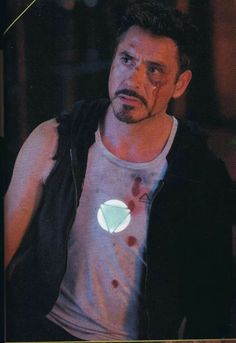
He described how he sees humans, with our technology that allows us to see millions of miles into space, fly at hundreds of miles per hour, and delve deep into the Earth, as godlike. But it is, as one of his friends phrased it, a prosthetic divinity. We can only do these godlike things with our fancy tools. And with those tools we can do great good or great destruction.

“Yes,” I said. “And that is the story of Ironman.”

Eventually, we agreed that archetypal stories have their place in human meaningmaking and identity production, and that as artists we can only be very intentional in what stories we tell and what stories we consume (read, watch, try to live into…).

In Which Our Hero Learns Nifty New Pop Culture Slang

I dedicate this post to my sister, Michelle Spilecki, whose birthday it is today.

sm

So over the weekend I learned a catchy new abbreviation and the idea that goes with it: OTP, One True Pairing. Think about some of the TV pairs from the last twenty years. These are just the shows I watch. I am sure you could come up with plenty more yourself, especially if you are more of a Zombie Apocalypse kind of individual.

Scully and Mulder

Buffy and Angel

Booth and Bones

Castle and Beckett

Phil and Melinda

Carter and Martinelli (or Sousa, if you prefer)

Xena and Gabrielle

These are all pairings in which the chemistry between the actors almost immediately got conveyed to people who were prepared to see it. When I think about The X Files, Buffy, and Castle, in addition to Xena: Warrior Princess, I would argue that in the pilot of each series you see the kind of chemistry before the end of the episode.

ba

I think one of the things that makes these shows so effective is that most of the pairs develop their relationship–their knowledge of each other, their professional and personal respect for each other, how they work together and when they give the other person space or slap them upside the head (usually metaphorically)–on the job, working to make the world a better place.

booth-and-bones

I have often observed that some of the solidest seeming marriages were between two people engaged in one or more complex, long term projects together: leading a church choir, producing community theater, things like that. Raising children together is not the ideal project for marriage building, simply because at some point your project learns to, for example, talk, and then express her/himself, and often what s/he might be projecting is disagreement with one or more of the aforesaid partners in the marriage. In comparison, plays and concerts don’t talk back (although to be fair, actors, singers and the like often do, although as they are not part of the marriage, even if they are part of the family, it does not matter as much). Anyhow, that is what it seems like to me.

So a friend was writing about OTP on her blog an I saw it and thought, as one does, Huh? So I asked her and she said:

One true pairing.  As in, “Xena and Gabrielle are my OTP,” or, “Gabrielle and Xena are OTP more than any OTP in the history of fiction, and if you don’t see it, you’re crazy.”

Which makes sense. One of the big problems I see with all my favorite pairs is that they are never completely equal. One person, usually the man, is a little better, smarter, stronger, more… Part of that is how the star billing goes. Part of that is our culture. Part of that is our culture running how star billing goes.

But even on something like Buffy, whose two main squeezes were superpowerful vampires, well, Angel couldn’t be around her without problems, so their equality was made out to be impossible. And Spike was morally her inferior (that whole century of killing sprees thing not followed by a quest for redemption as Angel managed). So they were only equal at fighting not at being in the world and making decisions about good and evil, until really close to the end. And when Spike finally did something to redeem himself, he blew up hell and died with it. Whoops. One more sorta equal relationship bites the dust.

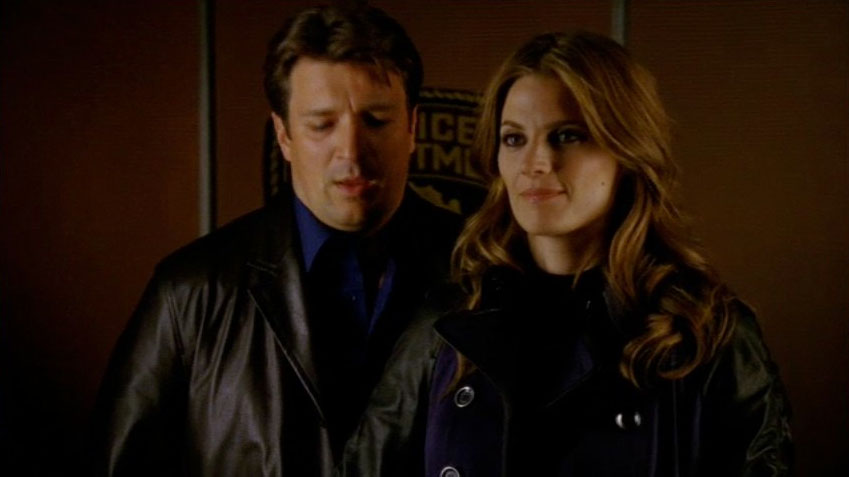
I think what they are doing on Castle is hopeful, with Stana Katic as Detective Beckett matching wits with Nathan Fillion and frequently taking on the more physical roles, but we will have to see how that goes. Hell, the fact that they are so much more often casting women who are five foot nine, and then putting them in four inch heels so they are as tall as the men, goes a long way toward changing how we see women as possibly strong and still lovable. But there is still a sense of women’s sphere and men’s sphere as different and probably not equal. Once Bones had her baby, she stopped going out into the field.

castle_after_the_storm_elevator_flirting_castle_beckett

In comparison, what we see with Xena and Gabrielle is two people who start with a very uneven friendship, and end up, six years later with one of the most equal, solid friendships/ partnerships I think I have ever seen on television. I think we would all like a relationship like that. And to some extent I think one reason we often watch these shows is to try out what we think we want and see whether it works. Some writers serve their characters better than others, and we love best the ones that not only show the chemistry and respect between the pairings, but also resist the inorganic cultural forces that try to bend the relationship into an old familiar pattern at the risk of the relationship.

Because, you know, mystery babies are NEVER a good idea. And I would love to see more of Philinda…

Phil-Coulson-Melinda-May-image-phil-coulson-and-melinda-may-36097307-500-356

How Line Lengths and Breaks Might Convey Voice

tumblr_lxdwjjKKUr1r9gjy7o1_500

So the other day, I went back to a poem I had started about Callisto, Xena’s arch-nemesis. This one is about episode 2.7 Intimate Stranger, where Xena and Callisto get their bodies switched by one of the gods, primarily because Lucy Lawless had broken her pelvic bones in a fall from a horse she was practicing stunts on for the Tonight Show. It was a great choice, not only because it is always fun to see characters we know switch (Enver Gjokaj is a genius at this; check out the Joss Whedon series Dollhouse), but because it pointed out how similar these two women are. With the right (or wrong, really) set of circumstances, they actually could have been each other: Callisto the warlord who set a village afire that would turn the orphan Xena into a psychopath. We like them better as they are, because let’s face it, Callisto is the BDVE (Best Damn Villain Ever), with her creepy line delivery and spidery physicality.

So anyway, I wrote version 1.0 below and did not think much about it. But then I was looking at the previous poem I wrote about Callisto, with the first two lines:

“As children we come to experiences bone to bone,

with no kind skin to muffle the uproar. Imagine:”

I realized that the new poem was at least a full inch thinner, 2 1/2 inches, than the old one, which has line lengths of 3 1/2 inches. Well, the thing is, at 5’ 8” and 120 pounds, one of the first things you notice about Hudson Leick is how thin she is, an impression fostered by her costume being even more revealing than Xena’s, especially at her midsection.

Know Your Enemy, Know Yourself: X. Reflects on C., v.1.0

In the night season, I dream memories

Misremembered, death in the form of

My perfect nemesis, a woman born

In the fire that killed her family. She is

Me. And I did create her as she claims,

Though it was not my hand that lit

The spark that tore her world away.

She revels in her pain. I did that

Once, as she does, and spread it

Far and wide: if I suffer, so too must

Everyone. I will wring out the world

Like a map weeping blood. I am

Her now, our minds and bodies

Switched by the gods in their infinite

Unfairness. My enemy is me. I look

In the river and the body that I know

Does not look back. She promised

Once to take away everything

I loved, my friends, family, horse,

Reputation, everything it took me

So many years to win back.

Now in her body I must race

Against time, again, to stop her.

Both of us suffer from my monumental

Guilt. Like a crashing wave, once

It starts, there is no stopping it.

So then I thought about a poem I wrote many years ago titled Cancer Barbie, using the image of a Barbie whose hair as been loved off, a là The Velveteen Rabbit, to talk about cancer as I have seen friends experience it. Given that the image is Barbie, the shape of the poem really matters, so I tried to make a poem about Barbie look like Barbie, to wit:

Cancer Barbie

for Jackie, Anita, Judy

Some

little girl

has loved

this doll

completely, loved her

long blonde hair

right off

just the

way these

chemicals

coursing

through

your body

love you down

to the very follicle

love you right

all

the

way

down

to

your

roots.

 …

At first, I thought I could do a similar thing by centering what I have here as version 2.0, but it ended up looking like, depending on how generous you want to be, a stubby gingerbread man or something my cat coughed up. So forget the centering. What the erratic breaks and short line lengths do is to make the voice of the speaker, in this case Xena inside Callisto’s body, sound more erratic. I can’t decide if the body you are in should decide your voice or if it is only the mind. In that case, I should go with Version 1.0 for this, but if I find a way to write a poem using Callisto’s voice, regardless of which body she is in, I will totally use this style. So let me know: which do you prefer, version 1.0 or 2.0 and why?

Know Your Enemy, Know Yourself: X. Reflects on C., v.2.0

In the night season, I dream

memories misremembered,

death in the form of

my perfect nemesis, a woman

born in the fire

that killed her family. She is

me. And I did create her

as she claims, though it was not

my hand that lit the spark

that tore her world away.

She revels in her pain. I did that

once, as she does,

and spread it far

and wide: if I suffer, so too

must everyone.

I will wring out the world

like a map weeping blood.

I am her now, our minds

and bodies switched by the gods

in their infinite

unfairness. My enemy is me.

I look in the river and the body

that I know does not look back.

She promised once to take away

everything I loved,

my friends, family, horse,

reputation, everything it took me

so many years to win back.

Now in her body I must race

against time, again,

to stop her. Both of us suffer

from my monumental

guilt. Like a crashing wave,

once it starts, there

is no stopping it.

 …

Spilecki, Susan.   “Cancer Barbie,” Midwest Poetry Review. Summer 2002.