Summer of 1816, or, Who Knew?

MTIwNjA4NjMzOTUzMDkzMTMy

My officemate at MIT has on her wall a call for papers about the Summer of 1816: Creativity and Turmoil. As she is, among other things a Shelley scholar, that year is right up her alley, so to speak, since in 1816 Percy and Mary Shelley were doing exciting things, most notably telling each other horror stories that eventually led to Frankenstein. Apparently major volcanic activity in 1815 caused major global cooling that led to a huge agricultural disaster, leading 1816 to be called the Year Without a Summer.

To put this in some kind of perspective, Jane Austen’s novel Emma came out in 1815. In the following year, Rossini’s The Barber of Seville premiered in Rome. Also the stethoscope was invented. I think of this now in part because I have been thinking about what we get taught in history, and how the Great Man Tradition of history is still running the show, even though social history (how people lived) and material history (what things people lived with) are lively trends in historical studies.

But I have looked at my high school world history textbook, and it segues from World War I to the Depression to the things that led to World War II without ever mentioning the Spanish flu that killed 500 million people worldwide between January 1918 and December 1920. But apparently that is less important to know about than World War I which only killed 10 million or so in twice the time, because it’s not political.

There’s a lot goes on we don’t get told. Or perhaps it is more apt to say that some of the things we get told are wrong. Think about the poem, “Paul Revere’s Ride” by Henry Wadsworth Longfellow.

.

Listen my children and you shall hear
Of the midnight ride of Paul Revere,
On the eighteenth of April, in Seventy-five;
Hardly a man is now alive
Who remembers that famous day and year.

He said to his friend, “If the British march
By land or sea from the town to-night,
Hang a lantern aloft in the belfry arch
Of the North Church tower as a signal light,–
One if by land, and two if by sea;
And I on the opposite shore will be,
Ready to ride and spread the alarm
Through every Middlesex village and farm,
For the country folk to be up and to arm.”

Then he said “Good-night!” and with muffled oar
Silently rowed to the Charlestown shore,
Just as the moon rose over the bay,
Where swinging wide at her moorings lay
The Somerset, British man-of-war;
A phantom ship, with each mast and spar
Across the moon like a prison bar,
And a huge black hulk, that was magnified
By its own reflection in the tide.

Meanwhile, his friend through alley and street
Wanders and watches, with eager ears,
Till in the silence around him he hears
The muster of men at the barrack door,
The sound of arms, and the tramp of feet,
And the measured tread of the grenadiers,
Marching down to their boats on the shore.

Then he climbed the tower of the Old North Church,
By the wooden stairs, with stealthy tread,
To the belfry chamber overhead,
And startled the pigeons from their perch
On the sombre rafters, that round him made
Masses and moving shapes of shade,–
By the trembling ladder, steep and tall,
To the highest window in the wall,
Where he paused to listen and look down
A moment on the roofs of the town
And the moonlight flowing over all.

Beneath, in the churchyard, lay the dead,
In their night encampment on the hill,
Wrapped in silence so deep and still
That he could hear, like a sentinel’s tread,
The watchful night-wind, as it went
Creeping along from tent to tent,
And seeming to whisper, “All is well!”
A moment only he feels the spell
Of the place and the hour, and the secret dread
Of the lonely belfry and the dead;
For suddenly all his thoughts are bent
On a shadowy something far away,
Where the river widens to meet the bay,–
A line of black that bends and floats
On the rising tide like a bridge of boats.

Meanwhile, impatient to mount and ride,
Booted and spurred, with a heavy stride
On the opposite shore walked Paul Revere.
Now he patted his horse’s side,
Now he gazed at the landscape far and near,
Then, impetuous, stamped the earth,
And turned and tightened his saddle girth;
But mostly he watched with eager search
The belfry tower of the Old North Church,
As it rose above the graves on the hill,
Lonely and spectral and sombre and still.
And lo! as he looks, on the belfry’s height
A glimmer, and then a gleam of light!
He springs to the saddle, the bridle he turns,
But lingers and gazes, till full on his sight
A second lamp in the belfry burns.

A hurry of hoofs in a village street,
A shape in the moonlight, a bulk in the dark,
And beneath, from the pebbles, in passing, a spark
Struck out by a steed flying fearless and fleet;
That was all! And yet, through the gloom and the light,
The fate of a nation was riding that night;
And the spark struck out by that steed, in his flight,
Kindled the land into flame with its heat.
He has left the village and mounted the steep,
And beneath him, tranquil and broad and deep,
Is the Mystic, meeting the ocean tides;
And under the alders that skirt its edge,
Now soft on the sand, now loud on the ledge,
Is heard the tramp of his steed as he rides.

It was twelve by the village clock
When he crossed the bridge into Medford town.
He heard the crowing of the cock,
And the barking of the farmer’s dog,
And felt the damp of the river fog,
That rises after the sun goes down.

It was one by the village clock,
When he galloped into Lexington.
He saw the gilded weathercock
Swim in the moonlight as he passed,
And the meeting-house windows, black and bare,
Gaze at him with a spectral glare,
As if they already stood aghast
At the bloody work they would look upon.

It was two by the village clock,
When he came to the bridge in Concord town.
He heard the bleating of the flock,
And the twitter of birds among the trees,
And felt the breath of the morning breeze
Blowing over the meadow brown.
And one was safe and asleep in his bed
Who at the bridge would be first to fall,
Who that day would be lying dead,
Pierced by a British musket ball.

You know the rest. In the books you have read
How the British Regulars fired and fled,—
How the farmers gave them ball for ball,
>From behind each fence and farmyard wall,
Chasing the redcoats down the lane,
Then crossing the fields to emerge again
Under the trees at the turn of the road,
And only pausing to fire and load.

So through the night rode Paul Revere;
And so through the night went his cry of alarm
To every Middlesex village and farm,—
A cry of defiance, and not of fear,
A voice in the darkness, a knock at the door,
And a word that shall echo for evermore!
For, borne on the night-wind of the Past,
Through all our history, to the last,
In the hour of darkness and peril and need,
The people will waken and listen to hear
The hurrying hoof-beats of that steed,
And the midnight message of Paul Revere.

.

“Historians say Longfellow probably knew most of this when he wrote his poem. He had access to Revere’s written recollections, but he seems to have ignored them. “I think he told it the way he did because it’s simpler and more dramatic,” says Patrick Leehey, research director at the Paul Revere House in Boston.” (qtd. in Ewers)

.

“1918 Flu Pandemic.” Wikipedia. 3 Sept. 2015. Web. 1 Oct. 2015.

Ewers, Justin. “Rewriting the Legend of Paul Revere.” U.S. News & World Report.

27 June 2008. Web. 5 Oct. 2015.

Daylight Savings Time, or, It’s Not Dark Yet, But It Soon Will Be

images

There is a car that parks behind the bank next to my apartment building that has a strange bumper sticker that says, “It’s not dark yet but it’s getting there.” For months I have assumed that it was a cynical (and therefore accurate) commentary on the environmental mess we are in with climate change, superstorms, sea–level rise and what-have-you. All. The. Problems. (which our overbribed politicians ignore, deny and fail to lead on, of course).

Call me pessimistic, but I don’t see it getting better anytime soon. And it really needs to. But thinking about Daylight Savings Time made me Google the phrase and I discovered that it is actually the tagline for a Bob Dylan song that I have never heard (which is dark and cynical but more about human relationships than environmental disaster, apparently). Here is the final verse:

.

I was born here and I’ll die here against my will
I know it looks like I’m movin’ but I’m standin’ still
Every nerve in my body is so naked and numb
I can’t even remember what it was I came here to get away from
Don’t even hear the murmur of a prayer
It’s not dark yet but it’s gettin’ there.

.

In retrospect, I still think I was kind of right.

.

Dylan, Bob. “It’s Not Dark Yet But It’s Gettin’ There.”

Psycho Sunday: Badass Women in Combat Gear #10

latest-1

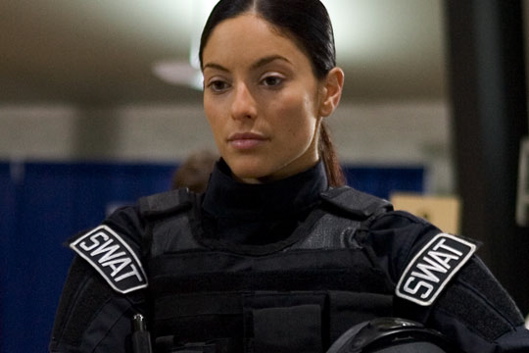
So I have been noticing a pattern in my TV/Netflix watching lately: in addition to hot male leading actors and characters who love each other (Firefly, Bones, Agents of SHIELD, Castle), apparently one of my prime choice factors is Badass Women in Combat Gear. So I decided to do a countdown, or rather, a count-up, of my ten favorite BWCGs.

So Number Ten is Erica Cerra, Deputy Jo Lupo from Eureka (2006-2012). The show had an interesting premise: imagine that MIT was actually a secret town in Oregon, and much, much funnier. Then add a handsome and perplexed sheriff to keep people in order. And because of course a handsome white man with police experience who rides into town automatically gets the job of sheriff over the hot Latina deputy who is probably more experienced and right for the job, we also get Colin Ferguson, Sheriff Jack Carter. Now I have to admit that Ferguson is easy on the eyes, but for some reason nothing makes a SWAT uniform look better than Erica Cerra. And despite Lupo’s affections for Absurdly Large SciFi Weapons, the character was interesting and likeable, although because television is what it is, when she finally ends up with a romance, it ends up being with the third least attractive man on the show, go figure.

erica_cerra_01

The Weirdness of Precipitation. Also Umbrellas.

8d6781cf937172027dee33d74d831c33

So a friend has pointed out that I have been veering from the straight path of poetry and investigating all kinds of apparently nonpoetic things, and she is not wrong. At first I thought this was simply a result of my writer’s block, again, and to some extent it is. Then I thought about how I started this blog in part to figure out my poetics, that is, what the Princeton Encyclopedia of Poetry and Poetics defines as “a systematic theory or doctrine of poetry” (Preminger 636). What do I think counts as poetry and where do we draw the line? Is it enough to “not be prose,” i.e., to have lots of short lines, some of which may happen to rhyme? Is it likely to have more elegant language and imagery than non-literary prose generally uses? Must it be beautiful? And what do we mean by beauty?

And then I realized that some of what I have been unconsciously doing is figuring out my aesthetics, which oddly enough, Preminger does not define, although he does include aesthetic distance and aestheticism, this last of which he seems to define as art for art’s sake, although he takes several pages to do it. I think for me defining one’s aesthetics is about defining what one as an individual, artist and nonartist, find beautiful and not. What draws you, as the bagpipes drew me before my mind had realized that my legs were moving? What repels me, as the sonorous, groaning organ does, even though it has great symmetry and harmony and All The Things, and can move other folks to tears for Very Different Reasons?

And I have been fascinated by our recent popular culture projects, because they have been drawing me in a similar fashion. Some of what I like is the smart juxtaposition between apparent opposites that we often get, the mixing of deadly serious and light wit, or dark, almost Gothic environments mixed with warm companionship. Or just high school students reading 500-year-old texts in an actual library to learn about the demons they are about to face. These tinctures in the story-telling of our time fascinate me, and I hope are teaching me about how to tell a more beautiful story, whether I do it in poetry or prose or some other way.

But for those who came for the poetry, here is a poem from last Monday when I got soaking wet about three different times.

.

Suddenly the air

is awash front to back

with water, which once,

before today, used

to be ocean or cloud.

.

And walksign people

scurry and slosh across

sidewalks become rivers

for a moment or two

too long for dry shoes.

.

Only the dry ones, those

who planned ahead,

stay anywhere near dry

carrying their nylon roof

on a stick.

.

Preminger, Alex, ed. Encyclopedia of Poetry and Poetics. Princeton, NJ: Princeton UP, 1974.

The Butterfly of Regret

The-Blue-Butterfly-castle-30029564-1280-929

According to Wikipedia, “Chaos theory is the field of study in mathematics that studies the behavior of dynamical systems that are highly sensitive to initial conditions—a response popularly referred to as the butterfly effect.[1]” So if a butterfly flaps her wings in Singapore today, Boston gets a hurricane a few days later. Or something like that.

I think of this today in part because the Massachusetts Bay Transit Authority (MBTA) had not one but two or three Total Screw Ups (TFUs) yesterday, causing several of my colleagues AND several of our clients to be stuck underground in Central Square Cambridge yesterday for a Very Long Time Indeed in the morning and even more hilarity in the afternoon, both times when the humidity content of the air was about 200%, i.e., it was pouring rain like the ocean was coming at us sideways. And, yes, I got drenched both times, thank you very much. I can’t wait to see how the MBTA is going to handle winter, as the Farmer’s Almanac is predicting a winter as bad as this past year’s or worse.

So, in the interest of keeping my part of next winter relatively less stressful, I just went with my colleague Bob to get my flu shot at MIT Medical’s impressively organized Flushottapalooza (my term, not theirs). The longest part of the process was finding a pen to fill out the form. Everything else went swimmingly, which is surprising because a) I am used to things run by the MBTA and b) there was absolutely no ocean water in the building.

I know. Right?

.

“Chaos Theory.” Wikipedia. 1 Oct. 2015. Web. 1 Oct. 2015.

When Even Page 51 Doesn’t Work

page51

So there I was on Wednesday morning, at work at MIT. I had no clients (because, duh, beginning of semester), no access to the Internet because of the new computer not being finished “setting up,” and two blessed hours when I could, theoretically, work my blog. Because Writing Is Easy, a thing you can do without a whole heck of a lot of technology, if only you have ideas.

Which I did not, in fact, have.

So I thought, no problem, there is the old Page 51 trick. I will look at a book or four on my shelf and see what the first sentence on page 51 is, and then I will have something to write about!

Living with Honor: “It better accepts another character of that taproot: the power of fertility.”

Bossy Pants: “When we got home I was sent to play outside so my father could shampoo the rug.”

Poetry and the Visual Arts: Page 51 is completely blank. It doesn’t even say 51.

Modernism and the Architecture of Private Life: “Like Wilde, Dorian has a home that is a product of his creative vision, filled with things that are both decorative objects and works of art.”

All of which is kind of depressing, because not only have I not found anything interesting to write about, I have also realized what a weird bookshelf I have. Sigh.

Instruments that Speak to/for/against Us

14720009

I started out Roman Catholic in the 1970s, which was a mixed time for Catholic hymnody. On the one hand, the conservatives who still hadn’t gotten over Vatican Council II (1963-7) still insisted on the organ (and thankfully we didn’t have one of those arrghanists who play at half speed and twice the loudness!) and on the other hand us younger/more liberal crazy kids wen to the so-called “folk” masses with guitars and hymns that had actually been written by somebody who wasn’t dead. (You can clearly see into which camp I fall, yodeling.)

In theory I understand a friend who finds the idea of anything less grand than an organ being an affront (I guess) to God’s grandeur. But let me tell you a story. Sometime about ten years ago I was in a Catholic church in Boston that in fact did and still does have an arghanist of the kind I described above. But to this particular Mass, the pastor had invited some young men from an orphanage in Haiti to come and speak to the congregation (and collect money, natch). I don’t remember what the processional hymn was but the two young men had their long drums suspended from their necks and were drumming away behind our singing—that is, until they reached the altar, when they stopped and the organ picked up the accompaniment. Well, I say, accompaniment, but in fact I found myself drowned out. As a female in the Catholic Church, I had felt that way before from time to time, but only metaphorically. But that experience—of the big, loud, low and therefore symbolically male voice of the Organ drowning out not only my female voice, but also the “voice” of young men whose country had been colonized by the western church—that was probably one of the last times I set foot in a Catholic church as a Catholic.

Now I am mostly happily Protestant—Episcopalian (we have women priests! and bishops! and gay priests! and bishops! Ask Me How!)—but I still get that icky feeling when I hear organ music, like somebody’s voice is being drowned out and nobody is even noticing except me. They invented the piano for a reason, people!

And I think about this because one of my Facebook groups, Scottish Clans & Families, had a post about how you know you have Scottish blood when the pipes speak to you like no other instrument could. And I started thinking about how we identify ourselves not just with things you can see, like pictures or desk toys, but also with things you can hear. The organ fills me with moral outrage. Bagpipes make me cry (in a good way, but I am also an old softie). Last summer at the alumni reunion at Middlebury, they had a piper standing just below Mead Chapel playing for an hour before the big convocation. On the other side of campus, I heard the music and immediately moved in that direction, in tears, like there was some big emotional switch in my bone marrow that the fellow had turned on from a quarter mile away.

I’m not quite sure if I have a conclusion about all of this, unless it is “humans are weird.”

Constructing Identity

51S2U8Wt1aL

Well, it is hard to believe it but the MIT Writing Center has been in its “new” location in Kendall Square in Cambridge for more than a year: a hot summer, followed by an interminable grey fall, followed by nine frigging feet of snow, a fair spring and a mild summer. The welcome difference between our current digs and the old grey bullpen in the late and not lamented Building 12 is that we all have our very own desk and computer and file cabinet With Wheels (and I know this because I personally put on all the wheels myself). This may not sound terribly impressive to folks who A. only have one job and B. have had their Very Own Space for like always, but when you are functionally somewhat itinerant having your own space is, scientifically speaking, way cooler.

Even back in the bullpen you could tell who was working at which desk based on whether the books on it were about nuclear proliferation, environmental ethics, Percy Shelley or opera, but now that we can accessorize a bit more, the differences are much clearer. My office mate (Shelley) has a Sherlock Holmes calendar and other Holmsian pictures, bookmarks, etc. I have a painting of red bamboo, a GreenPeace poster, a Fu dog bookend and, on my file cabinet, a maneki-neko clock amid a miniature Stonehenge that I bought while at an alumni reunion at Middlebury College. Layers upon layers.

It’s a bit like the way, back in Catholic school, although encased in plaid uniform and everybody wearing the same shoes, we found exciting shoelaces, with hearts or whales or rainbows, to assert our individuality.

The Block of the Writer, Redux

pirnin-44540999056_xlarge

So there I am, sitting with my Brilliant Colleague, Rebecca, complaining about how I don’t have ideas for either of my blogs, this one or the one that my cat, Musashi writes, primarily for my parents and my other Brilliant Colleague, Pamela. And Rebecca told me to write about that blog for this blog. So brilliant.

It is an odd thing, writing for such a small audience from the point of view of someone I love very much and will never really know. He’s a cat. He probably doesn’t do a lot of linear thinking, and the idea that he would spend his summer writing (with a purple crayon) a novel about pirates does seem a little silly, especially because, as a tuxedo cat, if he were to enter the Great Philosophical Argument: Pirates vs. Ninjas, he would most likely come down on the side of the ninjas.

And yet, and yet…

It also helps the storytelling process that Musashi, as a writer, has a Somewhat Less Than Puritanical attitude toward spelling. For example, he is still not convinced about silent h’s, such as those in words like “might,” and so he does without. He is okay on the g because of it having a tail, but the h, not so much.

And then it is simply a matter of retraining my point of view downward by about four and a half feet or so, and adding fur and irony.

Getting To Know Characters

firefly cast 364700

So I have been rewatching Joss Whedon’s brief, lamented TV show Firefly and I started to notice how, especially in the pilot, one of the primary ways we get introduced to the characters and find out who they are is by watching their interactions/relationships with the other characters. This may seem obvious, especially for folks who are more used to reading/watching/writing for stage and small and big screens, but my background is primarily in poetry, stories and novels. In poetry what you primarily have to show your characters is their language. Do they talk like Tennyson’s King Arthur or like Popeye? In prose fiction, you get narrative description and internal monologue in addition to dialogue. But in more cinematic stories, all you get is what you can see and hear: costumes, dialect, and interactions that show, for example, affection or power or the like.

So we see the disillusioned Captain Mal Reynolds keeping a lid on the man he relies on for muscle and automatic weapons, Jayne, who is not a bad guy, just pragmatic and occasionally a little mean, when he teases the innocent mechanic Kayley for her obvious crush on the upper class doctor, Simon Tam. Mal has a love/hate relationship for the stylish Companion (read: courtesan) Inara, as in, he loves the woman and hates her job. Kayley and Inara, although seemingly opposites, clearly share an affectionate friendship, in part because they are two out of three women on a ship full of Manly Men, and in part precisely because they are opposites: each woman sees in each other relief from the day-to-day reality of their lives. Inara provides vicarious excitement for Kayley and Kayley has the innocence that Inara lost long ago.

And, sure the costumes help, but even if this were a radio play, I think we would very quickly see who these characters are—in themselves and to each other—and why we should care about them.