Elevating Experience avec Tous Les Mots Justes

I just had half a discussion about why we read poetry and I am thinking at the same time about why I write poetry. I think during the Teenage Angst Years, I wrote for the same reasons a lot of kids write: to Express My Inner Turmoil. This is not a bad reason for writing, and if you can also make money off it (which some novelists and pop singers do manage to do), that’s even better.

Sometimes I write to experiment with sound, as I did when I wrote a dozen poems about Jack of the Beanstalk with tons of internal rhyme to get a bit more of a constant rhythm going, or when I wrote twice that many about flamenco, using staccato short lines to try to convey the percussion’s feeling.

Sometimes I write to tell stories, as I do when I unpack what I think is going on in a Japanese woodblock. Sometimes I write to take a story that already is out there—Jack of the B, Xena Warrior Princess, the Wright brothers—and go deeper into it, looking at it from a few sides.

But sometimes it seems just a matter of elevating experience, giving dignity to our joys and sorrows as Marge Piercy might say, through finding all the exactly right words to make Truth happen.

One of My Favorite Poems That I Didn’t Write

images

“A Hardware Store as Proof of the Existence of God”


I praise the brightness of hammers pointing east

like the steel woodpeckers of the future,

and dozens of hinges opening brass wings,

and six new rakes shyly fanning their toes,

and bins of hooks glittering into bees,


and a rack of wrenches like the long bones of horses,

and mailboxes sowing rows of silver chapels,

and a company of plungers waiting for God

to claim their thin legs in their big shoes

and put them on and walk away laughing.


In a world not perfect but not bad either

let there be glue, glaze, gum, and grabs,

caulk also, and hooks, shackles, cables, and slips,

and signs so spare a child may read them,

Men, Women, In, Out, No Parking, Beware the Dog.


In the right hands, they can work wonders.


Nancy Willard

Preparing for Christmas in a Changing Climate

plain door wreath 450

Fall has been lingering this year. Normally, cold weather in Boston starts at the beginning of November, and by “cold” I am thinking below 40 degrees Fahrenheit, the temperature at which I begin to consider locating my long Johns. The first (usually uneventful) snowfall tends to be between Thanksgiving and the start of December. Not this year.

I’ve heard people say how “lucky” we’ve been with the mild weather, but in my book if the weather is routinely 20-30 degrees different than the usual temperature not for a day or a week but for (so far) a month and a half, that has got to be a bad sign. It also means that I have had a hard time accepting that Christmas is really on the way. I keep forgetting to pick up the wreath I usually put on the inside of our main door (trees don’t work in a small apartment with a large cat).


Now as the high glaciers melt into green

Ocean water, rising, rising, now when we look up

Expecting the water to fall in flakes for hungry tongues,

Now the sky is grey and strangely warm.


Unseasonal, that’s what it is. The nights are long

Just as you might expect, but the air lacks crispness,

The blue of the afternoon sky lacks snap. I cannot say

I feel lucky. Even after nine feet of snow in Boston,


Which only finally melted six months ago, I fear

What might be coming: either ten feet this winter, or,

Possibly, none at all. Either way we lose. Already

Polar bears are drowning for lack of arctic ice.


Already small Pacific islands are losing ground

The way an old man loses hair: a little at a time,

Then all at once. It’s the opposite with the stores,

Switching the candy and hangings from one holiday


To the next overnight and at least three weeks early.

I cannot make that transition at all this year. So much

Worry about the Earth, not enough glad tidings.

Too much grey and drear, not enough merry and bright.


In the face of this, I force myself to find a small, green

Wreath for the inside of my door, to dangle small golden

Pigs—for abundance—a red bow to remind me to take

The bull by the horns and face the absence of winter


And the endless presence of winter, both living in me

As I move through the warming world feeling colder

Now than I ever felt as a child in a snow fort. Courage,

Says the angel in the branches. Embrace hope.

Pride Goeth, after the Fall

Sidewalk_in_autumn_-_Salem,_Oregon

How did we get here after nine feet

Of snow fell on my city, my streets

Where I walk unhindered eight months

Of each year? How did we get to this brightness

With trees waving yellow hands and smiling

With cheery red faces? Who allowed spring

.

To be so very short indeed, maybe two months

And then a long, slow summer, not too hot

And, thank God, not humid nearly at all

For a change? This chill in the air cheers

Me, suggests to me even better things

To come, despite the inevitability of winter

.

Just around the corner. I will not say

I am ready for any of it. I will not claim to be

Happy to see autumn go, with its bright

Calm and see winter come, all slippery

And not trustworthy at all, white sidewalks

Preparing now, in secret, to take us down.

The Weirdness of Precipitation. Also Umbrellas.

8d6781cf937172027dee33d74d831c33

So a friend has pointed out that I have been veering from the straight path of poetry and investigating all kinds of apparently nonpoetic things, and she is not wrong. At first I thought this was simply a result of my writer’s block, again, and to some extent it is. Then I thought about how I started this blog in part to figure out my poetics, that is, what the Princeton Encyclopedia of Poetry and Poetics defines as “a systematic theory or doctrine of poetry” (Preminger 636). What do I think counts as poetry and where do we draw the line? Is it enough to “not be prose,” i.e., to have lots of short lines, some of which may happen to rhyme? Is it likely to have more elegant language and imagery than non-literary prose generally uses? Must it be beautiful? And what do we mean by beauty?

And then I realized that some of what I have been unconsciously doing is figuring out my aesthetics, which oddly enough, Preminger does not define, although he does include aesthetic distance and aestheticism, this last of which he seems to define as art for art’s sake, although he takes several pages to do it. I think for me defining one’s aesthetics is about defining what one as an individual, artist and nonartist, find beautiful and not. What draws you, as the bagpipes drew me before my mind had realized that my legs were moving? What repels me, as the sonorous, groaning organ does, even though it has great symmetry and harmony and All The Things, and can move other folks to tears for Very Different Reasons?

And I have been fascinated by our recent popular culture projects, because they have been drawing me in a similar fashion. Some of what I like is the smart juxtaposition between apparent opposites that we often get, the mixing of deadly serious and light wit, or dark, almost Gothic environments mixed with warm companionship. Or just high school students reading 500-year-old texts in an actual library to learn about the demons they are about to face. These tinctures in the story-telling of our time fascinate me, and I hope are teaching me about how to tell a more beautiful story, whether I do it in poetry or prose or some other way.

But for those who came for the poetry, here is a poem from last Monday when I got soaking wet about three different times.

.

Suddenly the air

is awash front to back

with water, which once,

before today, used

to be ocean or cloud.

.

And walksign people

scurry and slosh across

sidewalks become rivers

for a moment or two

too long for dry shoes.

.

Only the dry ones, those

who planned ahead,

stay anywhere near dry

carrying their nylon roof

on a stick.

.

Preminger, Alex, ed. Encyclopedia of Poetry and Poetics. Princeton, NJ: Princeton UP, 1974.

More Refrigerator Poetry

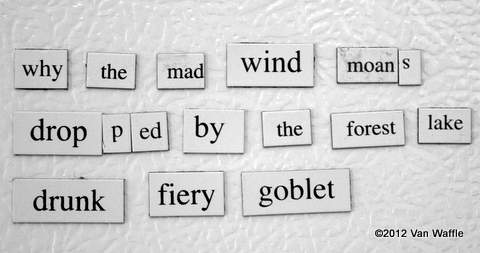
See incredible sweat blowing from my winter

chimney to shine and sleep and illuminate

incohate zeal in the delirious frantic ocean.

Watch me make a picture with language,

ephemeral in the hold of angels.

My need is wild, brazen, cunning,

and yet the urge for blood moans through.

maxresdefault

I just put this together on my refrigerator. And now I have the voice of the little boy from The Sound of Music in my head saying, “But it doesn’t mean anything!”

Refrigerator Poetry, Stealth and Otherwise

IMG_6590

One of the great inventions of the 20th century is Refrigerator Poetry, little boxes of magnetized words with which anyone with a rudimentary understanding of grammar can make unfathomable stabs at Poetic Meaning or at least Colorful Descriptions of Nothing Much. For those of us with decades of practice and training, we can make (with enough words, including articles, prepositions and S’s) Art Sublime, or At Least Almost.

It is one thing to do this on one’s own refrigerator. In that case, you are the person responsible for all the lost articles and S’s, so if you can’t make it work, you have no one to blame but yourself (and possibly your roommates).

Much more fun is Stealth Refrigerator Poetry, which is when you go to a party and, when your Host is off Hosting, you steal into the kitchen and rearrange their words to be something sublime, humorous, useful, or at last resort, unfathomable. When it is someone else who is to blame for too much penury and not enough the, you can claim to be Tragically Limited by your Medium, with which You Did Your Best. It can help, if you know in advance that the party will have magnetized words, to wear a beret to the party. This is called Priming your Audience.

1f7147d17ee4e0c8d66b2eb09d23e9d4

Hiroshima and Nagasaki, 70 Years Later

450px-Nagasaki_Peace_Park_01

The funny thing about traveling through Japan, as a Caucasian, is that you are automatically assumed to be American, whether you are or not. Normally, that simply translates into children waving at you and shouting, “Haro! Haro!” (i.e., Hello! Hello!), but in some places it is extremely uncomfortable, primarily in Hiroshima and Nagasaki. On the one hand, nowhere else have I felt so visibly and problematically American. I walk around the peace parks, looking at the dioramas of the damage done and the absolute nothing that was left in so many places, and I think, “My people did this.” On the other hand, the people of those two cities have so internalized the need for world peace that they are powerfully forgiving. They know that their government did some fairly unforgivable things also during World War II. One of the elderly women I met when I lived in Japan, 1990-1992, told me of the kindness of the American GIs during the occupation, and how one even managed to get eggs and flour so she could make her sister a birthday cake. War. Humans. Ridiculous acts of violence and tiny acts of kindness.

.

Pilgrim

.

Something about this breeze

damply fresh at 4 a.m. touching

my face as I stand on the concrete

platform, sway slightly, wait

for a train to take me, oh, anywhere

really, but especially south, southwest

to Nagasaki, international city,

city of the other bomb, city of pigeons

masquerading as doves.

.

Every bird is a dove

in a place like that, every

recreated building a monument

that looks you right in the eye.

I know. I have walked

Hiroshima’s busy streets. I’ve walked

where apocalypse burned

and was defeated, for now.

.

For now, I stand

on the platform, swaying with sleep

unrealized. Where I am going,

I will feel eyes all over: me,

blond, gaijin, outside-person, American.

Eyes like black rain remember

when a cool breeze could scald

a face beyond recognition.

The breeze that keeps me upright

while fluorescent lights battle

the darkness is filled with possibilities.

All roads lead from this one.

.

This one train could begin taking me

anywhere, measuring out the miles

with its laddered tracks. It will take me south

to a park filled with cherry blossoms

and monuments. A wall and,

perched on it, a weathered bronze dove.

A pigeon filled with love

by the damp bright air, who will land

and kiss the green dove,

beak to beak. The kiss of peace.

.

It is peaceful here on the platform,

alone and swaying, fighting

to open my eyes. The train will come soon.

The city will be filled with people,

jostling and contrary. I must remember

something then, when I arrive,

something about this breeze.

.

Spilecki, Susan. “Pilgrim.” The Kerf. May 2001.

And in Honor of Amelia Earhart’s Birthday Last Week

 amelia

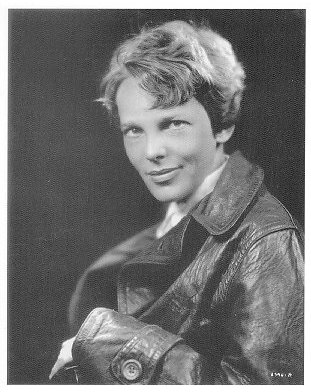
So I wrote this admittedly brilliant little poem in a white heat on the train in to my summer job many years ago. It is one of the few poems that I only sent out once before it got published. Sometimes the magic just happens. I originally wrote it as a prose poem and that is how it was originally published. In the coming book it will appear as free verse. I like it better this way. There is more nuance with real line breaks. It is rare that I get chills reading something I wrote, but this one is special.

.

Flying Lessons with Amelia

.

I met her the day of her first crash.

The stars in my eyes reflected the flash

of the cameras, the sun kissing her

silver pocket compact. The photos,

shades of grey, didn’t do her justice.

Storm clouds only capture spring

by reversing its leaves, tearing them

away. At all altitudes she eluded capture.

In her plane, the cockpit hot with her

concentration, she parsed the spectrum for me.

You will be flying through

the chandelier of heaven. The crystal is blinding.

You must fly with eyes open. You must

be prepared for any hue. We began

with asphalt, the grey of landings and rebirths,

aged embracing arm of the runway,

creased by time, that cumulus indigo

umbrella holding us down.

Someday I will fly right through.

.

I was not her navigator. I did not drink.

I did not charm or exude animal scents

the pink of tongues and inner ears. I did not

read the stars for her. I read only the lessons

she gave me: airship lessons, the silk grey

skin of a winged beast she knew intimately,

silk white lessons of sky. But white had to wait.

Green followed grey, kelly pine jasper,

the mustard green tips of leaves

pawing at our uplift, the midnight green of dusk

landings, verdancy so gloomed there was no telling

landing strip from the shadow of the ship,

our wings jet branches gathering darkness in.

Ebony comes later, she laughed at my awe

as my mouth opened on this night,

whalecub learning to swallow sea.

First you must finger gold.

.

I never fathomed the depths of my avarice

until we flew into sun, the goggles she despised

shielding us only from its molten grasp,

not from its flames licking the edges

of things, our gauges and leather gauntlets,

the straying lock of her hair peering out

from the leather helmet. Both our noses shone,

two bloodhounds following bullioned muzzles

to the end, flying west, into noonday, solarium

studded with citrine, topaz, blinking Midas tears.

The sun veered off our wingtip, my voracity

seeping away into the stratified marble, in

to its aquamarine veins. Her wrists

when the sleeves of her leather jacket rode up.

The struts of this plane when the ivory spider

sky wove us new, a web for wind to climb

all the way into the center. Sometimes

we flew into cloud, that turbulent nothing

clawing at our wings, hissing hushed threats

to fling us down against the serrated curve of earth

She was never afraid of falling.

Another kind of flight. Another airstream

leading to another place.

Some days the clouds refused to end, pure

immortality billowing about us

like anger. But purity is illusion, she said,

a wall of water you could pierce. Open your eyes

wide. Wider. Fly right through.

.

Blue was her forté, azure stones

seen from distances, purple mountaintops

from above. But purple is imprecise.

Say rather, the ache that seeps into everything

unbendable. Clouds and grass lose hue

and youth as they lose the sun, growing brittle,

vanishing. When each lesson ended, she too

vanished, after paying me a smile and a slap

on the back. Alone in the hangar, I rested

my hands like wings on the Electra’s wings,

imagined myself wind, the ever-present

hand of air flinging her through space. I became

the airship singing, “I am her destiny, spinning

propeller pulling her forward. If she moves

too slowly, she will break upon my invisible blades.

If she is quick enough however—

O if she is quick—she will fly right through.”

.

Each time she crossed an ocean, I prayed

in glasses of water, gulping down waves, dreaming

desert. I prayed by inhaling headlines, whole

paragraphs of storm. I prayed the grey

asphalt arm reaching out to catch her.

Shallow sea. Fair winds. Safe landing.

I told her my desert dreams, the cracked argent

lips of summer singing unspeakable endings.

What does it mean, O my master?

You have not known silver until you’ve soared

between desert and a full moon. Tongue falls silent.

Music falls in sheets to the dunes, arpeggios of sand.

.

Nightflight was the last lesson,

a leisurely voyage down corridors of unlit coal

rubbing itself off on our wings. To become night,

you must let go of everything. Every time

you embrace it, you must empty your pockets

and hands. Plunging into cold volcanic depths of

sky requires valor, resolute defiance of the grip

of blindness pressed against your eyes, of the lure

of the stars you cannot fly to. Nothing.

Nothing can save you here, nothing

but the Electra beneath her tan hands

with their raised blue veins, nothing but

the changing tint of grey in the curtained cloud,

penumbra lightening in blinks of tired dark eyes.

Night was not time but distance, an endless road

winding through itself and more of itself,

narrowing as I nodded and fought to wake.

You sleep from fear, but someday you will keep

this vigil too, in the long tunnel toward morning.

.

Never in her lifetime could I keep that vigil

whole, a faithful watchman, never

until her last flight, without me,

when she slammed into sea

the way I always slammed into quartz white

day, facetted and sparking seed-suns to burn

and stab our eyes. There is a place called horizon

where gold and deep blue lie down together, fuse.

The nose of my Electra aims to be a point

upon that line. When I fly now, years later

without her, I am always flying right through.

.

Spilecki, Susan. “Flying Lessons with Amelia,” Quarter After Eight 5. Fall 1998.