Something For an Actor at Winter Solstice

Even in December, your eyes are prodigal

Green like the low and leafy mountains

Of my youth, or variegated green like an autumn

Field that the breeze fingers and the sun flickers

Over, the bright greens of still summer and the faded

Sepia greens of summer drifting away.


Lie back as you would adrift on the ocean,

That constantly floating green that wraps the globe

In an embrace of waves constantly, constantly

Ebbing green, flowing green, the flash of sunlight

On the mighty roaring green, the hiss of foam

Like a promise or a kiss. Such greens dazzle


This heart, which far away contemplates that one

Distinct gift of the rainbow that light presents us, this time

Through you as you look in this direction, unseeing

But seen, showing all the lively greens—friendship,

Envy, desire and wrath—we come to know through your eyes,

So prodigal green, even in cold December.

Psycho Sunday: Badass Women in Combat Gear #5

085cbdb11ef4a79c9094acee3830c474

It shouldn’t surprise anyone that roughly half of my BWCGs come from shows helmed by Joss Whedon, since he practically invented the trope. The women of Firefly and Serenity represent a wide variety of badassery from the smart kind—Kaylee (Jewel Staite) is a mechanical genius and Inara (Morena Baccarin) is a woman who knows her way around blasters, swordplay and archery, not to mention the tea ceremony and light massage—to the more usual fighter kind. And once again the fighter kind include both the broken and the unbreakable.

0qLmpOM

River Tam (Summer Glau) is a bit like what Natasha Romanov would have been like if, in her teen years, the Black Widow Program had removed her amygdala, the part of the brain that allows you to ignore painful or worrying feelings. This is an operation that apparently makes for a good sleeper assassin, but man, can it just ruin the rest of your life.

zoe-washburne-gun-100507

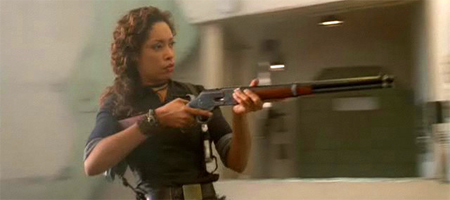
In contrast is Captain Reynold’s second in command, Zoe Washburn. In boots and a duster, the tall Gina Torres radiates confidence and capability and a, hah yes, serenity that is in short supply on the spaceship on the outer rim of the galaxy. She shoots what I originally thought was a shotgun, but apparently is a “Mare’s Leg,” a customized shortened rifle. And she wears a string necklace that Torres speculated might have come from the combat boots that Zoe wore during the war against the Alliance. Which is pretty darn badass, if you ask me.

During a ComicCon panel a while back, Torres said that she has often been told by fans that Firefly saved their lives, that people with cancer or dealing with domestic abuse returned to the show and to her character in particular to gain strength. Which is also pretty darn badass.

tumblr_n5h1f3FEG91skhsroo3_250

“Mare’s Leg.” Wikipedia. 16 Sept. 2015. Web 20 Sept. 2015

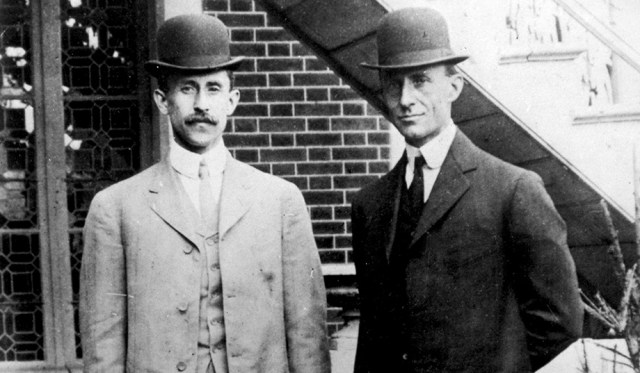
My Boys, Wilbur and Orville

pic_giant_052715_SM_Orville-Wilbur-Wright

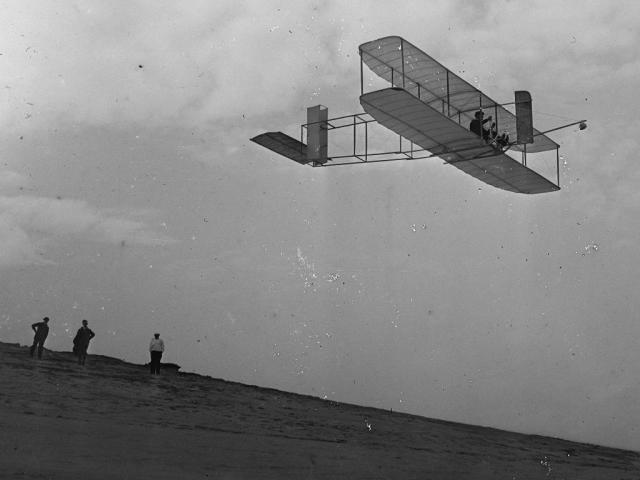
So 112 years ago the Wright Brothers made the first successful airplane flight near Kitty Hawk, North Carolina. A while back I wrote an oratorio about their process and I even had a composer who was working on it, but then we kept having our planned meetings go strangely awry—buses that were an hour late and the like—so I have actually never heard the music she wrote for it. Anyway, here is a taste of my attempt to capture their voices.


Finding Wind/Kitty Hawk Tango Baritone/Wilbur


When I sought for a safe place to practice

To learn the aeronautic riddles of flying,

They sent me to stand on a stretch of sandy land

In Kitty Hawk, North Carolina.


The abode of mosquitoes and buzzards,

A clime either roasting or raw,

A suitable location

Fraught with vexation:

I found it at Kitty Hawk.


I desired to make tests meticulous

In winds exceeding fifteen miles an hour,

Even quicker gales are here ubiquitous,

Enough to make a bold man cower.


The sand drives forth like an army

Over the hills and the flat.

The winds that rattle the tent

Are grand for experiments

But you’ll want to hold onto your hat!


If you desire a wind continual,

A place for vying with your flying machine,

The unbroken wind of the Kill Devil Hills

Will shrill and splinter your dreams.


I pity you, sir, for a coward,

If you dislike the picture I draw:

A land riddled with erosion

Betwixt Sound and Ocean:

Where I build my camp at Kitty Hawk?

1911_Wright_Glider

How the Birds Rise Tenor/Orville


Consider the owl,

The predator of night,

Who glides through the darkness,

Keeping the field mouse in his sight.

And then he dives down

Without disturbing the air.

The mouse is carried aloft

And never knew the owl was there.


And I am left to ponder

Mother Nature’s wonders:

How the owl glides,

How the stars sing,

How the birds rise.


Now consider the gull,

The scavenger of day,

Who sails across the morning

And her flying is play.

How she turns on a wingtip!

How she soars without a care,

Calling out her jubilation

Carried on ascending air.


And I am left amazed

At Mother Nature’s ways:

How the gull soars,

How the sand stings,

How the birds rise.


Now with the wind I sing,

I will learn to fly

As the owl glides,

As the gull soars,

As the birds rise.

Truth and Truths

In his book, The Things They Carried, Tim O’Brien writes about the Vietnam War (because he almost never writes about anything else). He discusses the difference between factual truth (the things that really happened in Vietnam) and emotional truth (the story of what happened that readers can actually take in). I think of this because I have been thinking about Emily Dickinson’s poem:


Tell all the truth but tell it slant —

Success in Circuit lies

Too bright for our infirm Delight

The Truth’s superb surprise

As Lightning to the Children eased

With explanation kind

The Truth must dazzle gradually

Or every man be blind —


I also think of this because of all the writers I love who have used fantasy or science fiction or even comedy/horror to tell truths that are difficult to communicate directly in a straight documentarian kind of way. Fantasy frequently helps us talk about religion and moral values: good vs. evil. Science fiction interrogates our fears about the uses and abuses of technology. Horror can illustrate a more manageable or more laughable version of social fears: vampires demonstrate class warfare, werewolves our discomfort with the wild vs. the domestic, zombies our feelings of incipient chaos. Perhaps all of literature is in part telling the truth at a slant so that it catches the light in a more meaningful way.


Emily Dickinson, “Tell all the truth but tell it slant.” The Poems of Emily Dickinson: Reading Edition. Ed Ralph W.  Franklin. The Belknap Press of Harvard University Press, 1998,

All I Want for Christmas, or Mrs. Claus Has Her Work Cut Out for Her This Year

15353939253_7ddfdf25b2

My two front teeth. Check. 1978

Somebody to lean on. Check. 1985

Just a little more time. Check. 1992

You.

The abolition of imperialist white supremacist capitalist heteropatriarchy.

A self-cleaning litter box.

A hard-boiled egg.

And a cup of coffee.

keep_calm_by_focusing_on_hard_boiled_eggs_11_oz_magic_heat_color_changing_coffee_mug-rfd722f4875cf44f88ebe438d17484883_x7j1x_8byvr_324

Preparing for Christmas in a Changing Climate

plain door wreath 450

Fall has been lingering this year. Normally, cold weather in Boston starts at the beginning of November, and by “cold” I am thinking below 40 degrees Fahrenheit, the temperature at which I begin to consider locating my long Johns. The first (usually uneventful) snowfall tends to be between Thanksgiving and the start of December. Not this year.

I’ve heard people say how “lucky” we’ve been with the mild weather, but in my book if the weather is routinely 20-30 degrees different than the usual temperature not for a day or a week but for (so far) a month and a half, that has got to be a bad sign. It also means that I have had a hard time accepting that Christmas is really on the way. I keep forgetting to pick up the wreath I usually put on the inside of our main door (trees don’t work in a small apartment with a large cat).


Now as the high glaciers melt into green

Ocean water, rising, rising, now when we look up

Expecting the water to fall in flakes for hungry tongues,

Now the sky is grey and strangely warm.


Unseasonal, that’s what it is. The nights are long

Just as you might expect, but the air lacks crispness,

The blue of the afternoon sky lacks snap. I cannot say

I feel lucky. Even after nine feet of snow in Boston,


Which only finally melted six months ago, I fear

What might be coming: either ten feet this winter, or,

Possibly, none at all. Either way we lose. Already

Polar bears are drowning for lack of arctic ice.


Already small Pacific islands are losing ground

The way an old man loses hair: a little at a time,

Then all at once. It’s the opposite with the stores,

Switching the candy and hangings from one holiday


To the next overnight and at least three weeks early.

I cannot make that transition at all this year. So much

Worry about the Earth, not enough glad tidings.

Too much grey and drear, not enough merry and bright.


In the face of this, I force myself to find a small, green

Wreath for the inside of my door, to dangle small golden

Pigs—for abundance—a red bow to remind me to take

The bull by the horns and face the absence of winter


And the endless presence of winter, both living in me

As I move through the warming world feeling colder

Now than I ever felt as a child in a snow fort. Courage,

Says the angel in the branches. Embrace hope.

Getting Lost, Getting Found

51a6160672fb8f1dce08040f02c6437b

So I was reading Robert Frost’s poem, “Directive,” about getting lost in a small, old town. He mentions Panther Mountain, so it is probably set in the Catskill Mountains of New York. It is full of Frost’s individualistic syntax, starting out:

“Back out of all this now too much for us

Back in a time made simple by the loss

Of detail, burned, dissolved, and broken off

Like graveyard marble sculpture in the weather…”

My college freshmen would probably oversimplify this to “back in the day” but then we would lose the photographic detail and the lovely iambic pentameter (five feet of unstressed/stressed syllables) that is at the heart of much great poetry in English. He goes on to say:

“The road there, if you’ll let a guide direct you

Who only has at heart your getting lost,

May seem as if it should have been a quarry—“

And this reminds me of the irony of anyone who has ever given directions and insisted, “You can’t miss it!” when we all know that is almost never true. Also, it reminds me of dreams I have often had about places I have lived, Middlebury, Vermont, Matsuyama, Japan, used bookstores in Boston long defunct, and small, hilly towns in New England and New York, when you are on the way to someplace else and slow down to drive by the statue to the men of the town who served during the Civil War. Often there is a small Congregational church, white wooden clapboard and a tall pointed steeple. And then, in a moment, the village is left behind and once more you are on a road from somewhere to somewhere else, and a forest of a hundred greens lining either side of your road.

“As for the woods’ excitement over you

That sends light rustle rushes to their leaves,

Charge that to upstart inexperience.”

The urban soul hungers for green upon green: sprint, mint, old oak, malachite, jade, evergreen. The leaves overlap like Earth’s eyelashes, the whole forest flirting with you as you let the road drive you through and away, content to let it take more time than travel takes in even your small city.

“And if you’re lost enough to find yourself

By now, pull in your ladder road behind you

And put a sign up CLOSED to all but me.

Then make yourself at home.”

We think we travel to get to another place, to achieve something: to participate in a conference, a wedding, a family meal, a family fight, a game, a job. But such things are simply the excuse for being on the road, seeing the unfamiliar multitudes of green, the all-too-familiar tarmac stretching out before and behind. Ideally, if you let it, even such simple travel can change you.

“Here are your waters and your watering place.

Drink and be whole again beyond confusion.”

.

Frost, Robert. “Directive.” Beginning with Poems. Ed. Reuben A. Brower, Anne D. Ferry and David Kalstone. New York: Norton, 1966. 330-331.

Yelling “Theater!” in a Crowded Fire

images

Writer’s block is a thing like when you sit down on the train and realize that you have just stepped (in your brand new shoes) into the sticky residue of someone’s spilled soda. And you think, well, heat melts sugar, right? So if only the curtains of my imagination were on fire, I could pull myself out of this urban transit tarpit and actually create something.