Poetry, Food. Food Poetry

o

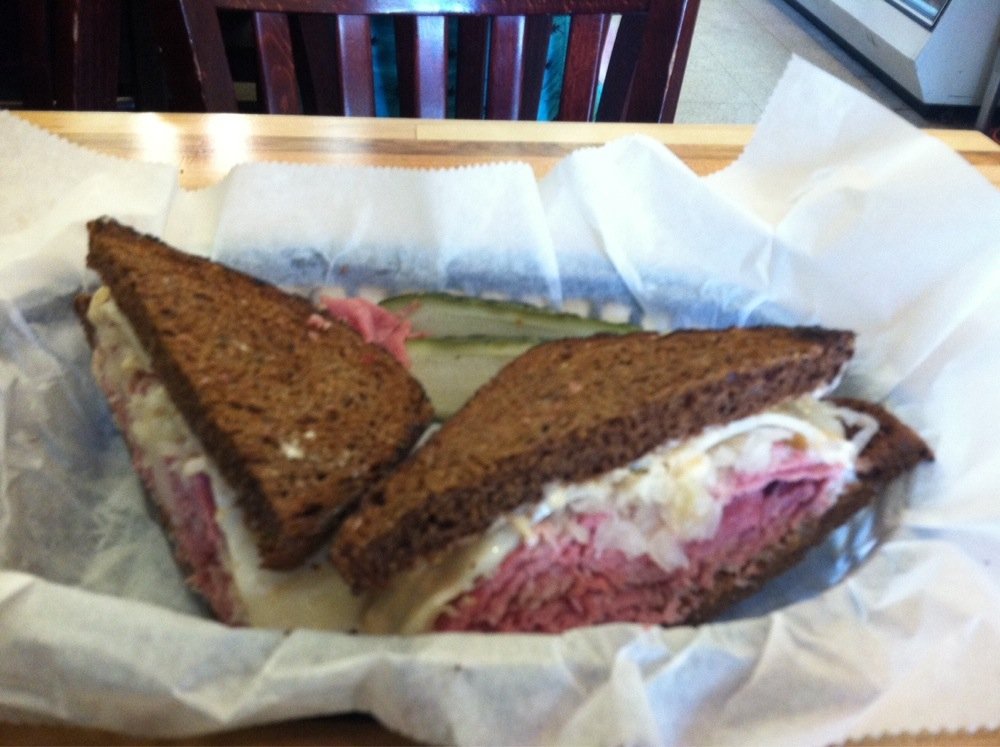
After living in the Boston area for more than twenty years, I finally went to Michael’s Deli in Coolidge Corner of Brookline and had their storied Reuben sandwich. That sandwich was bloody inspirational and when it is me that is talking, you know I mean that literally. So:

Ode to the Michael’s Deli

Reuben Sandwich

How perfectly heavy this

Pile of sweet corned beef,

How sour the kraut, how

Rough and soft the brown rye

Bread, the bed of this old marriage.

Even the cheese knows

Its perfect place, dripping out

On the dark edges, soft and

Hot, so utterly prodigal.

And the pickles? They

Keep their own secrets.

JUST SO YOU KNOW…

I am working hard on a Brilliant Blogpost for the Soon, while being distracted by Emergency Disseration Proposal Editing Clients (EDPEC). I am saving a teeny tiny portion of the world in between epic-heroic poems and mildly amusing blogposts.

Because, as it turns out, yagottamakealivin’.

Who knew?

Sticking the (Stylized) Landing

the landing

So the other day I wrote about my poetry midwife, Pamela, and how she has helped me, particularly in learning to pay close attention to the endings of my poems. I remember being at the Bread Loaf Writer’s Conference way back in August 1988, back when I was just a Writer Niblet, the poet Nancy Willard said, “Poetry is like bread. You can smell when it is done.” That may very well be true. But that is also assuming that you mixed the dough correctly and that all you need to do is add heat for a specified amount of time. Sometimes the ending comes out messed up because you messed up the start, so you can’t simply do a closure-style ending like a circle. Or you messed up the middle, which I think of as the Airplane Mistake, because if an airplane pilot is only one degree south of where she should be on her trip from Boston to Oregon, she may well end up in Los Angeles or worse.

I think of this in particular because I have been watching Agents of SHIELD lately and awaiting Joss Whedon’s Avengers: Age of Ultron. One thing I have noticed about the Marvel Cinematic Universe is how stylized a lot of the action is, in particular the dramatic landings. The person you see this most clearly with is Scarlet Johansen’s Black Widow, but you also sometimes see Agent May do this too.

may landing

The Urban Dictionary defines sticking the landing as meaning to “execute flawlessly from the beginning through the end. Follow through.” (“Stick”). The phrase originates from gymnastics. “When a gymnast lands a tumbling pass, vault, or dismount without moving his/her feet, it is called a stuck landing. The aim of every gymnast is to stick–if the gymnast moves his/her feet at all it is a deduction” (Van Deusen). More generally, it has come to mean “to finish an athletic, gymnastic, or other sports performance with an ideal pose or stance, especially after a jump or leap; (hence, also outside of sports) to do or finish well; to win” (Barrett).

I like the idea of an ending that is stuck solid to its foundation, unwavering. I also think that finishing well should not by necessity entail winning. Think about the 35,000 people running the Boston Marathon last month. Four won and 34,996 did not, but I imagine the goal for all but 100 was simply to finish well.

For a poem, this may mean you have an ending that quivers in the air in front of you shimmering with beauty. That is, often, the goal. But more often I think it is that you learned something from writing the poem and perhaps your readers have learned something from reading it.

Barrett, Grant. “Stick the Landing.” A Way With Words. 3 Feb. 2006. Web. 1 May 2015.

“Stick the Landing.” Urban Dictionary.com 21 Dec. 2006. Web. 1 May 2015.

Van Deusen, Amy. “Stuck Landing.” About.com. 2015. Web. 1 May 2015.

Velcro, Cottonballs, Muse

EMC over Boston

Okay, so I know I have written before about my yoga teacher, Erica Magro Cahill, and how she says things that get stuck in my mind like a cotton ball clinging to Velcro, which then leads to a poem. Or ten. Usually about yoga, because, duh, yoga teacher. But not always. One turned out to be about Odysseus and two are meta, being about the ways in which the things she says end up with me writing and/or changing. Here is the beginning of a sestina; note the end words, which come from something she said back in December:

In the crash and tumult of the year’s end, hearing the heart’s

Voice is difficult, especially if it is a shy, halting voice

Unused to asserting itself. So many other things are louder:

Car engines, sirens, the mind insisting it’s more important than

Everything else. As in an echo chamber reverberating, the mind’s

Insidious messages bounce back and forth against the bony walls

Of the skull.

And here is part of the Odyssey poem based on her phrase: “The intimacy of a beating heart inside your beautiful skin…” The phrase “muscle hugging to bone” also comes from her.

The percussion of the human heart, its calm

And agitation, how it pushes blood through

The body, emotions through the mind. Just as

The x-ray bypassed skin to show muscle hugging

Bone, to introduce me to my trembling heart,

So too, sometimes, do the songs we sing

Bypass the outer shell, however beautiful,

To speak quiet comfort to the fearful, feral

Cornered self within another body contained

In skin, the reverse of Siren song.

And this, which I wrote last week:

Because of You, I Carry the Sky Everywhere with Me

for EMC

your phrases like cirrus clouds

belie the true weather

grey, it may be, and

cold or raw or wet

and roaring

but inside my head the weather is

clear, the sky robin’s egg

blue, traced with fragile willow

buds and yellow and

clean, like early summer

almost a year I have listened to

your wisdom, your poetry

scudding across my wide blue

mind, chased by gulls

who also desire

outside, everything vibrates, frantic,

tidal: few sail through serene,

sails up, prow unwavering

few speak of these things

clearly, or at all

I have tried to learn to speak of that

particular wind that drives me

how to sail through

the roar, not

your way, but mine

to offer the wisdom and passion

I have for this one

thing: the words

and the heart facing

sky, our only ship’s compass

Or Maybe Growing a Poem

cecropia moth to send

So I know that the language I often use for this blog to talk about writing is architectural for the most part, but I have not always thought of it this way. On the one hand, I see students and other writers who see a piece of writing, a paragraph, say, as a brick wall that cannot be changed without actually breaking it apart and making a mess and then getting new bricks and more mortar, and it all seems to be much more work than they are willing to do. And I tell them, well, okay, if it must be a wall, make it out of Legos not bricks, because then you can change the size and color and try to do it a whole bunch of different ways quickly and easily and with some sense of fun.

And they often respond, “Huh.”

I do tend to think of words as small varicolored toys of varying sizes and infinite complexity, but that is more often when I feel that either I am in control of a piece of writing or, at the very least, or perhaps best, the writing is in control of the writing and I just have to let it come through my hands.

Alas, as we know, most writing doesn’t work that way, even for a bloody productive writer like me (last count: 48 days, 79 poems, 100 pages). Sometimes a piece of writing, or a part of it, kicks your butt for days, weeks, even months. In this case, where I can’t see a way in to simply take out pieces and replace the working parts, I start to think of the poem as being more organic, something that needs to grow, without me doing the growing. All I can do is water and weed and wait.

That is when it helps to have a writing buddy to kick back for you, or if you are very fortunate, a midwife. For years, my Poetry Midwife, Pamela read my poems when I was stalled out. Usually her answer to my dilemma, though phrased much more diplomatically and kindly, was basically, “The ending sucks.” Over and over, I just couldn’t end the thing right. Either I was overwriting or underwriting (which sounds like I was selling insurance) or just not, well, right-writing.

The beauty, however, of having the same problem over and over is that once you have finally figured out how to fix it, you have practically no problems left, until the next one comes along. So I got to the point where, when I was stuck on a poem and ready to pass it to her for help, I said to myself, “Self, I bet you she is going to say (nicely) that the ending sucks. So fix the ending first, self, before you send it to her.”

And somewhat magically that left her saying things like, “I really like this one.” Period. Success! And in my gratitude for all she did for me, I wrote her the following poem.

The Midwife’s Poem

for Pamela

Rub your hand across this mound

of words. Do they kick? Does the rhythm

move your hand? How fast does that

counter-rhythm heartbeat flutter behind?

Does it fly in time? What kind of moth

child trembles under your hand, under

the skin of the poem? Is it drawn to the heat

of your palm? Does it hear yet another counter-

rhythm, the heartbeat that you bring

to your silent, mulled questioning?

Every few weeks, I come to you for this

questioning, this touch you have for rhythms

and the reasons behind them. Without you, yes,

I might gestate properly, but anxiety, the ache

in the night, might slow this mothchild’s growth

in me. You have a touch, softer than feathers

on a warm breeze, for the unborn delicate grey

wings, for the dark hot blood pumping, pumping

into each phrase, each stanza. You deliver

them, living, into the pale papery light.

Occasional Poetry, Part 2

setsubun

As a working poet, I often have the opportunity to write for specific circumstances, as I mentioned a few days ago when I offered the poem I wrote for the wedding of some friends many years back. This is called occasional poetry. It is a more public poetry, in comparison with what might be considered the “more intimate … lyric” poem (Sugano 5).

Wikipedia tells us:

‘As a term of literary criticism, “occasional poetry” describes the work’s purpose and the poet’s relation to subject matter. It is not a genre, but several genres originate as occasional poetry, including epithalamia (wedding songs), dirges or funerary poems, paeans, and victory odes. Occasional poems may also be composed exclusive of or within any given set of genre conventions to commemorate single events or anniversaries, such as birthdays, foundings, or dedications.’ (Occasional)

Some occasions are not as obvious as those listed here. For example, many years ago a good friend ended up on the wrong end of a restraining order from her roommate and bunked on my couch for three days while she sorted it out. When the judge had thrown the roommate out of court and out of my friend’s apartment, and after all the dust had settled, my friend had an Exorcism Party, for which I wrote the following poems. The goal was not only to celebrate the end to an excruciating time but also what I think of as the prophetic task of reminding us to forgive our enemies eventually.

The Exorcism, First Movement: The Beans

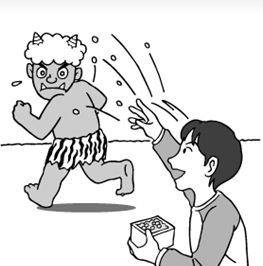
oni wa soto, fuku wa uchi

(out with the devil, in with good fortune)

In this place, we rise and shout:

Good luck in and demons out!

To darkness that has gathered here,

We now demand: Go! Disappear!

In foreign lands, where now sunlight

Is rising silver on beached stones,

Many-colored demons wrapped

In deerskins wander winter night

Free. They fear one thing alone.

They tremble when they hear beans tapped

Together, gathered for the rite

Of Setsubun, Bean-Throwing Fest,

Which, every February, means

The end of winter-darkened fright.

All folk have ways to expel the Beast;

There they drive it out with beans.

But here no Oni stalk our night,

Steal our rice, upset our shelves

Or walk the night to work us ill.

It’s with each other that we fight:

The dark fire is within ourselves

To stoke or extinguish as we will.

Now in this place, we rise and shout

To darkness that has gathered here,

Forgiveness in and anger out!

We eat the beans. It disappears.

The Exorcism, Second Movement: The Book

The book proclaims

that God’s voice

strips the bark from trees

standing in the wilderness

arms raised–

Your money or your life–

How long O Lord–

How long can I stand

here without skin. The wind is cold;

the thunder cracks through; each layer

around layer cowers.

The book reminds

that wilderness is wild

but not empty.

Look!

the voice shouts,

you do not stand alone:

all around you I have planted

my people, whose arms reach out.

Now

the voice whispers

Now

I will sing you

into new skin.

We Speak of Exorcism, Yet

demons never lived here. Just a woman

surrounded by light, who ground the heels of her

palms into her eyes, a woman surrounded

by the spirit, who steadfastly refused

to inhale. We must know the spirit; like a child-

woven paper chain, it rises and falls

here between us, these people you have

called to your side in trouble. We all have

breathed, these forty days, its freshening wind.

The spirit is the only part of God

I trust: out of darkness, invisible eyes see us

in our frailty. We skitter below like woodmice

cowering alone–we think–waiting,

praying for the spirit to swoop down,

not a dove but a hunting owl: accurate,

terrifying, saving us.

When She Has Finally Moved Out

After the room has emptied, you weigh

the air between winter-locked windows

with your kitchen scale: lighter, easier

to breathe now. You take a sip

of tea, the saucer in your left hand as

you wander, a sacrament. Liberated

like this air, like this room’s white door

now you are swinging

wide

open–

setsubun-1

Occasional Poetry. Wikipedia. 9 Jan. 2015. Web. 25 April 2015.

Sugano Marian Zwerling. The Poetics of the Occasion. Stanford: Stanford UP, 1992.
Occasional Poetry, Part 1

cecelia

On Her Fifty-Somethingth Birthday, Greater Boston Rejoices

Lo, the Amazing C. Musselman has been

On the Earth these last five decades and we,

Waving our hands and dancing with our feet,

Are grateful. So we show our gratitude

With colored banners, cakes and ale, broad cheers,

And songs (probably in Finnish) and small bonfires.

We light up the bay. The tourists likely think

It must be some local holy day but we

Know better. Having had the mission furniture

In our brains rearranged by her speeches

Over the preparations for every dinner,

We know that holy is not the word for it.

The word is knowledge, or wisdom perhaps,

The domain of Athena. What they both bring

The world is yearning for knowledge,

That sudden spark that lights the conflagration

That annihilates all we thought we knew

To make room for what we never thought

Possible. This is their gift to us, ever being

Offered, ever received. And so the fireworks

(Fireflowers, the Japanese call them) erupt

Across the skies of the world this night

In their honor, in the honor of her chariot

Pulled by cats, that she won from Freya

When Apollo decreed that he liked Cecelia’s

Pottery better, in honor of her baked

Mac & Cheese that Thor decreed could make

A warrior weep, in honor, in short, of her birth.

And though those who do not know the woman

Might think this paean overwrought because

They have never seen the shine of her mind or

Eaten the food she offers with such love, I, who

Know her, tell you it is not. As with many we know

And underestimate for their size or quietness,

Though she is but tiny, she is fierce.

Post-Modern Quilting Zeitgeist

ironman

My roommate, Jack, is, among other things, a filmmaker. So far he has made at least three short films in the apartment, which generally means that all the furniture that was in one room ends up in another for about three days. And the cat is intrigued. When he is not making films here, he is usually making films elsewhere as he and his peers all serve on each other’s films in different capacities. Aside from being a fascinating study in collaboration, this situation means that my cat frequently gets to take over his room when he is not around, and Musashi is very much for that.

When he is around, Jack tends to start conversations about writing that last for a couple of hours, usually starting with the words, “So, do you think…?” Last night, when I came home very late (thank you, Massachusetts Bay Transportation Authority, for failing us yet again!) after a lovely dinner of Chinese food with my poetry midwife Pamela (the one I can always count on to tell me whether the ending of a poem sucks; apparently the ones I showed her yesterday do not; Huzzah!), I found Jack actually cutting up VEGETABLES for his dinner.

In my sheer amazement at this, I got into a conversation with him that lasted two hours, largely about Post-Modernism and the death of opportunity for artists to make anything new, since we are all just rehashing what has been done before. Part of this is in regard to an ongoing conversation about my rewriting the Xena narrative, which I would argue is, yes, rehashing, but rehashing to change the world, or at least myself, which is the only way we ever start changing the world, after all.

We were discussing, among many other things, the coming reboot of the X-Files with Gillian Anderson and David Duchovny, the coming Batman vs. Superman movie (link to the retro trailer) and other rehashings of popular culture, and he was bemoaning (no, really, he was: and how often do I get to use that word?) the state of our culture and how if we only redo what we did we will not have the time, money or energy to do new things.

He is not wrong, but I do argue that this is, if you will, not the whole story.

He described how he sees humans, with our technology that allows us to see millions of miles into space, fly at hundreds of miles per hour, and delve deep into the Earth, as godlike. But it is, as one of his friends phrased it, a prosthetic divinity. We can only do these godlike things with our fancy tools. And with those tools we can do great good or great destruction.

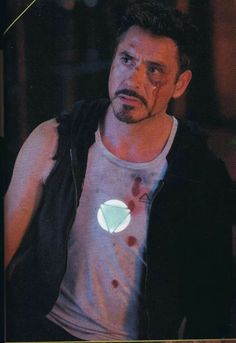
“Yes,” I said. “And that is the story of Ironman.”

Eventually, we agreed that archetypal stories have their place in human meaningmaking and identity production, and that as artists we can only be very intentional in what stories we tell and what stories we consume (read, watch, try to live into…).

Negative Traits, Or, Is That What I Was Doing with That Character?

photo-31

So I was just reading Author Matt Bowes and the Dogs Breakfast blog (and I still have not figured out how the dog comes into the picture) and lately he has been talking about how you make characters more well rounded by, duh, giving them negative traits. This is an aspect I have never really given much thought to because I just find my characters fully formed in my head most of the time, so if they have those traits I run with it and often they do not and are unconvincing, but when you are writing fantasy, as I did for many years, we expect characters to be a bit larger than life, so you can get away with it.

But now that I am writing about Not My characters, e.g., Xena Warrior Princess, the negative traits come with the fully formed character. The thing I have been noticing is that it is the other characters who discuss the negative traits. Face it, especially during the first season, Xena is dismissive of anybody who is not an actual warrior. And throughout the first few seasons she has, as the characters in the Buffyverse would say, really honed her brooding skills. She often speaks in monosyllables and pretends the emotional things do not matter.

So my job is to somehow highlight those traits, which are for the most part lacks or absences with the possibly more positive traits of talkativeness and emotional availability/frustration in the other characters and, by contrasting those things, show the whole relationship. The cool part about poetry rather than fiction is you get to write lines like these from Gabrielle:

Life on the road is better. Even when

Whole days go by without her talking,

More is said than in weeks of talk back home.

Versus this from Xena:

And after, it was hard for us to speak

Of any of it. The silence between you and me

Crashed through the trees behind us like a kite.

Because, oh, the glory of the metaphor and abstraction to describe the bone deep emotions we all feel when the relationship is a struggle.

Robert Okaji Is the Bomb

okaji

So I just bought the pdf version of Robert Okaji’s chapbook of poetry, If Your Matter Could Reform, and as my southern friends would say, y’all should too. Look at the elegant sparseness of his verses, as in this example from “Wind”:

that it moves, that it blends,

that it withdraws and returns without

remorse, without forethought, that it

increases, expands, subtracts,

Or the important comment on our current racist moment in America from “If We Burn”:

change I can’t breathe from epitaph

to actuated plea for help?

Are words ever enough?

Can we stack our indifference and fear

into a mile-high pyre, and torching it

watch them rise to nothingness,

Or the quiet confidence that sets up an image and lets it do what it needs to, as in the end of “Ashes”:

Today the rain spells forgive

and every idea becomes form, every shadow a symptom,

each gesture a word, a naming in silence.

Scatter me in air I’ve never breathed.

I mean, fuck, people! I have seen the rain spell forgive, a very long time ago, to be sure, but I have seen it. And he just lays out this beautiful little impossible thing for us, a gift like a tiny origami crane in your open hand and walks quietly away.

The way I look at it, a man who can say, “In the marrowbone of night,/your song parts the fog” deserves your two or six bucks (pdf/paper). And as you know by now, that is a professional opinion.