The Onionicity of Dolls and Drafts

images

I thought I had two different translations of Nobel Prize winning poet Wyslawa Szymborska’s poem, “The Onion.” But what I have is two books by her, neither one of which has the poem. I love the poem for the way it interrogates the complex and ordinary Onion, impoverished baronet of vegetables.

Translated by Stanislaw Baranczak and Clare Cavanagh

the onion, now that’s something else
its innards don’t exist
nothing but pure onionhood
fills this devout onionist
oniony on the inside
onionesque it appears
it follows its own daimonion
without our human tears
our skin is just a coverup
for the land where none dare to go
an internal inferno
the anathema of anatomy
in an onion there’s only onion
from its top to it’s toe
onionymous monomania
unanimous omninudity
at peace, at peace
internally at rest
inside it, there’s a smaller one
of undiminished worth
the second holds a third one
the third contains a fourth
a centripetal fugue
polypony compressed
nature’s rotundest tummy
its greatest success story
the onion drapes itself in it’s
own aureoles of glory
we hold veins, nerves, and fat
secretions’ secret sections
not for us such idiotic
onionoid perfections

I often suspect that my college freshman writers think of writing a paper as starting with a tiny nub of an idea and gradually building their argument, layer by layer, along with blood, sweat, and tears, until they have a fat little paper with lots of impressive words like “plethora,” “utilize” and “myriad.” Sometimes it even begins with a layer the size of a pumpkin: “Since the beginning of time, man has…”

In such cases, I am the one with the stinging eyes, who stands to clear my head.

In contrast, I feel like writing a paper for me is starting with a big-ass onion and peeling it down, layer by layer and draft after draft, until I have a small, beautiful thing: a pearl of bittersweet onioniciousness to convey my complex ideas. Generally my first completed draft of an essay is 35-40 pages long, but since folks rarely publish anything over 15-20 pages, my revision process generally involves me in the drawing room with a machete.

But, since onions, over time, are either eaten or they rot, I do not in fact have an onion at my office at MIT to serve as an object lesson in the layering and unlayering that is the process of writing. Instead, I have a matryoshka, a Russian nesting doll. Another benefit in addition to unrottability is that if I pick it up to make a point to my students, neither of us will end of crying.

Probably

Getting To Know Characters

firefly cast 364700

So I have been rewatching Joss Whedon’s brief, lamented TV show Firefly and I started to notice how, especially in the pilot, one of the primary ways we get introduced to the characters and find out who they are is by watching their interactions/relationships with the other characters. This may seem obvious, especially for folks who are more used to reading/watching/writing for stage and small and big screens, but my background is primarily in poetry, stories and novels. In poetry what you primarily have to show your characters is their language. Do they talk like Tennyson’s King Arthur or like Popeye? In prose fiction, you get narrative description and internal monologue in addition to dialogue. But in more cinematic stories, all you get is what you can see and hear: costumes, dialect, and interactions that show, for example, affection or power or the like.

So we see the disillusioned Captain Mal Reynolds keeping a lid on the man he relies on for muscle and automatic weapons, Jayne, who is not a bad guy, just pragmatic and occasionally a little mean, when he teases the innocent mechanic Kayley for her obvious crush on the upper class doctor, Simon Tam. Mal has a love/hate relationship for the stylish Companion (read: courtesan) Inara, as in, he loves the woman and hates her job. Kayley and Inara, although seemingly opposites, clearly share an affectionate friendship, in part because they are two out of three women on a ship full of Manly Men, and in part precisely because they are opposites: each woman sees in each other relief from the day-to-day reality of their lives. Inara provides vicarious excitement for Kayley and Kayley has the innocence that Inara lost long ago.

And, sure the costumes help, but even if this were a radio play, I think we would very quickly see who these characters are—in themselves and to each other—and why we should care about them.

Landscape and Identity

It’s hard to believe it has been fourteen years since the events of 9/11. The college freshmen I was teaching that semester are now in their early thirties, and one can only wonder if that event was formative for them. Certainly for the kids from New York and New Jersey, I imagine they were. I remember one student describing looking out her window at home, over the river to see Manhattan’s high rises, and then going home for Columbus Day weekend and her crucial landmarks were just gone.

It is unnerving when our landscape just disappears. It robs us of our anchors, the margins of our world that tell us which way is up and down and left and right. Perhaps that is one reason the Budweiser tribute to the victims of 9/11 from five years ago is so affecting.

An even more powerful example of this is the Japanese tsunami four years ago, when the sea rose up and ate whole towns and villages, leaving over 15,000 people dead, 340,000 people displaced and 24-25 million tons of rubble and debris. I cannot imagine returning home to see only barren broken land, shorn of natural and built environment, stranded in rubble and mud.

The flip side of all this loss are the barely visible landmarks by which we make our way through our familiar environments. I remember coming home to New England after spending more than two years in Japan and being amazed at all the church steeples everywhere I looked (or so it seemed). Although I started out Roman Catholic, the ubiquitous white wooden Congregational church steeples were like architectural punctuation telling me that this geography is a sentence I understand how to read.

And now, working at Massachusetts Institute of Technology after my time in Japan many years ago, I cannot pass under an apparently nameless concrete gate next to the Wiesner Building without thinking of all the torii gates I saw in Japan, particularly the most famous on out on the water near Miyajima. You can leave a place, but it doesn’t always leave you.

Itsukushima_Gate

So Sad to be Sans Serif

Larson-Google-Logo1-1200-977-03175102

So Google just “upgraded” its logo, by taking all the pretty serifs off and making the current logo look like something out of a cheap children’s chapter book. Any subtlety it used to have is gone. I am surprised they kept the colors. “Upgrades” like this drive me nuts. Microsoft Word “upgrades” in a similar manner, taking all the useful things I use constantly and hiding them in a different menu or behind a ruler I would never think to use, something that automatically generates, for example, a memo. Why on God’s green Earth would I ever need to automatically generate a memo? Nobody even uses memos anymore, not since the invention of email. But this is the global corporate world for you. Rather than sticking with something that works well, we have to change it up so you buy a new one that won’t work nearly half as well and takes too much work to learn.

And if you think all this is just my opinion, it turns out that Sarah Larson from The New Yorker agrees with me. “In streamlining its logo, Google took something we trusted and filed off its dignity. Credit PHOTOGRAPH BY JUSTIN SULLIVAN / GETTY”

More Refrigerator Poetry

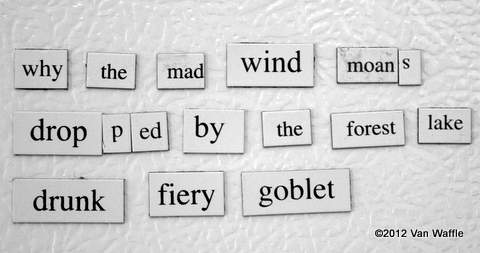
See incredible sweat blowing from my winter

chimney to shine and sleep and illuminate

incohate zeal in the delirious frantic ocean.

Watch me make a picture with language,

ephemeral in the hold of angels.

My need is wild, brazen, cunning,

and yet the urge for blood moans through.

maxresdefault

I just put this together on my refrigerator. And now I have the voice of the little boy from The Sound of Music in my head saying, “But it doesn’t mean anything!”

Refrigerator Poetry, Stealth and Otherwise

IMG_6590

One of the great inventions of the 20th century is Refrigerator Poetry, little boxes of magnetized words with which anyone with a rudimentary understanding of grammar can make unfathomable stabs at Poetic Meaning or at least Colorful Descriptions of Nothing Much. For those of us with decades of practice and training, we can make (with enough words, including articles, prepositions and S’s) Art Sublime, or At Least Almost.

It is one thing to do this on one’s own refrigerator. In that case, you are the person responsible for all the lost articles and S’s, so if you can’t make it work, you have no one to blame but yourself (and possibly your roommates).

Much more fun is Stealth Refrigerator Poetry, which is when you go to a party and, when your Host is off Hosting, you steal into the kitchen and rearrange their words to be something sublime, humorous, useful, or at last resort, unfathomable. When it is someone else who is to blame for too much penury and not enough the, you can claim to be Tragically Limited by your Medium, with which You Did Your Best. It can help, if you know in advance that the party will have magnetized words, to wear a beret to the party. This is called Priming your Audience.

1f7147d17ee4e0c8d66b2eb09d23e9d4

Calvin Was Wrong, Mostly

bda93a302b5e01300649001dd8b71c47

While Hobbes was the Tiger of Reason, Calvin had the option to be the 8-year-old of Middle School (Il)Logic, hence his ideas about what made good writing. One of the most troubling things about teaching young people (and the younger they are, the worse it is) is that what you teach is not the same as what they learn. Hence, college freshman are still wedded to the Dread Five Paragraph Essay (like the Dread Pirate Roberts, except it actually does kill you in the morning. Every morning when you hand in a paper after fifth grade.)

As I face the hard fact of Fall Semester 2015, after having taught writing for longer than my incoming students have been alive, I hope to find a Hobbes-like way around the Calvin-like assumptions of my freshmen. Wish me luck, or, failing that, a really fast sled that can take the curves of the coming snow mounds!

Fur-People

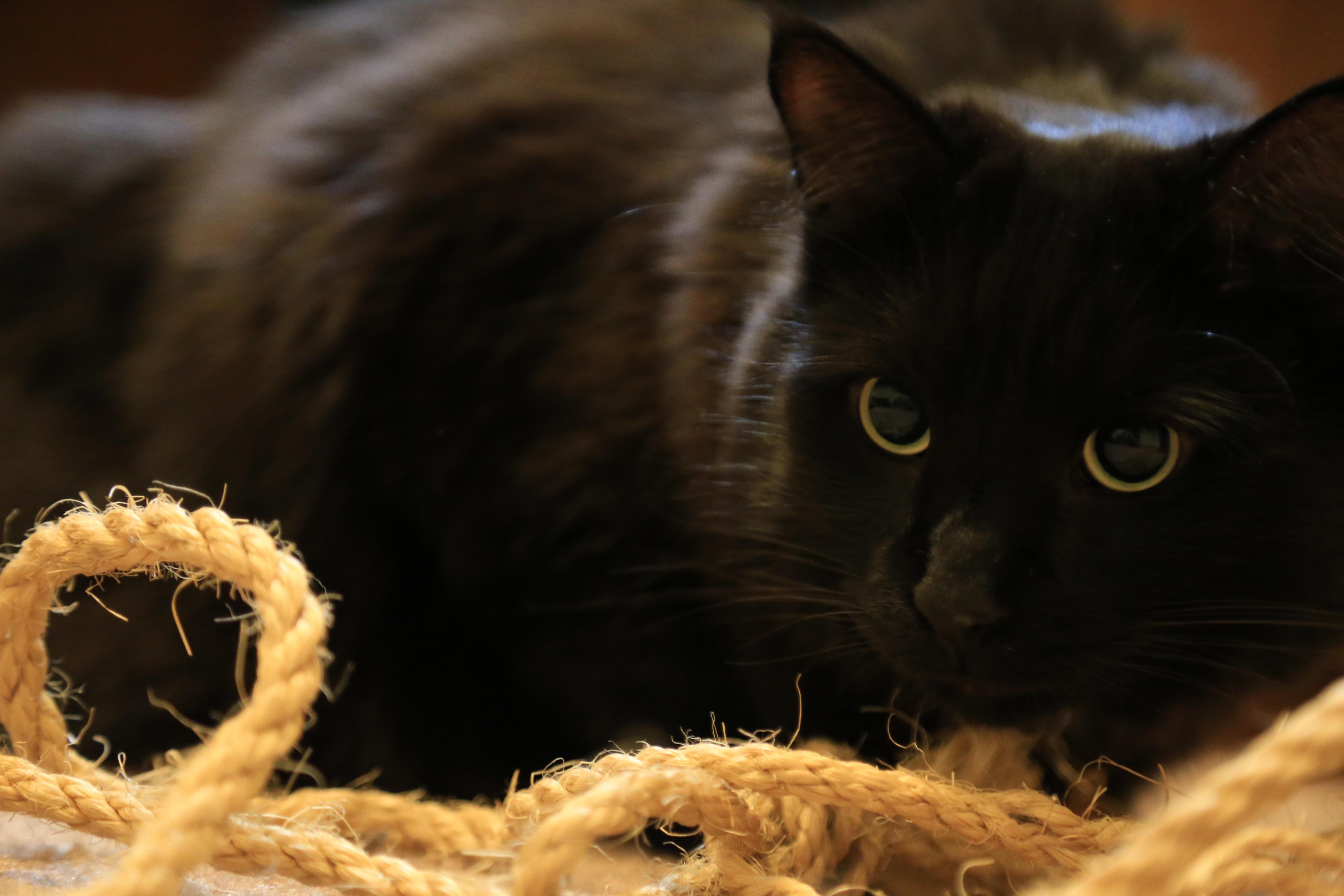
Dog people go out in the rain, snow and sleet to take Fido for a walk. Cat people put off doing important work on the computer because Musashi is lying on the chair looking blissful. Procrastination: if you do it for love it doesn’t half count.

Mu with StringPhoto by Jack Siberine 2014.