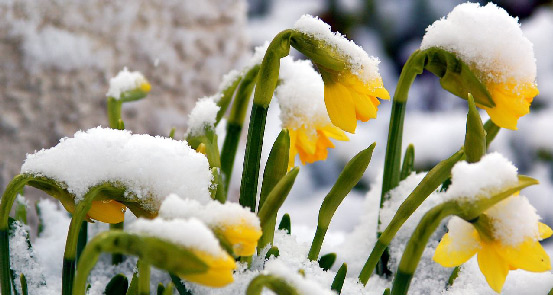
Snow on the Daffodils/Invicta

173-daffodils-in-snow-for-web

After so many years in New England: you would think

I would know by now. Spring begins, flowers bloom,

The sun comes out, then runs away. Snow falls.


A flower that has spent its whole life pushing

Up through the soil, toward sun, toward itself,

Toward its own flower-ness: it didn’t do the work


Only to be frozen out, wilted. Who wants to stand

In the cold damp, waiting for something warmer?

Who wants icicles drizzled on one’s finery?


But the blossoms you can see are only the top

Third of the plant. The bottom third is root,

Deep in the hard, cold soil, holding on, taking in


Sustenance, the stuff of life. The middle, compressed

At the soil line, invisible: that is the tough mind and soul

Of the flower: resistance, resilience, hard unyielding patience.
Fisheye Lens

We believe the world is round. We believe that

When a ship sails out of sight, it keeps on sailing

Without falling off the edge of the planet, along

With the ocean waters ever pouring past the edge,

The world’s meniscus. We believe the astronauts

Who saw the Earth from far, far away, a round

Blue marble spinning in space. We believe even

Though we will never see it for ourselves,


Not with our ordinary eyes. There are many such

Things in the world. Sometimes it takes a distortion,

A lens like the eye of a fish, born to see through murky

Water, to understand the realness of strange truths.

Stand on a fire tower two hundred feet in the air.

Look out on the world like a bird or a god of poetry:

Pick up your camera and find a way to show us

An orange golden forest curving away at the edges


Of our eyes, and in the distance–what is that?

Mountains melting into a sea of navy or teal or

The darkness that beckons dusk to inhale

These curving clouds, pulling them away so that

The golden hour can have a few more minutes

Here, caressing this forest the way fire might

But without destruction, only love. If we blink,

The clouds might pour down over the edges of day.

Spring Promise

black_capped_chickadee_1

Now every breath is a scintillation of birdsong.

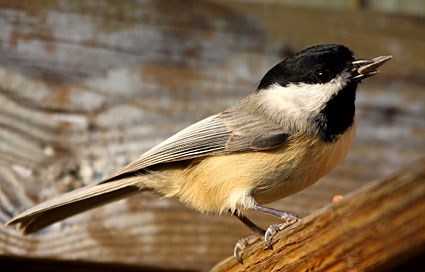
This fat little chickadee singing high and loud

Over the mild urban uproar: such a tiny feathered

Body to make such a big sound. Now yellow

Proclaims herself Empress of Grass, with squads

Of daffodils marching in her army. Now, after

A quick rain, the still bare branches hold onto

Raindrops like placeholders for the buds to come.

In the background, the snowbells ring out

A farewell to winter. Now only the dogwood

Will send its petaled snowflakes down on us.

Now, we throw off hibernation like a dark wool

Duffel coat as March clomps away in heavy boots.

Conversation with Classic Bridge, Birds and Fog

  1. Fog


The people like to call this bridge golden, though by day

It appears to be red and by night, black. I never see it

The way they do, nor would I want to. I am an artist

Of black and white and all the uncountable shades

Of grey and gray in between. I paint with water and

The air is my medium. Call it hydrography and assume

Viewers who want to feel the pictures I produce

Damply, on their faces, like morning and a new day.


  1. Birds


A bridge is fine if all you want to do is pause

Between one bit of land and the other, holding on

To the hard, cold, damp steel with your feet, and

Watching the cars go this way and that, watching

Sky blur into bay, and bay into sky: all that grey

And gray. On our feathers, the fog huddles close

Then we cast it off as we burst into the damp air:

Speed! Freedom! Even the light cannot catch us.


  1. Bridge


No one values stability the way I do, or the way

I reach out to both sides: always. Standing still

Is an unappreciated art. Fog appears and disappears.

Birds land and take off again. I, alone, remain.

Connecting land and land, grey and gray, birds

And fog. I, alone, repeatedly painted red by humans,

Grey and grey by fog and dusk and early morning,

Hold land and water together with my solitude.

The Thing About a Bridge

By day, a bridge is all about departure and destination, a way

Of getting from place to place:

We focus on the ends as if they were the whole point, as if

The middle span was mere

Afterthought and not the central reason for being. We think

Perhaps of the view visible

As we speed our way across, some water usually and perhaps

A boat or two, the kind

Of thing we don’t tend to see so much in the city. Then we focus

Again on our objective,

Where we are headed to, the grand goal of the journey, but not

The journey itself.

But the thing about a bridge is precisely its bridgeness, its span,

Its willingness to stretch

Itself from here to there for our benefit. There is an elaborate

Geometry to a bridge,

Squares, triangles, and at dusk the lights become stars, so there is

Astronomy as well,

And the tiny curved moon hangs as if by a grey-blue thread of sky

Underneath the bridge

And above the setting sun as it blushes the horizon, to remind us

To pause up there

And just be in the in-between space, neither here nor there, but

Content like stars.

Night Photography

Even without a camera, humans are always drawing

With light: every two hundred feet across the bridge

Street lamps hold out hope in pools of grey light

Across the tar. From a distance the bridge is almost

Perforated, an embroidery picked out in stars.


Holidays bring out our artistry. Look at the building,

Its roof, eaves and colonnade shining like a geometry

Problem written with a magic wand. And over there,

Across the river, fir trees like pointed wizard hats

Shimmer in gold, red, green and blue, silently.


But summer is best, when we let the colors fly

Into the black silk sky, an explosion of fire flowers:

Ice blue chrysanthemums, connect-the-dot

Scarlet tiger lilies, and the flash and flare of white

Snowbells that fall in a flurry into the river.


The river reflects on the sizzling stamens

As they disintegrate into its depths. It thinks

We are making offerings and perhaps we are.

Take these scattered petals of fire.

Grant us, in return, a year full of light.

Heliotrope


sunshine1

Ode to Apollo


Too often the sky goes white all the way

To the edges, as if all the blue we had drained

Into the river and washed away. Too often


It seems like the world is void of blue or even

The grey that people call the sky when it rains.

And it’s not just color that leaks from the sky:


Light also loses its luster, as do the faces

Of the buildings, the people, the flowers.

There’s nothing the buildings can do about it.


They sit there facing the four directions

Equally. The people face downward, even

While walking, their noses inches away


From their phone screens; only a sickly light

Emanates without illuminating, and they

Never notice the sky, even when the sun


Reappears, finally, Apollo’s horses riding out

Of the cloud-cover to reassert the god’s sheer

Radiance. Only the flowers pay such close


Attention to the sky that they look up, basking

In the sudden warmth, and follow his blazing,

Glorious trail across the sky, transfixed and


Unable to look away, unwilling to think

Too soon about the inevitable fall of indigo

Dusk, purple evening and charcoal night.


But even then, the warmth stays with them

Nesting among their petals until chill midnight

Finds them facing East once more and hopeful.

Purple Poem

DurantaErecta

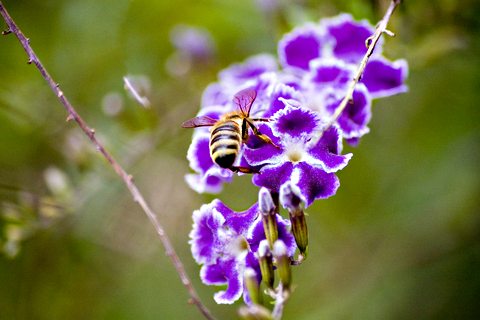
A while back I read something Georgia O’Keeffe said about how she stopped using color for a while and that it was a month before she found herself needing blue. I have written several poems about green for some reason, possibly because trees do this thing where all the leaves are a slightly different green. But I interacted with a purple flower recently and it made me think about that. So here we are.


There is a purple in the world–

Long ago only emperors

Were allowed to adorn themselves

With the rich, dark end

Of the rainbow–night coming on

With a light dew on the fields,

The stars blinking, the long yawn

Of the first full moon of spring:

That purple. Now even I could pluck such

A delicate flower, an emperor’s gift

And offer it to a perfect stranger.

When I Am Seventy-Plus

70plus

It took a year-plus to relieve the trauma we recall

From last winter that pounded us with seventy-plus

Inches of snow. It took an unseasonably mild winter


To counter the instant dismay caused by a sky greying

Over like ice over broken tar. We paused, tensed,

Refused to panic. We checked our shovels. We relaxed


When we realized that the 36-inch forecast meant

An inch or two, though wet. We still shudder to think

Of the wall of snow on every sidewalk, the wall that made


Parking almost impossible. We still shudder to think

How cold we were. We still shiver. Last July, I heard a man

Talk about how he still couldn’t believe the snow had melted.


Last July, the last of the snow finally melted. Last July,

When the summer was mild and I was not melting

In the 70-plus-plus but not yet 90-degree heat,


I shivered, but not as much as I am shivering this winter,

This mild, mild winter, when Christmas is 70 degrees

And it’s snowing at Easter, and no one really knows


How to forecast the future, how to predict weather:

I shiver in fear that the extra 20 or 30 degrees added

To our winter will also be added not just to this summer


But to all the summers to come, both those now

When I squander my forties and those later when I, 70-plus,

Look around at the 120 degree heat, and learn despair.

The World Arranging Itself

1912718

“It is not everyday that the world arranges itself into a poem.” –Wallace Stevens


Yes, yes, it does, this spinning marble of a rock, watery

Outside, fiery inside, hurtling through ice-cold space

As if nothing could stop it. And somehow the oceans,

Waxing blue as the sky, waning green as an emerald,

Flashing in the sun, foaming–fiercely, furiously—

Never peel off and sail away into the dark and sparkling

Blanket of space. Why not? Beauty holds together

The way life, once it has ended, keeps on beginning,

Day after day, century after century, aeon after aeon,

And if that’s not poetry, Mr. Stevens, I don’t know what is.