A Poem about Food

Thinking about what I said last week about writing about food, I came across an example from a long way back that is also a good example of concrete poetry, a poem that is written in the shape of its subject. I do not use this style often (and in the digital age, issues of formatting for audiences on a variety of platforms can be tricky), but I think this is a great example of form following function, since I am trying to say something not only about a piece of fruit but also about women and body image. This was published in Frontiers: A Journal of Women Studies. The title comes from a line of a poem by Robert Pack (with whom I studied at Middlebury College), “Guardians” from his book Keeping Watch: “What can the half-grown pears say? ”

 What the Pear Says

 …

Now you see

me: chartreuse skin,

ample convexities of

hip, abdomen, buttocks

curving, tapering, as I sit

regarding your twitching

fingers, watering mouth, and

indecisive eyes. Am I heavy?

Not at all. A mere handful. I have hips,

yes, but then so do love’s roses. Oh, I know.

This is not a shape you’ve been taught to desire.

No matter. Slide your hand around me,

pull me close. To taste me

is to love me.

 …

Spilecki, Susan. “What the Pear Says.” Frontiers (1997) 18:1.

What NOT to Do at a Poetry Reading, Rant #1

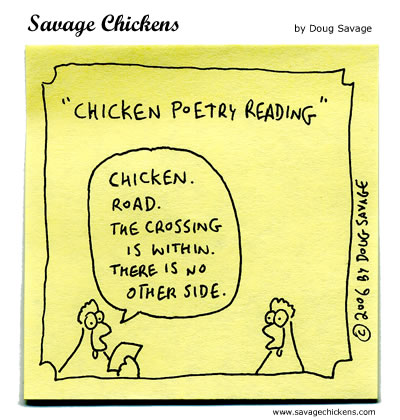
chickenreading

For those of you who have gained enough renown that folks are actually asking you to do real time readings of your poetry, I have tons of advice.

(These are also known as rants, because apparently what is obvious to me is not obvious to everyone else. It is kind of like how climate change is not being equated with gravity: the love rocks have for the ground, which for most of us is Super Obvious.)

I will eventually talk about the Mechanics of Reading in Public, and cover the Problem of Random Microphones, etc. But right now I feel the need to explain why you should never feel the need to explain too much. Archibald MacLeish once said, “If the poem can be improved by the author’s explanations, it never should have been published.” So never spend more than a few seconds explaining a poem. We want to hear the poem, not your explanation.

Do not hunch over the microphone. Your posture should be the posture of a professional human, not of a sloth.

When in doubt, do ask, “Can every one hear me?” In my experience, unless it is a Very Intimate Setting, the folks in back cannot.

And do, PLEASE, show respect for your audience by PLANNING ahead on what you are going to read. Do not just say, “Gosh, I wonder what I will read.” That is just an egotistical time-wasting lack of respect. Alvin Ailey dancers never go on stage saying, “Gosh, I wonder what dance I am going to do.” The New York Met does not congregate on stage saying, “I wonder what opera we should do tonight. Do we have any requests?” Prepare your reading. Hell, you might even want to practice it once or twice!

And, for those of you in our Studio Audience, if you have been dragged to a poetry reading by your (probably female) significant other, at least do us the favor of trying hard to pretend to stay awake.

Much obliged.

Image by Doug Savage.

PS: To catch one of my recent poems, go to this blog.

The Loneliness of the Long-Distance Writer

lonelypanda

In the end, we all write alone.

As a performing introvert, sometimes I revel in the solitude and sometimes I get edgy and want to talk to other people about the things I am writing about. Not imaginary people, like editors of journals and their subscribers. Real people with faces and names and opinions. At least, that is what it feels like.

I don’t know a lot of poets these days. Working in academia, I know a lot of fiction writers, scholars, science writers, bloggers and at least two recovering journalists. This is usually enough, as the issues we all face in terms of writing process and simply putting down the right words in the right order are ubiquitous regardless of genre. Having some writer friends is not only helpful; I would argue that it is necessary for your long-term happiness as a working writer. There are some things that only other writers understand:

  • the habit of leaving a notepad in the bathroom for 3 am inspirations
  • the frustration with having thought of the almost-right word (no, that is not good enough, dammit)
  • the victory of writing 1665 words a day for more than two weeks in a row
  • scribbling the lyrics to a new song idea on the inside of your Dunkin Donuts bag, sometimes before you get around to eating the donut
  • those white-noise days when you stare at page or screen for hours and produce nothing
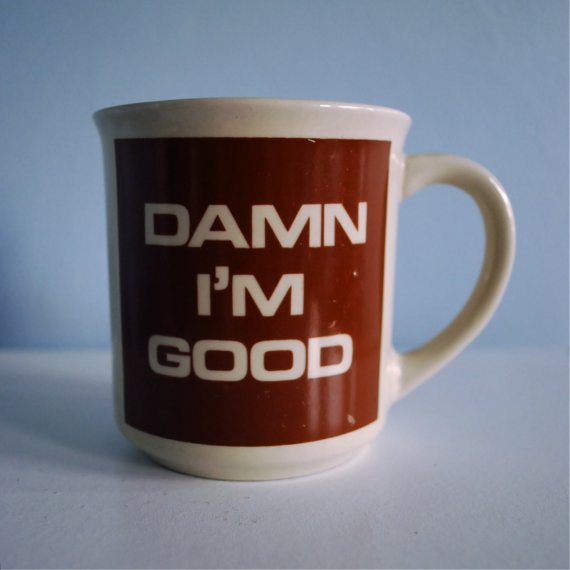
  • the feeling of “Damn, I’m good!”* when you finish an exquisite bit of writing even you didn’t know you were capable ofdamnfinemug

You can experience the joys and pains alone, but it is exhausting, especially when you are also submitting work to those imaginary editors out there in Journal Land and receiving form rejections back in a much higher proportion than the acceptances. And, alone, you can solve the obstacles in your writing—the clunky transitions, the fifth draft ending that still sucks—but it will go faster with a friend.

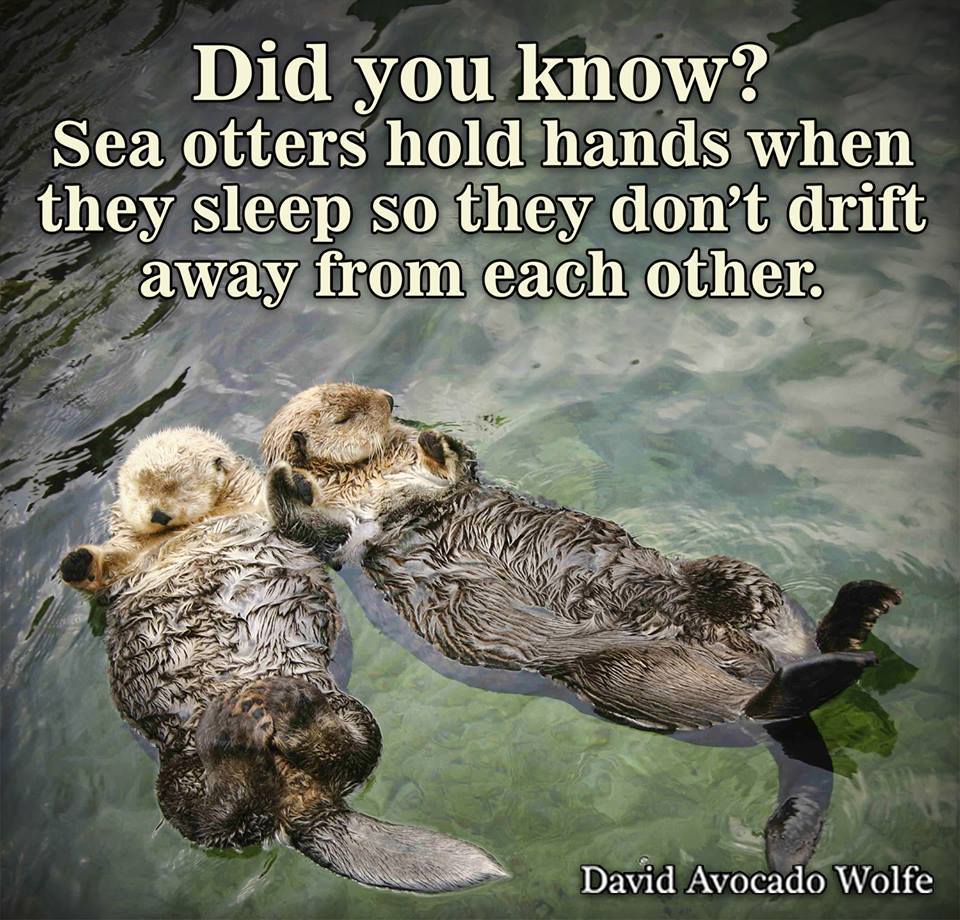
When I think of this, I think of otters, who sleep on their backs on the water, holding hands so that they don’t get separated. Sometimes, you just need a buddy.

otters

* A college friend of mine had a mug that said this. I have always thought it would be a great mug for a writer. George Eliot at the least would have found it invaluable.

Inspiration Tip: Revisiting Old Friends

sign

One way I rev the engine of creation when I am stuck in neutral gear is to go back to one of my favorite poets, often Marge Piercy, Billy Collins, or Nancy Willard, but occasionally someone less famous. A while back I was updating the Publication section on my Curriculum Vitae, which entailed digging through contributer’s copies. During the 1990s, I published a lot of my poems about art in a then-new journal called Ekphrasis, which means–get this–poems about art.

It is still around, a great little journal, and one of the best things about it is that it publishes some really cool poetry/poets. One of the poets I discovered there was Simon Perchik, who writes these skinny little poems with lines that just blow my mind. His line “or perhaps your shadow overflowing again” (from “D111”) inspired a poem about a panic attack; “today is missing/the ground is missing” (from “D180”) inspired a poem about an anxiety attack on a hot summer day. I cannot find some of the other poems; they were not all about mental health!

The ending of one of my favorite Nancy Willard poems was put on postcards several years back in a Poetry in Public sort of program. This is from “The Hardware Store as Proof of the Existence of God.”

“In a world not perfect but not bad either

let there be glue, glaze, gum, and grabs,

caulk also, and hooks, shackles, cables, and slips,

and signs so spare a child may read them,

Men, Women, In, Out, No Parking, Beware the Dog.

In the right hands, they can work wonders.”

Willard, Nancy. Water Walker. New York: Knopf, 1989.

Voice: Made from Eyes and Heart and Some Legos

midd

I was just reading Ann E. Michael’s blog post about voice and it got me thinking. She quotes Stanley Kunitz, who thought images from childhood were a key part of voice, but I am not completely convinced. I feel like I did not find an outer landscape that matched my inner landscape until I went to college in Vermont. If I were to write with my childhood imagery, there would be a lot more fireflies and dragonflies in my writing, more lilacs and sunflowers, small islands in the center of small lakes, and cloud animals.

Instead, I have a deep love of the passing seasons, the colors of mountains changing as the color of the trees changes, rolling hills, flashing waterfalls, and somewhere a cow or two hanging out. Living in Japan also affected my poetry strongly. The Japanese often represent the seasons in their visual arts and literature. And I think the complex process of translation that is living in a very different culture also changed the way I hear my voice. Also, the moon: there is a famous Japanese poem written while the poet was working in China as a sort of ambassador and missed his wife, something like how we all walk beneath the same moon. I still find that comforting and I think that is why the moon comes up often in my poetry.

One of the interesting things I have learned from studying singing is that I can feel where my voice is in my body. The high parts resonate in the head and the low parts resonate in the chest. It seems to me very important to remember that we write from the body. It is not enough to have a brain and hands.

And of course part of voice/style is always going to be technical, how you put the words together in a way that conveys your personal music. You keep rearranging the parts until it comes together the way you want it.

lego_yellow3-6001-522x442

Writing about Food

Dramatic_Woodchuck_by_HankaBanka

Back in the 1990s, when I taught creative writing in Northeastern University’s old night school, I found similar problems with the poetry and the autobiography students: cliché and vagueness. The poets wrote things that sounded like bad pop love songs and the autobiographers covered large swaths of time with things like, “I would go to school and then I would come home and after I would do my homework, I would go out with my boyfriend…”

Q: How much would would a wouldchuck chuck if a wouldchuck could chuck would? A: None. Smart Writer Woodchucks use simpler tenses and more riveting detail.

To solve this dilemma, I had both classes write about food before they took on any other topic (and, following the advice of a colleague, I said they were not allowed to write about Love until they had earned it). Food is a great topic for a few reasons. Everybody eats, everybody has an emotional connection to food (both positive and negative), and food stimulates not just the visual sense, but also the smell, taste and tactile senses. It is the perfect topic.

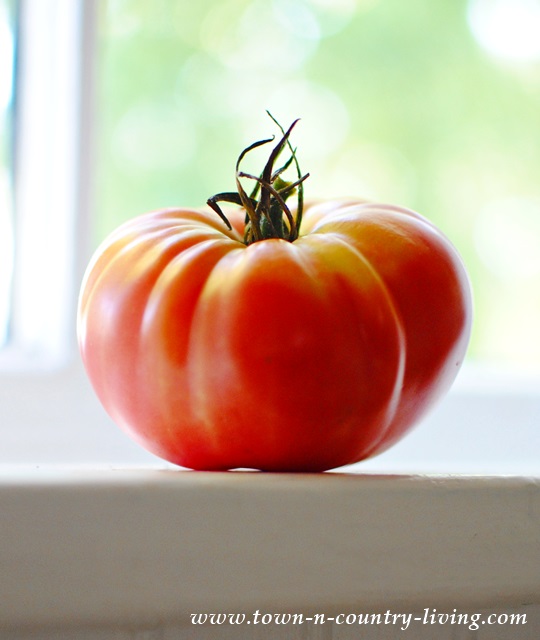
During these years, the English department of the night school sponsored an April poetry reading every year to showcase the teaching poets in honor of National Poetry month. One year I read a poem I had written about a tomato, sunning itself on my windowsill like a Buddha.

After the reading, a student came up to me goggle-eyed, and said, “I am never going look at tomatoes the same way again!”

Without thinking, I said, “That is the whole purpose of poetry.”

And the more I have thought about it, lo these many years, the more I believe I was right.

Tomato-on-Windowsill

33 Years of Poetizing!

snoopydance

Well, it does not seem possible, but I have been writing poetry seriously for 33 years. Such a landmark seems to require a thoughtful contemplation of what I have learned, and also a giddy Snoopy dance of celebration. First the contemplative bit.

Some of my poetry is conversational. Conversations in different languages have their own music. English tends to march along, which is why iambic pentameter is historically such a popular rhythm in our literature. Japanese is more takataka takataka, as they say, at least in the cities. The romance languages are more fluid and flowing. One way to achieve this kind of music is through internal rhyme and slant rhyme. Rather than putting a perfect rhyme (bright light) at the end of lines, you put them in the middle of lines, and not necessarily at the same distance from each other. A slant rhyme (light bide) pulls the reader’s attention without drawing too much attention to itself, a bit like the difference between a cat tapping you on the arm rather than jumping into your lap. You can see examples of this at poetry slams, spoken word events and other performances.

I have learned a lot about why and how revising happens. This post by Ann Michael on gestation says it quite well.

I have learned about dealing with rejection, which for me is having many eggs in many baskets, and only caring deeply about the eggs I am currently laying, rather than the ones I have sent off to become omelets. Many writers struggle with this. There are even whole books about it.

One of the hardest things for some people is abandoning projects that are going nowhere. I remember the utter aghast looks on my college classmates’ faces when a visiting poet said that if the work in his Not Yet drawer still didn’t work after half a dozen passes with weeks or months in between, he chucked it. But honestly, sometimes it make sense to, you should forgive the phrase, Let It Go. Though as one of my colleagues has recently shown, it is not always easy.

Lastly, I have learned that although we all write alone, we are saner and wiser if we also surround ourselves with a community of other writers and artists and people who are trying to make order out of chaos.

And when you have the opportunity, do the Hokey Pokey to bagpipe music.

Yoga Lessons for the Working Poet #1

pretzel

Today, I am taking this as the opportunity to talk more about yoga, my latest obsession/Important Excitement. As I think I have said before, I have always believed that the other arts–visual, musical, physical and spiritual–have much to teach the working writer, and in particular the working poet. I sing a lot (often at the top of my lungs) although I am a poor musician, and I have been a martial artist for more than half my life now, so I am always noticing how these practices apply to my practice of writing. Doing yoga now for almost eight months has brought similar insights.

It’s funny. I have several women friends who each have two brothers, the one they get along well with, who is always named, and the one they don’t, who is always called “my brother” or “my other brother,” even if the first is not named. Similarly, my gym has several yoga instructors, most of them very good, one who is a drill sargeant, and Erica Magro, who I consider My Yoga Teacher. Because what I learn from her isn’t just about turning my body into a pretzel or seeing how long I can hold a particular pose; it’s about learning a new way to live.

I think writing is like that. There are lessons to be learned from the constant, daily practice of writing. Some of those lessons are similar to the lessons I learn in yoga. Erica often says, “Get there how you get there. If it doesn’t feel right, back off.” This is not the sort of thing we get taught in our hypercompetitive culture, and it is a lesson I frequently need to pass on to the writers I work with, especially the scientists and engineers at MIT, who didn’t get to the top of their profession by going easy on themselves, and sometimes find themselves tied up in figurative knots because of it when it comes to their writing.

This may sound like a contradiction to the things I say about discipline and not waiting for a muse before you get down to the work that is writing. It isn’t really. The word discipline doesn’t inherently mean being hard on yourself. It is more akin to the word disciple, and means teaching and learning. So for me, self-discipline involves learning how I do things, what is the best environment for me, the best medium for getting my ideas on paper, and then taking advantage of my strengths. And it means, when I hit a wall in whatever I am working on, I back off for a while. I do something else. Let the back of my brain mull over the problem while I use the front for other things. Then, when I go back to my wall, I am more apt to see possible doors and windows or tunnels or even ramrods.

And when I see how useful this practice of backing off and returning is in my writing, when I have proof that it works, I am much more likely to bring it to the rest of my life. And I live with a little less stress as a result.
Answering the Call

flycar

Well, after a long time away from the Grueling Slog that is submitting work for publication (I had a coaching business and then went and got a second masters degree; I wasn’t just sitting around eating bonbons), I am finally back in the game, and my word, how the game has changed. Ten years ago I was still printing poems out and sticking them in envelopes with a Self-Addressed Stamped Envelope for return. How 19th century that feels now. In comparison, the new online submission vehicle, Submittable, feels like a flying car.

One thing that has stayed the same, though, is how I feel about Calls for Submission that are vague or cheeky. “Our only criterion is excellence” is a load of horse hockey; once you get past the beginner stages of creative writing, excellence becomes more and more subjective. What I like better is when they tell you who they’ve published. Also, general calls are less interesting to me than theme-based calls. If somebody says the theme is “storms” then I have a good idea which of my poems to submit, whether the stormy weather in them is real or metaphorical.MUSASHI_MIYAMOTO_by_BARCYD

A recent one that I have been playing with is “elements.” This one is cool because you could take it to mean parts of a whole, the Table of Elements, or any of a variety of cultures’ primary elements, from the four of Western Euro-culture (earth, air, water, fire) to the five of China or Japan or…. For example, the 16th century Japanese sword master Miyamoto Musashi (pictured above) after whom my cat is named (pictured below, photo by Jack Siberine), split The Book of Five Rings into five parts named after earth, air, water, fire, and the void. I wrote a really cool poem about the void that I am sending out (yes, it mentions lost socks). But I can also send out one about the painter Hiroshige, who was a fireman’s son in Edo (now Tokyo) in a time and place when/where a small fire could wipe out whole portions of a city where most buildings were made of wood. I could write about alchemists trying to turn lead to gold, or about Superman’s trouble with kryptonite. The themes not only make it easier to pick out poetry I have already written, but it also inspires me to write more.

Mu with String

And we all want to find ways to write more.

The New Grub Street

For those of you in the Boston area, my friend and colleague Rebecca Thorndike Breeze, a recovering academic and awesome writer, describes some resources for writers.

rtbhive's avatarInhabit Your Town

Gissing - New Grub Street, vol. I, 1891 George Gissing [Public domain], via Wikimedia Commons

BOSTON

January 9, 2015

Grub Street

Grub Street doesn’t exist any more — as an actual street — and it hasn’t done so for well over a century. But Grub Street has, and still does, exist as a certain kind of ethos. By the time George Gissing wrote New Grub Street  in the early 1890s, “Grub Street” stood for “hack writing” — in other words, writing for pay, or writing “to get one’s bread,” as they used to say. Gissing’s novel dramatizes the cultural split between “high culture” and “mass culture” as it tells the story of two very different writers: an idealistic novelist who writes for art’s sake, with very little success, and a cynical journalist who writes for money and as the market dictates. It’s a good novel — and a great example of British naturalism — though I like The Odd Women

View original post 596 more words