What Poetry Is Not: A Short Rant

These days, going to the gym gives me indigestion. I blame the Food Network. You see, some days the only thing on the TV on the elliptical machine is food shows. So I watch Giada De Laurentis or Ina Garten or Robert Irvine making magic with food. And then there is the dreaded commercial.

I get it. It is now Advent, the four weeks before Christmas, and everybody wants to Get Into the Spirit of the Season, but why do they have to do it by sounding like a stupid Hallmark card? The ad for a new holiday dessert competition tells us about the show that will apparently give chefs only an hour to make their cookies “and dust them with flour.” (Which they say while actually showing a chef dusting a cake with sugar. But you know how it is with rhyming poetry: the only thing that really rhymes with sugar is…wait for it…booger.) At Christmas, cheesy rhymes, especially rhyming couplets (an AA rhyme), come out of the woodwork to make my blood boil.

Now it is one thing if you are under the age of consent to still believe that a rhyme makes a poem. And especially if you do not think of yourself as a poet and you are not trying to become a professional poet, you can believe whatever you want. I don’t care. But I have seen too many badly rhymed pieces of crap labeled poetry. And if that weren’t bad enough, you also get the other side of the coin: prose broken up into very short lines, usually broken right before prepositional phrases, with no rhythm at all, not even conversational or, failing that, blank verse (unrhymed iambic pentameter). It’s like the writers aren’t even trying. And they justify it by saying anybody can write poetry.

Well, you know what? They are right. Anybody can write poetry. Sometimes it is going to be bad poetry. Ted Sturgeon, a science fiction writer, famously said that 95% of science fiction was crap, like everything else, and Ursula K. Le Guin commented, “The Quest for Perfection fails 95% of the time but the Search for Garbage never fails” (223).

So if you are going to insist on writing poems and calling it poetry, then do yourself and the rest of us a favor. Invest in some Peterson’s Guides and a really good thesaurus, so that you know the difference between a birch and a sycamore and you have lots of different words for green. And if you insist on rhyming then also get a good rhyming dictionary so that at least your rhymes will be more original…

…and less boogery.

Le Guin, Ursula. The Language of the Night: Essays on Fantasy and Science Fiction. New York: Berkley Books, 1982.

Practical Poetry

You might think, if you are not a poet, that poetry isn’t practical. You might recall Ernest Hemingway’s assertion that “Prose is architecture, not interior decoration,” and think, well, maybe poetry is interior decoration… You would be wrong. Or, if right, not in the way you think.

Poetry won’t keep the rain off your head and unless you have a really thick hardback book of it in your breast pocket, it probably won’t save your life. (Teddy Roosevelt once survived an assassination attempt because he had a thick speech in his pocket, but bullets were slower and smaller back then.) Poetry does not protect us the way architecture does. But what is the practical purpose of interior decoration?

Many of us, when thinking of interior decoration in the abstract, might think of the crowded Victorian parlor with its innumerable mementos on tables and mantles, and walls so filled with pictures that the wallpaper is invisible: lots of things that have little value and serve mainly to distract the viewer and make the room feel full. Abundance presumably symbolizes wealth here, with quantity being more important than quality.vic parlor

It is no surprise then that it wasn’t the Victorians who invented the haiku! A lot of us were taught that the haiku is a 17-syllable poem of 3 lines, of 5, 7, and 5 syllables each. Actually that defines a senryu, which can be about any topic. Strictly speaking, a haiku needs to be about nature, the seasons, etc. But here is the problem that nobody explains. A 17-syllable poem in Japanese might have as few as 5 to 8 words. The word sensei, teacher, sounds like only 2 syllables in English, but in Japanese, it is 4 syllables: se-n-se-i. So those brilliant haiku poets, Basho and Issa? They are even more brilliant than you thought!

tokonoma

Similarly Japanese interior decoration is traditionally minimalist. A home might have a room where you would greet guests, and in that room is an alcove called the tokonoma where the family will display a scroll or flower arrangement or holiday decoration. Not ten. One. Keeping it simple and classy. Often the decoration will change with the seasons, making a small artistic statement about how we move through the year, and how the seasons move through us. I think poetry can be like that, a beautiful moment to acknowledge a truth about the world and ourselves. And to me, that kind of poetry is very useful, very practical.

In the introduction to her 1982 collection of poetry, Marge Piercy explained how she wanted her poems to be of use. “What I mean by useful is simply that readers will find poems that speak to and for them, will take those poems into their lives and say them to each other and put them up on the bathroom w all and remember bits and pieces of them in stressful or quiet moments. That the poems may give voice to something in the experience of a life has been my intention. To find ourselves spoken for in art gives dignity to our pain, our anger, our lust, our losses. We can hear what we hope for and what we must fear, in the small release of cadenced utterance. We have few rituals that function for us in the ordinary chaos of our lives” (xii).

This is what I look for in poetry that I read, and this is what I work for in poetry that I write.

Piercy, Marge. Circles on the Water: Selected Poems of Marge Piercy. New York: Knopf, 1982.

The Benefits of Levitas over Gravitas

About two centuries ago Napoleon said, “From the sublime to the ridiculous is but a single step.” Well, actually, he said it in French, so it probably sounded more impressive, but my high school French is limited, to say the least, so were going to stick with English here. When I think about truly ridiculous poetry, I think of the greats: Ogden Nash, Dorothy Parker, Shel Silverstein, Calvin Trillin, Lewis Carrol, J.R.R. Tolkien, Walt Kelly, and Edward Lear.

But poetry doesn’t have to be ridiculous to be funny, and often a funny poem can move someone who is leery of being moved by a more serious poem. And there are a lot of people like that. I blame fifth grade teachers.

Do not misunderstand me. I applaud the long hard labor of grammar school teachers. I admire their endless patience and willingness to work with Other People’s Children at an age when kids still have too much energy to sit still all day. However, as an English teacher in college for the last two decades, I have seen that a lot of damage gets done to kids by teachers who think they know what poetry and writing should be, even though by definition they probably don’t have time to do much of it themselves.

Whenever I teach a literature class, I first ask my students to raise their hands if they hate poetry. Usually a third raise their hands and one or two say, “Well, I don’t hate it but I don’t understand it.”

To them I promise that they might come to feel differently about poetry, hopefully better. The rest of the students I promise that they will not come to hate poetry because of me. Because I guarantee that if a person hates poetry, it is because a particular person made them hate it. Some teacher, most likely, either insisted that her/his reading of a poem was the Only One Allowable, or she/he insisted that a poem could mean anything at all (which any ten year old can tell you means that the poem means nothing). Neither of these readings is really useful.

And if I have students who Really Detest Poetry, then I give them a copy of Marge Piercy’s “Attack of the Squash People,” which begins:

“And thus the people every year

in the valley of humid July

did sacrifice themselves

to the long green phallic god

and eat and eat and eat.


They’re coming, they’re on us

the long striped gourds, the silky

babies, the hairy adolescents,

the lumpy vast adults

like the trunks of green elephants.

Recite fifty zucchini recipes!”

Now a lot of my students grew up in urban environments, but still most people know the trope of planting “a few vegetables” and ending up with a whole lot more than they bargained for, a whole lot more than they, their families, friends, and neighbors can eat. And the poem isn’t just about the humor of overabundance. It ends with something worth remembering:

“You give and give

too much, like summer days

limp with heat, thunderstorms

bursting their bags on our heads,

as we salt and pickle and freeze

for the too little to come.”

Another lesson that can be taught with a funny poem is how less is, yes, more. My favorite example of this is Lucille Clifton’s “wishes for sons,” which begins like this:

“i wish them cramps.

i wish them a strange town

and the last tampon.

i wish them no 7-11.


i wish them one week early

and wearing a white skirt.

i wish them one week late.”

Understatement gets the job done. No extra details are necessary. We see the speaker’s sons learning the hard way what it is like to be a woman. This kind of gentle humor, stripped-down form and simple diction are characteristic of Clifton’s work. I love how the poem ends:

“let them think they have accepted

arrogance in the universe,

then bring them gynecologists

not unlike themselves.”

This one inevitably wins over the women. I have other poems to help with winning over the men.


Clifton, Lucille. Blessing the Boats: New and Selected Poems, 1988 2000. New York: BOA Editions, 2000.

Piercy, Marge. Circles on the Water: Selected Poems of Marge Piercy. New York: Knopf, 1982.

Poetry of the Sublime

I have subtitled my blog: All About Poetry: Sublime, Ridiculous, Useful. And that is what it is going to be. Over the next few posts, I aim to unpack those three things, starting today with Sublime.

When I think of a good example of a sublime piece of poetry, I think of Stephen Spender’s “The Truly Great.” Spender (1909-1995) was a British poet and essayist who wrote a good deal about social injustice, was first pro- and later anti-Communist and ended up being knighted about ten years before his death. Let us look at the first verse:

“I think continually of those who were truly great.

Who, from the womb, remembered the soul’s history

Through corridors of light where the hours are suns,

Endless and singing. Whose lovely ambition

Was that their lips, still touched with fire,

Should tell of the Spirit, clothed from head to foot in song.

And who hoarded from the Spring branches

The desires falling across their bodies like blossoms.”

There are a lot of things to notice about this verse. There is no rhyming. The lines are not metrical or even the same length: the longest is 14 syllables and the shortest is 9. But they feel right. And the language! I feel like I know what it means to remember “the soul’s history/Through corridors of light where the hours are suns,/Endless and singing.” I can see it and hear it. And desire is not located inside the body but outside like falling blossoms.

The Japanese have a saying about the blossoms of the cherry tree, which bloomsFeatured image very briefly in April, perfuming the people wandering below their branches: beautiful and gone. It means that life is brief and to be treasured for what little time we have. I think Spender is using this imagery in just this way, especially given how he ends.

“The names of those who in their lives fought for life,/Who wore at their hearts the fire’s centre./Born of the sun, they travelled a short while toward the sun/And left the vivid air signed with their honour.”

One of the things poetry can do is remind us to wear the fire’s center at our hearts, to live vividly in the sun. Computers cannot do that for us, not really. I cannot see anyone living with a fire in their heart huddled over a smartphone on the train while outside the window golden leaves are falling across the tracks, longing to be noticed like the people inside the train are longing to be noticed. Poems can wake us up.

Spender, Stephen. Selected Poems. London: Faber & Faber, 1965. (I like this poem so much I accidentally bought a second copy of this book.)

Poetry and Cathedrals: An Introduction

When I think about poetry, I often think about cathedrals.

This does not mean that I think poetry is a place to get lots of people who believe more or less the same thing, and a bishop who would probably LOVE it if they actually did, together to sing really loud so it echoes a hundred feet up in the rafters where the gargoyles can sing along, although that is nice too.singing gargoyle

Nor am I necessarily thinking of it as a place where a thief on the run could claim sanctuary from the posse carrying torches and pitchforks and chasing him down, although, now that I think of it, it would be very cool if poems could do that.

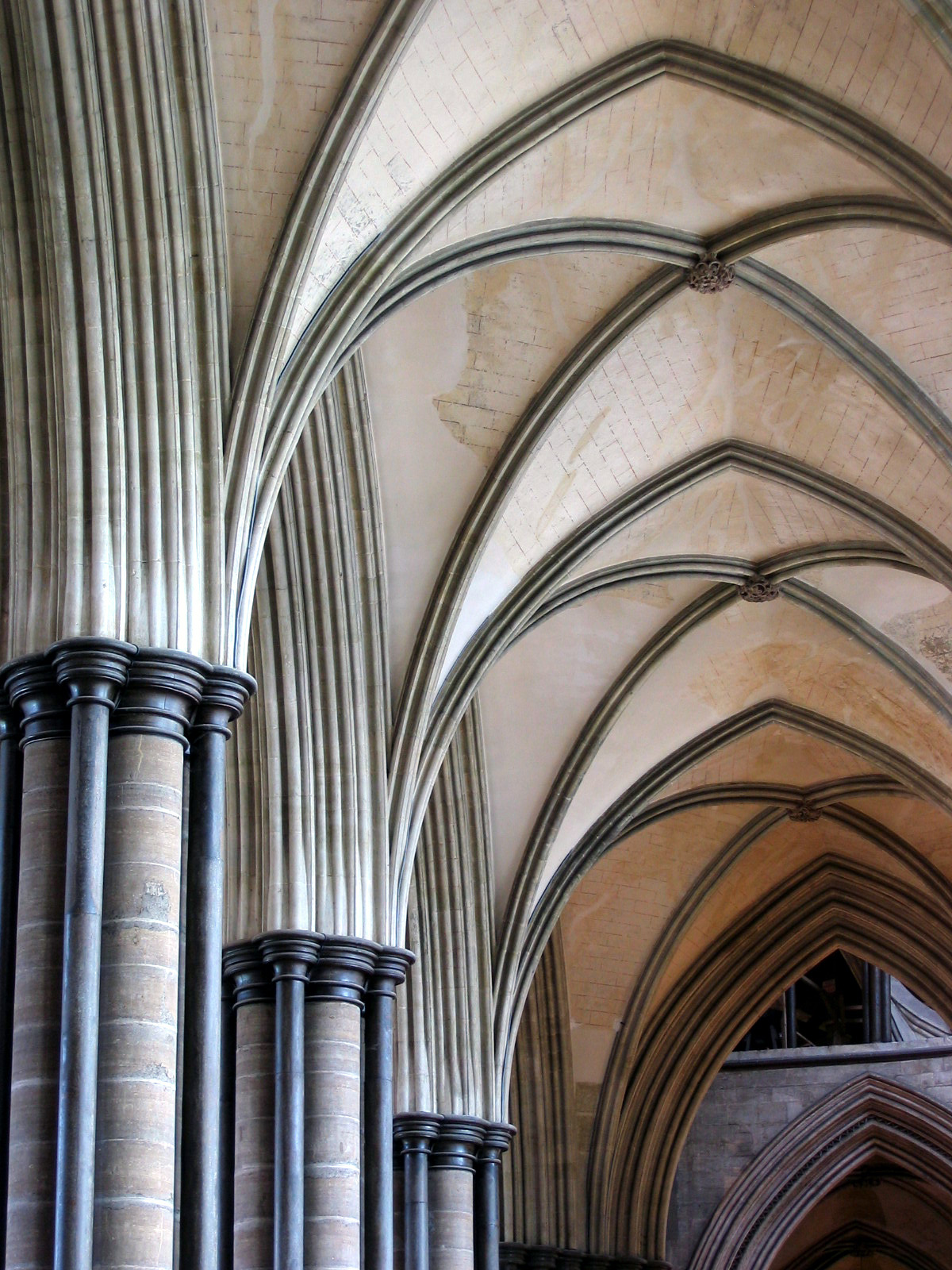
No, I am thinking about the architecture, the repeating fractals of the arches and windows and niches for statues of saints, repetitions like rhymes in stone. Salisbury_cathedral_plan

I am thinking about how, back in the twelfth century or so in Europe, they did not have a single consistent unit of measurement. A foot in a particular building was based on the length of one guy’s foot, say, Geoffry the masterbuilder. Then they figured out a good solid square size, say, twenty feet by twenty feet, and they repeated that square size outward to create the cross-section that made the plan of the cathedral. Given this apparently random style of measurement, the classic Gothic cathedrals of Europe are remarkably consistent, each within itself, even if not compared to each other.

Poems are like that. Even when there is a formal form, like a sonnet or a haiku, each poet is going to interpret it in his or her own way, turning something that is, after all, just a rule driven construction into a piece of art, a place where we can go to inhabit the poet’s ideas and imagination and hopefully his or her love of language. (I say hopefully because, unfortunately I think many poets are so in love with rhyme for its own sake that they don’t give the words they choose enough thought. And that can’t be good.)Salisbury_Cathedral_Detail_Arches

This blog will examine these kinds of ideas about poetry. There is a great line, attributed to Martin Mull, that says, “Talking about music is like dancing about architecture.” It is difficult to talk about one sense without referring to the other senses. Similarly, trying to elucidate structure means we use whatever language we have for structure, which is often architectural. I believe that to best represent the work of creativity that is poetry, I am going to have to draw on a lot of fields and the language of a lot of different arts. (Whoo hoo! Research party!)

I also intend to be very opinionated, because after all, I have been writing poetry for over thirty years, publishing it for more than twenty, and I feel that I have a right to my hard-won professional opinions. I can tell you what I have learned from my students, and also hopefully teach you the things I taught them that they have found useful.

We will also have fun, because I grew up reading the poetry of Ogden Nash, Dr. Seuss and Walt Kelly, and if I had only read the Terribly Serious Poets, I would most likely not be a poet today. So I will end with the words of Dorothy Parker:

“In youth, it was a way I had,
To do my best to please.
And change, with every passing lad
To suit his theories.

But now I know the things I know
And do the things I do,
And if you do not like me so,
To hell, my love, with you.”
Dorothy Parker, The Complete Poems of Dorothy Parker