A Poem about Food

Thinking about what I said last week about writing about food, I came across an example from a long way back that is also a good example of concrete poetry, a poem that is written in the shape of its subject. I do not use this style often (and in the digital age, issues of formatting for audiences on a variety of platforms can be tricky), but I think this is a great example of form following function, since I am trying to say something not only about a piece of fruit but also about women and body image. This was published in Frontiers: A Journal of Women Studies. The title comes from a line of a poem by Robert Pack (with whom I studied at Middlebury College), “Guardians” from his book Keeping Watch: “What can the half-grown pears say? ”

 What the Pear Says

 …

Now you see

me: chartreuse skin,

ample convexities of

hip, abdomen, buttocks

curving, tapering, as I sit

regarding your twitching

fingers, watering mouth, and

indecisive eyes. Am I heavy?

Not at all. A mere handful. I have hips,

yes, but then so do love’s roses. Oh, I know.

This is not a shape you’ve been taught to desire.

No matter. Slide your hand around me,

pull me close. To taste me

is to love me.

 …

Spilecki, Susan. “What the Pear Says.” Frontiers (1997) 18:1.

What NOT to Do at a Poetry Reading, Rant #1

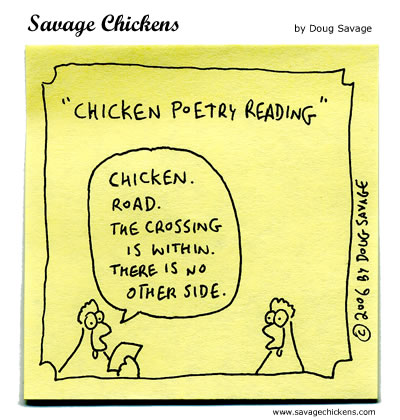
chickenreading

For those of you who have gained enough renown that folks are actually asking you to do real time readings of your poetry, I have tons of advice.

(These are also known as rants, because apparently what is obvious to me is not obvious to everyone else. It is kind of like how climate change is not being equated with gravity: the love rocks have for the ground, which for most of us is Super Obvious.)

I will eventually talk about the Mechanics of Reading in Public, and cover the Problem of Random Microphones, etc. But right now I feel the need to explain why you should never feel the need to explain too much. Archibald MacLeish once said, “If the poem can be improved by the author’s explanations, it never should have been published.” So never spend more than a few seconds explaining a poem. We want to hear the poem, not your explanation.

Do not hunch over the microphone. Your posture should be the posture of a professional human, not of a sloth.

When in doubt, do ask, “Can every one hear me?” In my experience, unless it is a Very Intimate Setting, the folks in back cannot.

And do, PLEASE, show respect for your audience by PLANNING ahead on what you are going to read. Do not just say, “Gosh, I wonder what I will read.” That is just an egotistical time-wasting lack of respect. Alvin Ailey dancers never go on stage saying, “Gosh, I wonder what dance I am going to do.” The New York Met does not congregate on stage saying, “I wonder what opera we should do tonight. Do we have any requests?” Prepare your reading. Hell, you might even want to practice it once or twice!

And, for those of you in our Studio Audience, if you have been dragged to a poetry reading by your (probably female) significant other, at least do us the favor of trying hard to pretend to stay awake.

Much obliged.

Image by Doug Savage.

PS: To catch one of my recent poems, go to this blog.

Yoga Lessons for the Working Poet #1

pretzel

Today, I am taking this as the opportunity to talk more about yoga, my latest obsession/Important Excitement. As I think I have said before, I have always believed that the other arts–visual, musical, physical and spiritual–have much to teach the working writer, and in particular the working poet. I sing a lot (often at the top of my lungs) although I am a poor musician, and I have been a martial artist for more than half my life now, so I am always noticing how these practices apply to my practice of writing. Doing yoga now for almost eight months has brought similar insights.

It’s funny. I have several women friends who each have two brothers, the one they get along well with, who is always named, and the one they don’t, who is always called “my brother” or “my other brother,” even if the first is not named. Similarly, my gym has several yoga instructors, most of them very good, one who is a drill sargeant, and Erica Magro, who I consider My Yoga Teacher. Because what I learn from her isn’t just about turning my body into a pretzel or seeing how long I can hold a particular pose; it’s about learning a new way to live.

I think writing is like that. There are lessons to be learned from the constant, daily practice of writing. Some of those lessons are similar to the lessons I learn in yoga. Erica often says, “Get there how you get there. If it doesn’t feel right, back off.” This is not the sort of thing we get taught in our hypercompetitive culture, and it is a lesson I frequently need to pass on to the writers I work with, especially the scientists and engineers at MIT, who didn’t get to the top of their profession by going easy on themselves, and sometimes find themselves tied up in figurative knots because of it when it comes to their writing.

This may sound like a contradiction to the things I say about discipline and not waiting for a muse before you get down to the work that is writing. It isn’t really. The word discipline doesn’t inherently mean being hard on yourself. It is more akin to the word disciple, and means teaching and learning. So for me, self-discipline involves learning how I do things, what is the best environment for me, the best medium for getting my ideas on paper, and then taking advantage of my strengths. And it means, when I hit a wall in whatever I am working on, I back off for a while. I do something else. Let the back of my brain mull over the problem while I use the front for other things. Then, when I go back to my wall, I am more apt to see possible doors and windows or tunnels or even ramrods.

And when I see how useful this practice of backing off and returning is in my writing, when I have proof that it works, I am much more likely to bring it to the rest of my life. And I live with a little less stress as a result.

Answering the Call

flycar

Well, after a long time away from the Grueling Slog that is submitting work for publication (I had a coaching business and then went and got a second masters degree; I wasn’t just sitting around eating bonbons), I am finally back in the game, and my word, how the game has changed. Ten years ago I was still printing poems out and sticking them in envelopes with a Self-Addressed Stamped Envelope for return. How 19th century that feels now. In comparison, the new online submission vehicle, Submittable, feels like a flying car.

One thing that has stayed the same, though, is how I feel about Calls for Submission that are vague or cheeky. “Our only criterion is excellence” is a load of horse hockey; once you get past the beginner stages of creative writing, excellence becomes more and more subjective. What I like better is when they tell you who they’ve published. Also, general calls are less interesting to me than theme-based calls. If somebody says the theme is “storms” then I have a good idea which of my poems to submit, whether the stormy weather in them is real or metaphorical.MUSASHI_MIYAMOTO_by_BARCYD

A recent one that I have been playing with is “elements.” This one is cool because you could take it to mean parts of a whole, the Table of Elements, or any of a variety of cultures’ primary elements, from the four of Western Euro-culture (earth, air, water, fire) to the five of China or Japan or…. For example, the 16th century Japanese sword master Miyamoto Musashi (pictured above) after whom my cat is named (pictured below, photo by Jack Siberine), split The Book of Five Rings into five parts named after earth, air, water, fire, and the void. I wrote a really cool poem about the void that I am sending out (yes, it mentions lost socks). But I can also send out one about the painter Hiroshige, who was a fireman’s son in Edo (now Tokyo) in a time and place when/where a small fire could wipe out whole portions of a city where most buildings were made of wood. I could write about alchemists trying to turn lead to gold, or about Superman’s trouble with kryptonite. The themes not only make it easier to pick out poetry I have already written, but it also inspires me to write more.

Mu with String

And we all want to find ways to write more.

The New Grub Street

For those of you in the Boston area, my friend and colleague Rebecca Thorndike Breeze, a recovering academic and awesome writer, describes some resources for writers.

rtbhive's avatarInhabit Your Town

Gissing - New Grub Street, vol. I, 1891 George Gissing [Public domain], via Wikimedia Commons

BOSTON

January 9, 2015

Grub Street

Grub Street doesn’t exist any more — as an actual street — and it hasn’t done so for well over a century. But Grub Street has, and still does, exist as a certain kind of ethos. By the time George Gissing wrote New Grub Street  in the early 1890s, “Grub Street” stood for “hack writing” — in other words, writing for pay, or writing “to get one’s bread,” as they used to say. Gissing’s novel dramatizes the cultural split between “high culture” and “mass culture” as it tells the story of two very different writers: an idealistic novelist who writes for art’s sake, with very little success, and a cynical journalist who writes for money and as the market dictates. It’s a good novel — and a great example of British naturalism — though I like The Odd Women

View original post 596 more words

How Poets Get Published: A Rhinoceros and a Thesaurus Walk into a Bar…

rhino Back in December when I talked about line endings, I mentioned the late poet Bill Knott. I never took a class with him while I was getting my MFA at Emerson College, because quite frankly he was strange and a little scary and I already had tons more confidence in my poetry than in my prose. But from him, though second hand, I got two of the most useful bits of poetic advice I have ever gotten. The first was on line endings. The second was about how to play the publishing game.

These days, cover letters (CLs) are not as de rigeur as they were before the advent of online submissions, but they still exist and they still look pretty much the same:

Dear Ms. Editor,

I enclose my poems “Nonchalance,” “Influences,” and “What the Pear Says” for publication in The Stoat Literary Journal. My work has been published in The Rat Vomit Review, Villanelles for Voles, and Most Impressive Poetry. Thank you for your consideration.

That second sentence of the CL is the part where Bill passed on crucial info to me without knowing it. See, editors really prefer to publish people who have already been published. So you start by getting published wherever you can (The Rat Vomit Review was Bill’s way of exemplifying the sort of barrel bottom journal where you would start, a journal that took maybe 40% of submissions*). Then you have your first credit to put into that second sentence. Then you get a second, then a third, and then you start for the next tier, journals that take 35% or 30% and you replace the three journals and work your way up.

This process reminds me of a subletter I had one summer, Estelle, who said she only had two criteria: will it make me gain weight and will it look good on my resume?

So, no, do not start by trying to get your work published in The New Yorker. They only take folks who already have books. Do not waste their time and yours. Start at the bottom and work your way up. I have found that it takes sending any poem out between 15 and 25 times before I get a publication. It gets easier as you go along, but not much. So when they say Read Our Journal Before Submitting, they really mean it, and it is not just to get your money (libraries are your friends here…). You need to understand who actually publishes the kind of stuff you write and who really does not.

For those of you who are coming to poetry from academia, where apparently they tell you to send your journal articles to the top journals first and work your way down, well, that is just a very different world. And this makes sense, of course, because there are Way More WannaBe Poets than WannaBe Doctoral Candidates.

The three keys to this process are simple:

1) Keep good records. Know what you have sent, where, and when.

2) Get a good Rogets Collegiate Thesaurus. The importance of specificity and the Exactly Right Word in poetry cannot be overstated.

3) Develop rhinoceros skin. You will be rejected repeatedly for years. For every acceptance, there will be two dozen rejections, easily. Learn to take it. Learn to put your heart in the stuff you are currently writing rather than the stuff that you have sent like orphans out into the cruel world. You will last longer.

*Writers Digest Market books (Writers Market, Poets Market, etc.) have this info in their hard copy and electronic versions.

My Yoga Sestinas

fly-fishing-flies-lures-for-salmon-royalty-free-stock-photo-1200x801When writing sestinas, most people choose their six words fairly randomly, but I like to make a phrase that I can unpack and repack as I go through, as I did with the example last time: how I love those six lines. I think this is why, when writing an essay about my yoga teacher, Erica Magro, didn’t work, and free verse didn’t work, I instinctively started writing sestinas. Those little things that she said were often between five and seven words. Like fly-fishing lures, they caught my wandering mind and hooked it and would not let go until I had worked it out through a poem. Here are just a few:

“The Writing Teacher at Yoga Class”: letting go after all that work.

“Tadasana: Mountain Pose”: now return to mountain stand tall

“The Yoga Teacher” (v 2.0): breathe space into bodies so patient

“Utthika Trikonasana: Extended Triangle Pose”: lifting your heart open to sky

“Shavasana: Corpse Pose”: wholeheartedly resting by means of shavasana

You start talking about one thing and then halfway through, if (when?) the magic happens, you find you are saying True Things. For example, here is an excerpt from “Utthika Trikonasana: Extended Triangle Pose.”

The heart

Wants free flight through the cerulean blue of open sky,

The terrifying free-fall of loving and being loved. To open

Up such an opportunity is incalculable risk. You trust lifting

Forces will hold you up, but the hard ground is a fact you

Can’t ignore, below you, waiting more patiently than sky to

Gather you up and keep you. Sky can’t keep you, only help to

Keep you standing straight, tall, with your beautiful heart

Practicing being open. I think of this in triangle pose, your

Legs a perfect V, one hand on the floor, one reaching for sky,

Your heart radically open. With the rest, I imitate you, lifting

My eyes to open up my chest, my heart, and keep it open.

It’s an odd way to see things, sideways, from below, open

To the world.

ERICA triangle

And of course that is the risk of poetry as well, opening heart and mind and keeping them open in a world that doesn’t make that easy. But I think that most disciplines teach the same lessons, whether it is poetry or yoga or martial arts or music. If you keep on seeing the world from an unusual angle, eventually, if you let it, it will change you.

Also, let’s face it: utthika trikonasana is just a whole lot of fun to say.

Ma, Kelvin. Erica Magro, Yoga Instructor. 2012. Kelvin Ma Photography. Web. 7 Aug. 2014. JPEG file.

The Joy of Sestinas

sestina

Sestinas do not get nearly the same kind of PR as sonnets, but I love them much more, in part because, rather than rhyme (and you know how I feel about rhyme), the key to a sestina is the end words.

Before I go on, I should say that no, Dylan Thomas’s “Do Not Go Gentle Into That Goodnight” is not a sestina. It is a villanelle. We tend to get taught these two together in school but there are many more famous villanelles than sestinas. Elizabeth Bishop’s “One Art” is another great example of a villanelle that you might be thinking of. Everyone always mentions these two whenever I talk about sestinas. Sigh.

A sestina is a 39-line poem with only six end words. The order of the repetitions is as follows from verse one through six:

ABCDEF

FAEBDC

CFDABE

ECBFAD

DEACFB

BDFECA

Then the envoi takes the first three end words of that last stanza as the middle words of the last three lines, and the last three end words as its last three end words:

BE

DC

FA

This means that A will be the final word of your poem, so you have to choose that one carefully. I find it also helps if one or more of your end words can act as two different parts of speech. For example:

Ode to the Sestina    (Draft 1)

Let me now speak in praise of the sestina, and how

it allows me to look at things six and a half ways. I

take a phrase said to me, like a cookie’s fortune about love

and travel, and I hold it up like a gem. All those

facets reflect the light differently. I shine six

colors of light on the phrase, giving each word six lines

to stretch its legs and walk around, do tai chi, line

up for lunch, grab a cup of Joe, and demonstrate how

my blue eyes see the wor(l)d. It only takes six

repetitions before I crack the code, find out why I

can’t stop thinking about the phrase. It’s like those

songs that get stuck in your head, with lyrics about love

or how you want your burger, but it’s not about love

so much as attention, herding the cats of the mind into line

for inspection. The joy and the challenge of those

constraints of a formal form of poetry like this are how

to spread the wild wings of creativity, as if I

were a caged eagle in a zoo. But I don’t feel caged. Six

words repeated offers far more space than six

strides or wing-flaps. Maybe the difference is my love

of words and the many worlds contained in them. I

could make an epic quest inside each one, draw a line

showing my journey on a parchment map. I can show how

it’s done (certainly it helps if at least one of those

words can be both noun and verb), but showing those

intricacies is easy compared to showing how a mere six

repetitions opens up meaning. I don’t always know how

it happens, that slow unwrapping as if a poem were love

or a veil or a kilt. But I almost always find that toeing the line

gives me freedom, the way banks constrain a river’s flood. I

follow the turnings, the rise and fall of the language I

have travelled all my life. And when alchemy turns those

words into a fragile kind of gold, then                        line

six

love

how

I six

those love

lines how

And this is where things always fall apart for a while. Then I just stand up and walk away. Go to the bathroom. Get more coffee. Make a sandwich. Work with some clients (because I often have an open Word document on my computer at work to add a line or two in between appointments). And I trust that the magic that has gotten me this far, and the Working Poet’s Work Ethic that makes me go at it again and again, will see me through. Eventually.
The Pearl of English Poetry

Most people know what a sonnet is because in addition to simply hearing about them in English class, they are exposed to lots of examples from Shakespeare and even get to watch Snoopy act out Elizabeth Barrett Browning’s famous “How Do I Love Thee” on Be My Valentine, Charlie Brown (1975):

There are basically two rules to sonnets, depending on whether you take the English/Shakespearian or the Italian/Petrarchan:

  1. Fourteen lines in iambic pentameter (five feet, with each foot an unstressed and then a stressed syllable)
  2. Rhyme scheme: English ababcdcd efefgg OR Italian abbaabba cdecde

Note that both types have an octet (eight lines) and a sestet (six lines); these are generally used as a sort of problem/solution setup. This how Sherman Alexie can get away with calling this next example a sonnet of sorts. If you know the format, you get the joke.

Steamed Rice

Whole Wheat Bagel

Egg White

Baked Chicken

Tomato Soup

Broccoli

Cheddar Cheese

Garlic Clove

Grape Nuts and Non-Fat Milk

Almonds

Appleß

Ice Water

Insulin

Hypodermic

Alexie, Sherman. The Summer of Black Widows. New York: Hanging Loose Press, 1996.

Muses I Have Known and Written… Part 2

Athena-Pin-up

One thing that impresses me about my yoga teacher, Erica, is how, after we move into that final, fetal position, she always talks about how to use our practice in our busy lives. “The goal is to take the way you feel right now out into the world,” she might say, so that when we get overwhelmed we can call that feeling up and get back into a quiet place mentally and emotionally. We bow to each other at the end of practice, and return to the hectic pace of our “normal” lives like infants tugged from the womb into the cold harsh world against which we have no defenses.

Another time she said, “It’s a fact that the bad things that happen to us are like missiles that travel further than the good things. And that’s okay, because that’s the body trying to protect us from danger. But we need to bring our mind to reassure the body that it’s going to be okay. And that takes practice.” I was stunned, since this exactly explained the pain of a friend of mine who pretty much had been mentally abused by some professors when she was studying for her PhD and has had great difficulty with her writing process ever since, because those years taught her self-doubt to a crippling degree. I repeated the words to myself silently so that I could share them with her. At first I was surprised by the deep wisdom of a woman who is only maybe twenty-eight years old. Then I remembered some things I had said at that age, advice I’d given friends, unexpected insights that I blurted out in my grad school classes. Wisdom is often a byproduct of age, but there is nothing to say that it cannot also be a byproduct of the freshness of youth.

After attending Erica’s classes for three months, I tried to write an essay about the experience, but that didn’t work. Then I wrote the following poem, which I didn’t really like and quickly scrapped:

The Yoga Teacher (v 1.0)

I grew up with a father, brother

God, enthroned holding a rod

In one hand, a shepherd’s crook

In the other, like Aten, gilded,

A pharaoh god to rule both lands

By day. I always thought the spirit

Who flew between them should not

Be a dove, to coo helplessly at war

And devastation, but an owl,

Hunter by night, embodied spirit, holy

To Athena. You remind me of her now,

A grey-eyed goddess, a long dark line

Flowing smoothly into the next posture:

A warrior, ready to throw her spear

Straight through the enemy hordes,

Defeating their violence the hard way

With sweat and strength, and a calm

Eye that knows how to aim true, facing

The uproar outside herself and that within,

Knowing the poetry of long, patient practice.

The problem is that the first part starts so far away from the second part, which is the whole point of the poem. Erica’s tan skin and grey eyes and her powerful Warrior Two posture reminded me of Athena, who Homer always called the grey-eyed goddess. And since my second Masters degree is in Christian theology, I thought I had to start from the God I actually believe in before I could start talking about a Goddess I think is really cool and strong. And although the imagery in the second stanza works, it just seems weird to go from Hebrew to Egyptian to Greek religion just to talk about an Italian American teacher of an Indian practice! I was pushing it, trying to force the connection.

Note to self: that almost never works.