Robert Okaji Is the Bomb

okaji

So I just bought the pdf version of Robert Okaji’s chapbook of poetry, If Your Matter Could Reform, and as my southern friends would say, y’all should too. Look at the elegant sparseness of his verses, as in this example from “Wind”:

that it moves, that it blends,

that it withdraws and returns without

remorse, without forethought, that it

increases, expands, subtracts,

Or the important comment on our current racist moment in America from “If We Burn”:

change I can’t breathe from epitaph

to actuated plea for help?

Are words ever enough?

Can we stack our indifference and fear

into a mile-high pyre, and torching it

watch them rise to nothingness,

Or the quiet confidence that sets up an image and lets it do what it needs to, as in the end of “Ashes”:

Today the rain spells forgive

and every idea becomes form, every shadow a symptom,

each gesture a word, a naming in silence.

Scatter me in air I’ve never breathed.

I mean, fuck, people! I have seen the rain spell forgive, a very long time ago, to be sure, but I have seen it. And he just lays out this beautiful little impossible thing for us, a gift like a tiny origami crane in your open hand and walks quietly away.

The way I look at it, a man who can say, “In the marrowbone of night,/your song parts the fog” deserves your two or six bucks (pdf/paper). And as you know by now, that is a professional opinion.
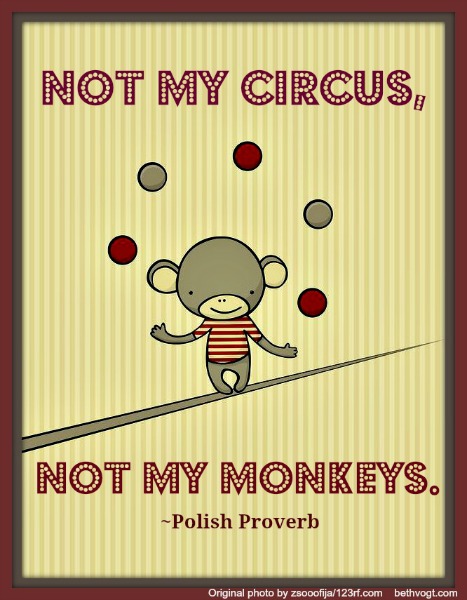
Not My Circus, Not My Monkeys: Or, Choosing the Problem to Address

not-my-circus-Polish-Proverb-rsz

Life imitates art at least as much as art imitates life. This morning I walked into my office to find on my desk a Xeroxed meme of a little juggling monkey, with the words “Not my circus, not my monkeys –Polish proverb.” This is one of two meme phrases we use among ourselves a lot at the MIT Writing Center. (The other is “I am a tiny potato and I believe in you. You can do the thing,” which comes in handy a LOT during Thesis Pain Season, i.e., spring.) In life, choosing which battles to fight, and whose, is a constant struggle. The ability to create boundaries for ourselves is a crucial skill, and one that our socialization seems to make a bit harder for women than for men.

But I think this principle is also important for writing (because if you hand me a principle or concept of ANY kind, the odds are ridiculously good that I can figure out a way to make it be about writing: The arc of Susan is long, but it rolls towards writing.) Increasingly, I have been thinking about the process of writing, and that of writing poetry in particular, as being about problem solving. With a poem, I have not only a story to tell in a particular voice or voices, both of which I am managing with word choice and line length and spaces between lines (stanza control, as I think of it, even with free verse); but I am also singing this to my readers and I want them to hear the music, the rhythm and pitch, the emotions that those convey, and I have to choose each word so very carefully, so that you can pick up the poem and turn it in the light and you will see the facets of a gemstone rather than the patches of a soccer ball (unless of course you are a soccer fanatic, in which case I would rather have you see my poem as your beloved ball). And each word that I choose limits my choices for the following words.

I know that all writing has some of these difficulties. These are the things inherent in a piece of writing that make writing hard. The other, more environmental things are not at play here for me, since this is a personal, free form, deadlineless project. And I think, because of that, when I say that a poem is a series of problems that have been solved I think of it as mathematicians think about problems as opportunities for beauty to happen (no, seriously, they think that way; they are just as crazy as the soccer fans, which is also kind of beautiful).

And sometimes in writing the most important choice is to know when to stop hammering away at the thing and get up and go make dinner or play with the cat or grade papers. The words will be there, waiting for you, when you get back. Trust me on this.

The Object is the Thing. No, Literally.

large-navajo-wedding-vase-signed-by-ella-morgan

Fifteen years ago, I wrote a poem to commemorate the wedding of two friends. I based it on the traditional Navajo wedding vase, and tried to use internal rhyme to give it movement, and to say All The Things I think about marriage, have witnessed quite a few over the years. The irony: the poem first appeared in To Love One Another, a book of poetry about marriage by an assortment of poets, of whom I am probably the only one who had never been married. I also read this a few years back at the wedding of another set of friends, which was a great compliment and honor. I feel like it has held up well over the years.

Now You Have Become One

Pitcher Pouring out Water from Two Sides

reflection on a Navajo wedding vase

for Andrew and Cathy

A difficult trick, requiring cooperation

and grace, like a three-legged race

where you hop and kick your way

to the finish line. Such a pitcher is full

of contradiction. No more can you

say of the water, “This is mine,” or

of the pitcher, “I.” Now you learn

to say “we,” take turns pouring out

on the dry ground around you—

for desert will always surround you,

awaiting clean water to awaken the green,

the flowering red and blue, from the baking,

cracked ground. Now you will practice

togetherness mopping floors and grouting

tile, opening doors in yourselves and leaving

them open, like the spouting lip of this

pitcher on each side. Now, man and bride,

woman and groom, you will cleave

like clay braided together, reaching around

to embrace. But first, you will need

to leave room in your day to pour out

over one another’s faces, to quench each

other’s thirst. And in your trade-off

for closeness, you must give up those

crabby mornings, easy freedoms, blithe

old habits. Sometimes you must give away

what you most treasure. You must give

water in due season. You must give to

each other, the world, in equal measures.

“Now You Have Become One Pitcher Pouring out Water from Two Sides” first appeared in To Love One Another, published by Grayson Books (Ginny Lowe Connors, ed.).

The Ups & Downs of Giving My Brain a Home

h_coverc

We each have a unique brain, but my lately my own brain has been acting particularly unique. On Tuesday, as I was heading for work, I started thinking about what I would write in the next blog. When I got to the train, I dug around in my coat for a file card and wrote 24 lines in very tiny handwriting to capture my ideas before class. I do realize that a lot of you young whippersnappers, especially those born after the bicentennial, probably would have tippy-tappy typed yourself a text or email, but you would, I argue, be losing out. The e-world does not have the serendipity of the material world (Oooh, now there is an epigraph. Everyone: go write me a poem with this as its heart’s kernel! Report back.) It is hard to accidentally come across something you have put into the ether as I did yesterday when I found the file card my cat had knocked off the dresser, a file card scribbled last year when I was at a bookstore, remembered the book and the line in it and copied it down, knowing I would eventually use it to write something (which I had done a few years earlier when I first read the book, but I lost that particular note). Serendipity on top of serendipity.

Anyway, my brain. So as I was entering the building where I teach, looking at my notes, I suddenly started singing in my head:

Chicken scratch blogpost, I don’t care!

Chicken scratch blogpost, I don’t care!

Chicken scratch blogpost, I don’t CAAAAAAAARE!

My master’s gone away!

Sigh. But there is also an upside to hosting my particular brain. On Monday afternoon, just as I was waking up from a nap, I could see, as if typed on the inside of my skull, the line, “As children we come to experiences bone to bone, with no kind skin to muffle the uproar.”

I know, right? Amazing!

I immediately knew that it was the beginning of a poem, at first I thought the poem about Troy but as I sat up and scrambled to get to the computer to write it down, I realized that instead it would enable me to write about the origin of the character I would argue is the Best Damn Villain Ever in popular culture, Xena’s nemesis Callisto, portrayed by the very talented Hudson Leick, who apparently now teaches yoga. That seems a trifle ironic, given that Callisto is a very likeable psychotic mass-murdering fiend. I even saw a short, 4 minute, YouTube video that explains with clips from the shows, just why Leick’s Callisto is the Best Villain Ever (so it is not just my opinion, huh!).

This is why, despite all my protests that There Is No Muse, GRRR!, I can absolutely understand why the ancients would make up the idea of the muse. Even I, after briefly minoring in psychology in college, have a hard time giving my own mind credit for such an unlikely phenomenon as the perfect gift of a perfect line after a damn fine nap. It is easier to give somebody else credit, whether that’s nine generous Greek chicks or God. The Greeks are the ones who handed us down the idea of hubris, the dangerous self-pride or arrogance that offends the gods. For writers, inspiration is a precarious thing, as illustrated by all the blogs on WordPress alone that focus on writers block. Even for me, the instinct is to be cautiously humble…

To Shock or To Seduce, or…

New York fashion week was recently shocked by designer Rick Owens, who put on his runway men, as the news sources quoted, with no pants. Now, while I would argue that fashion week, and quote fashion unquote in general, has absolutely no relation to what real people on planet Earth would ever consider wearing in public, I think there is more going on here.

First, the feminist argument. We exploit women without thinking much about it, but GOD FORBID we should exploit men. Exploiting women is business as usual; exploiting men is news. Second, I can only assume that Mr. Owens is gay, since the bit of these skinny models he was emphasizing is not the thing that most straight women want to see. Think about, maybe, but see? Not really. I turn to Facebook for support of my claim.

First a picture.

scot

Next a brilliant blog post: When Suits Become a Stumbling Block: A Plea to My Brothers in Christ*

I think a similar pattern can be seen in poetry. It helps to remember that many kinds of poetry that are now taken for granted were once revolutionary. I have talked before about those wild and crazy French poets writing prose poems, and the brave souls 100 years ago ditching rhyme and conventional rhythm patterns for free verse. The modernists, such as Gertrude Stein, tried to make their writing do for prose and poetry what Pablo Picasso was using Cubism to do for painting. The result depended largely on the talent of the writer, but ranged from revolutionary brilliance to word soup. I have met many students who think that poetry does not need to mean anything, which is harebrained if you ask me.

So the question is, as artists, when we want to shake things up, how are we going about it? Through shocking our readers or through seducing them? And actually, even seduction has its problematic characteristics even as a metaphor, since seduction usually requires, on one side, manipulation, and on the other side, ignorance, naiveté and a general lack of the conscious consent that we want to encourage as we attempt to turn the rape culture we live in into a culture of consent.

So if we want to win people over, ethically, whether it is to our physical selves or our ideas, perhaps a better word is romancing. I dunno. I just have a feeling that the language we use about everything matters, since we carry that language from one context to the next, often with very little thought about it. As the feminist post-Christian theologian Mary Daly said, “If God is man, then man is God. ”

So yes, fellow poets, let us stir things up and experiment with poetry. But for God/dess’s sake, let your poems keep their pants on.

The Quiet Stories of Japanese Woodblock Art

ejiri_in_the_suruga_province

I lived in Matsuyama, Japan from 1990 to 1992, teaching English and studying kendo, Japanese fencing. Since coming home, I occasionally find myself wandering in the Japanese section of Boston’s Museum of Fine Arts (MFA). While the kimonos and swords are works of art and poetry themselves, with their elegance and attention to minute detail, it is the woodblock art, ukiyo-e, which grasped my attention and made me want to learn more. Two of my favorite artists are Hokusai and Hiroshige. Today I’ll tell you about the first.

Katsushika Hokusai (1760-1849) made many different kinds of sketches and woodblock art, from portraits and still lifes to erotica and illustrations for humorous poems, but what he is best known for is his landscapes, particularly his two collections of Views of Mount Fuji. Most people are familiar with the “Great Wave off Kanagawa” (I even have a T-shirt of this!), but some of his less famous works offer me the opportunity for yet another Important Excitement/Small Obsession. And lots of poetry.

For me, the beauty of his landscapes lies not just in the visual beauty, but in the way he adds people to the scenes, villagers and travelers who are responding to each other, to the view, to the viciousness and beauty of nature. And when I look at these pictures in art books and draw on what I learned as an East Asian Studies minor at Middlebury College, I start to tell myself stories about what is happening, who those people are, what their hopes and dreams are, and what small epiphanies I can open up by telling those stories through poetry. Here is one from my upcoming ebook, Icons and Action Figures (Batteries Not Included):

Mount Fuji Seen from Eijiri

(Hokusai, 1823~29)

Typhoon season begins this way:

with a sudden gust

slamming travelers forward

blasting road-dust against their legs

hat papers leaves becoming birds

flutter and soar, tumble and fly—

the trees lean after their leaves

longing to follow

while the travelers stumble

cursing luck and wind and all

impermanence, the loss of letters

painted by hands of white silk,

the loss of a sloping straw hat that leaves

a poor man vulnerable

to the gushing rains

that wait, like Mount Fuji,

solid and irrevocable against the sky.

Spilecki, Susan. “Mount Fuji Seen from Eijiri.” Verve (1996) 8:1.