Pinterest Poem

pin

I am not sure whether this is a cento or a found poem. I saw something crazy about lasagna on Pinterest and decided that my writer’s block merited strong measures and immediately stole it. Astute readers will also recognize lines from Ernest Hemingway, Emily Dickinson, and Patrick McDonnell’s cartoon Mutts.


Writers are desperate people, just the way we want

Them to grace the cover of Life Magazine: somewhere

Between torture and fun and blasting it out

With charges that will rock your readers’ world.

Ten rules fit women use to stay fit. One: Exercise

Hypergraphia, an overwhelming urge to write,

To truly rest up, to stop in at my favorite place

For drinks and comfort food that leaves me

Impressed without fail, in gender reversals

We need in our stories, a great example of why

This is absolutely true, in a slightly more mystical light.


I think it’s fairly common for writers to be afflicted

With two simultaneous yet contradictory delusions:

I can always live by my pen, until not writing

Makes you anxious. It’s the one and only thing

You have to offer. Well, that and nineteen lasagna recipes

That will change your life: so flavorful, everyone’s bound

To have seconds. Now, I’ll be unstoppable. Yahoo!

Yippee! Woo! Woo! To keep a love story from being

Boring, you need, when asked about romantic chemistry

On the show, to write about the things you wish

You had the courage to say. Only death can stop it.

A Made Thing before Valentine’s Day

“My Foucault-friend, who is now an ­anthropologist, observes that in the West we tend to think of made things as being false” (Biss).

Anti-Valentines-Day-Metal-Playlist

If the poem I make is a false thing, as made as my house,

As false as your eyelashes that you also made this morning,

As thing-like as your car that falsely carried you

To work yesterday and just as falsely, eventually,

Carried you home last night, then how am I to cultivate

Truth like a garden of earthy, homegrown delights?


If my poem, made from words, which presumably also

Have been made, in this case by our ancestors

Who agreed what the grunt would mean, and the hiss

And the slow accumulation of consonants, then how

Can beauty be real, since there too we simply have to

Agree on the symmetry and style of another face?


If the song you made from notes just lying around

The universe is false, if the story you told yourself

Of love and loss and, eventually, redemption and love

Again, if that too is made and therefore false, what hope

Do any of us have to find the real thing, the true and

The beautiful thing, the unmade heart beating to ours?


Biss, Eula. “‘The Folded Clock,’ by Heidi Julavits.” Review. New York Times. 27 Mar. 2015. Web. 10 Feb. 2016.

Happy Birthday, Musashi


63bc1a6b1fac84d562cf95d60e66018e

So today Musashi, my animal companion, turns eight years old. This is as old as he’s ever been, though he would be the first to tell you that I am “way olderer” than him, as in “like elebenty.”

Meanwhile, in other news, a blizzard has just come in on little cat feet and is threatening to drop a foot of snow on much of Southern New England, particularly our little part of it, Boston. Boston public schools, Northeastern University, Episcopal Divinity School, Emerson College, Brandeis University, New England Conservatory—just to name a very few—have closed for the day. But not MIT, in part because not Harvard. Sigh.

On His Eighth Birthday, Musashi Poeminates

Cry havoc! And let slip the dogs of war. –Shakespeare, Julius Caesar


Cry havoc! And let slip the cats of winter,

Chasing the icy wind across parking lots,

Down streets, up trees into the branches

That only months ago wore leaves like green

Fur. February, that month cruelest to those of us

Who never spell easily, tightens its grip,

With every flurry a kitten ready and willing

To ravage your toes with her tiny claws.


Havoc is coming. The schools all know it,

The big men who drive the snowplows all

Know it, the bus drivers for whom havoc is

A daily burden, they know it too. And I,

Lying reflectively in my turquoise catbed,

Contemplating the existential drift, I too

Know the true havoc that is the lack of my

Housekeeper, soccer partner, butler,


Just because she has mad writing skills

And her school, like a German Shepherd

Facing off with a Rottweiler, all growl

And lack of poetry, refuses to accept

How weather makes fools of us all

Sometimes. The snow comes down,

An unfurling of fluffy white cats, stretching,

Shedding, everywhere, and all day.

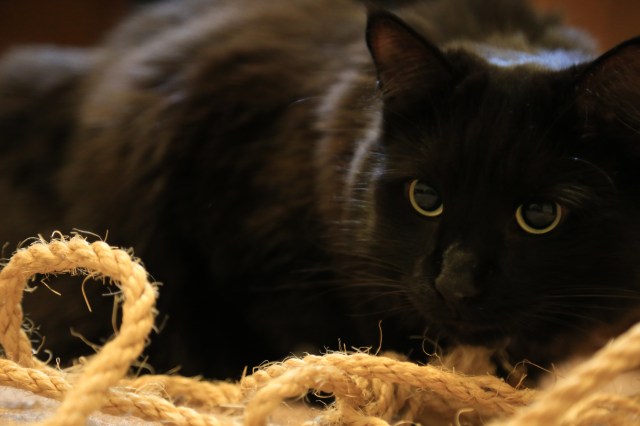
Mu with String

Photo by Jack Siberine.


The Thing about Existential Dread

So I saw this illustration on Facebook the other day and it felt so accurate that I am bringing it here, I finally found the illustrator, Shen. I’m grateful for their wisdom and hope I have done justice to their ideas.

existential dread

The thing about existential dread is how it drains

The color from every wall in your head, how it grows past

Every other emotion, the way a shadow can inflate itself

Until it is taller than the thing the light is hitting, whether

Self or other. The trick with existential dread is to move

So that the shadow must run if it wants to keep up:

Vacuum the rug, do cardio, chase the cat through

The living room—the room for living not simply existing—

Follow the cat’s example and live in the present moment,

This present moment, the only one we ever really have,

The one so hard to stay in. Don’t let the existential dread

Set in, don’t let it set in. Make pasta if you must, add pesto,

Eat it with gusto. Shop for a new tie to look dapper in. Don’t

Let the existential dread set in. Don’t let it set in. Keep moving.

The Donuts of Our Discontent

prune-donut

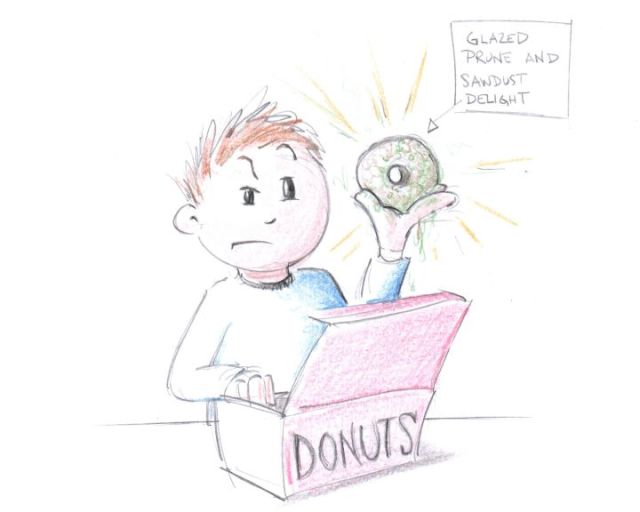
So the other day my pal, HeyLookAWriterFellow, wrote about Unfortunate Donuts and even illustrated it amusingly (he is one of my favorite contemporary artists, along with Laura Wilder, Anita Munman and Berkeley Breathed). This got me thinking about Perfect Donuts that I have eaten (all two of them) and set me up for the 7-Eleven’s 50-cent donut deal yesterday morning, which led to the glazed donut I ate half of yesterday and am finishing today, because no one should eat that much sugar in one day if there is absolutely no chocolate in it.

One of the perfect donuts was a coconut-covered jelly stick. I ate it in Cranston, Rhode Island in about 2001 or 2002. The other was an all-too-brief Starbuck’s creation, a rectangular blueberry-raspberry jelly-filled perfect balance of starch, sweet and salty goodness. Naturally, after only about two months, they stopped making them. Probably the gods complained. They just HATE it when humans create something perfect.

How do you write

a poem about a donut

you ate a decade ago,

how do you recall

the texture on your tongue, the zip

of sugary goodness, delicate

balance of salt and sweet, the color of jam

moistly melting


And now I have no idea how to end this….

Illustration by Mike Allegra 2016.

34 Years of Poetizing

ice-dam-icicles

On or about January 20, 1982, I officially started writing poetry. I had written a few poems before that, either at school or at a small library writing class one summer, but on this day off from school for a teacher in-service day (whatever that means), I looked something up in the dictionary and found my attention snatched by the illustration of an “irregular octagon.” Those two words sounded so good together that I wrote a long poem about them, which is, thankfully, lost to the ages. Then I wrote a few more poems. Then I decided I was a poet.

Some of those high school poems were good in terms of imagery, although I was unsurprisingly addicted to rhyme. I started experimenting with free verse in college, often to good effect. But it was not until the 1990s that I started actually reading poetry that was written by other people. This progression is very common in beginning poets.

One of the great values in reading other poets is figuring out why they made the kinds of choices they made. Was it the sound and taste of the words? Was it laziness? So I am going to offer you two new poems and see if I can trace my own choices.

Yesterday was ridiculously cold, so I started thinking like this:


My toes are become wild icicles, shedding

Heat with every beat of my muffled heart,

The cold sidewalk so lonesome it must steal

A degree at every step I take. I do not think

About the heaviness of my bag, my watering eyes,

Or how dark the night was. I only feel the absence

In my boots, the negative space like a Vulcan greeting…


Well, now this has gone in a direction I did not expect, especially since the wildness is the interesting part of that first line. But “wild” to me tends to bring the connotations of jungles and passion, heat and brightly colored birds, which is the opposite of icicles and lonely sidewalks. How do I bring the poem around? Also the structure “I do not think of X, Y, and Z” is one I often use—is this laziness? It is a way of pointing to other details of the scene that we expect, what I might call the “pedestrian” details, literally, the details of being a pedestrian in a cold city. The darkness of the previous night takes the potential physical heaviness and tearing up and shifts to a more abstract negativity, possibly connected to the loneliness of the sidewalk.

Then things changed. I did feel like my middle toes were missing, but I don’t know if that works here. Also it takes me much farther from the wildness of the first line, which is frustrating. What are wild icicles? I love the sound of the phrase but I don’t know what it means or how to get back to it. Let’s try a complete 180.


Or how dark the night was. The wild icicles,

Hiding in the darkness of my boots, predict

Summer brightness, glorious jungle greens,

Toucans, monkeys, flowers like explosions

Of feathers and alien stars, which, this morning,

Are difficult to believe in.


Somehow I have to get back to the fact that I can’t feel about a third of my toes, and don’t expect to anytime soon (noon? March?).


Are difficult to believe in. Faith is hard

In winter, as hard as the long and deadly

Icicles hanging from the eaves of every house,

Waiting to pounce and pierce. Today, only

My forward momentum drags me stiffly

Toward the possibility of spring and the hope

Of something hereafter.


Now I’ve got to figure out how to end this sucker that doesn’t sound either too depressing (winter will never end) or too optimistic (four months of winter will go by in a flash! You’ll see!). We could go for closure, repeating shedding or muffled heart, but I don’t know what to do with that. Something about faith? Or the seven cardinal virtues? I have always quite liked fortitude.


Of something hereafter. Perhaps fortitude is

What we need: the will to withstand the cold,

Hard days and long, thin dark nights, fortitude

And the patience of burrowing, hibernating animals.


So we are left with this. I am undecided about whether I like it or not or how much. Thoughts?


My toes are become wild icicles, shedding

Heat with every beat of my muffled heart,

The cold sidewalk so lonesome it must steal

A degree at every step I take. I do not think

About the heaviness of my bag, my watering eyes,

Or how dark the night was. The wild icicles,

Hiding in the darkness of my boots, predict

Summer brightness, glorious jungle greens,

Toucans, monkeys, flowers like explosions

Of feathers and alien stars, which, this morning,

Are difficult to believe in. Faith is hard

In winter, as hard as the long and deadly

Icicles hanging from the eaves of every house,

Waiting to pounce and pierce. Today, only

My forward momentum drags me stiffly

Toward the possibility of spring and the hope

Of something hereafter. Perhaps fortitude is

What we need: the will to withstand the cold,

Hard days and long, thin dark nights, fortitude

And the patience of burrowing, hibernating animals.


The Problems of the Epic Fantasy Fan Poet: Reportage, Character and Style


As I mentioned on Saturday, the big motivating questions behind so much fan fiction are when did the two characters finally get together and how. But for me as a poet, the question is more about who gets to “report” on these matters, and how do I do it with style, finesse, dignity and just a tiny bit of steam?

First, I set it after Gabrielle’s (brief) marriage to Perdicus. That gets the whole virginity thing out of the way, and it also gives me another chance to see Xena’s Hopeless Yearning (which is something that, as a writer, I have a whole lot more experience with anyway).

Alone on Her Wedding Night, I Think of the Past


Once upon a time, an innocent village girl

Left behind her village, parents, sister, even

Her betrothed, to seek adventure on the open

Road. Always ready to talk her way onto a farmer’s

Cart or out of a fight. Talking, stalling for time:

She has a real knack for using words. It’s as if

The words come to her, begging to be said

By her lips, molded to her uses by her tanned

Hands. If I could be a word, I’d come to her

To be said, over and over, like a litany

To Artemis the Huntress or Athena the Wise.


Why are all the best goddesses virgins? What is it

That men do to take a woman from her truest self?

Before I stood with her, I braided the garland

Of white flowers for her to wear. She should have

Had a laurel wreath, a crown to tell the world

Of her mastery of words, and the mystery of it:

How she reaches out her hand to touch

The stars, caress the waxing moon, and when

Dawn breaks, a scroll lies next to my pillow.

Perhaps she will write for him now. I promise you,

He won’t know enough to appreciate it any more


Than I did. If I had a heart to break, I would cut it

Out of my chest, leave it to beat its last on some

Flat rock, garlanded with a discarded wreath

Of small white flowers, fading as night falls hard.

It doesn’t take a blinded Cyclops to see where this

Night is headed. There is a storm on the horizon,

Purple clouds rolling in with the flash of lightning

Piercing the repeated booms of thunder. And I,

I stand in the pelting rain, oblivious, cold,

Alone again. Once upon a time, foolishly,

I had thought it would be me.


I have some poems where I show Xena letting Callisto die in the sandpit, and then I made a bunch of poems set during the Athenian games, which shows all the characters (including Joxer, Salomoneus and Autolycus) dealing with Gabrielle’s grief and mourning. Xena gets (briefly) killed and comes back with her friends’ help and then the ladies get back on the road.

I chose to have Xena be the one to tell what happened, but in an indirect format. Since Gabrielle is usually the bard/poet, I though I would have Xena try a shy love poem. Because beginning poets almost inevitably lean on rhyme, I knew I had to use some rhyming elements, but because I wanted the poem to be dignified and not sing-songy or trite, I used a stanza form with endings ABCDEFGH, so the first line of every stanza would rhyme, etc. Also, in the first two stanzas I used end-stopped lines, which means that the line either ends with a comma or period, or it ends at a fairly sensible place in the sentence. I only start using enjammed lines in stanza three, where a sentence ends in the middle of a line and a new sentence begins right after. So, similar to the events the poem recalls, she starts out shy and awkward and gradually gains confidence and speed.

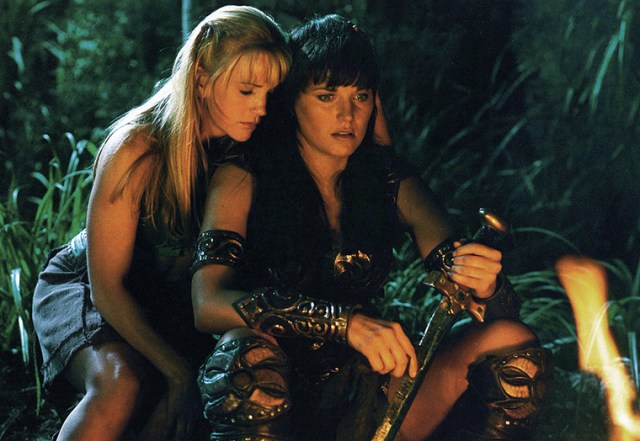
Xena-and-Gabrielle_article_story_large.png

Shyly, X. Tries Her Hand at Poetry the Morning After


Four hundred nights I must have watched you sleep,

The dying fire catching the gold in your hair.

Your sweet breath rose and fell and rose again

With the rhythm of your dreams I was not in.

I did not see you clearly, not at first.

Experience makes innocence seem weak.

Not until you fought beside me did I see

That you had steel in you and your own light.


You were a secret I felt I had to keep.

I could not ever let you catch me stare

When you, eager, scratched the parchment with your pen

Or dutifully cut our dinner, gill from fin.

But it was the long spring nights that were the worst,

As I lay by the fire, cold and bleak,

Knowing my desire could never be

More than a whispered dream of warm delight.


I could not know how time would make you weep.

The violence of my life you chose to share

Would take your light and heart and try to rend

Them apart, a battle you could not win.

Your pain, my fault; because of my past, cursed.

What changed it all was tragedy. We are Greeks.

We never take life easy. You and he

Married, deflowered, widowed: one day, one night.


The poets say that what we sow, we reap.

I had to make it right. I could not bear

To see you in such pain, my more than friend.

My vengeance had little glory, was messy, thin,

A deed I had to do, although perverse.

And after, it was hard for us to speak

Of any of it. The silence between you and me

Crashed through the trees behind us like a kite.


It took a few more months for you to steep

In your grief, to face the morning air

Without mourning his reaching of life’s end,

His power over you and its long romance.

You threw large stones into the watercourse.

You say you did not dream. Tears on your cheek

Kept my hand from touching your knee

To “comfort,” a self-deception I had to fight.


Then, one evening I heard you moaning in your sleep,

Crying out my name, demanding more!

You were tearing at your clothes and then

Reaching for me. I felt my whole world spin.

I touched your face. I thought my heart would burst

As your eyes flew open, blushing that I could see

All of you now seeing all of me

Finally! At last! And then, all night…

The Problems of the Epic Fantasy Fan Poet: Subtext that Has Been Seen Cannot Be Unseen

front


A poet, among other things, is a problem solver. (Ha! Bet you didn’t see that coming.) It’s true. We try to find a thing to say and then say it in the clearest and/or most beautiful way we can. A fan poet, like a fan fiction writer, is also trying to resolve the problems in an original piece of fiction/television caused by the original creators and writers. Sometimes this is about bringing Characters Who Shouldn’t Have Died back to life; more frequently, it is about fulfilling the subtext romantic possibilities of a pair of characters, whether or not that relationship ever happened in the official canon or not.

Back in the 1990s, I never saw the romantic subtext between Xena and Gabrielle. I just thought they were really great friends who had each other’s back no matter what. I thought this up until Season 6, episodes 19 and 20, two episodes right before the series finale, by which time, to quote Rupert Giles, “the subtext [was] rapidly becoming text.” Including a poem by Sappho, fer cryin’ out loud. Even I with my firmly established Straight Brain couldn’t ignore that.

Part of the difference in how I see the show now is the difference in the time it takes to view it. In the nineties, when I was watching a 45-minute episode once a week, it was easy to not see the way the relationship was changing. Now, when I can watch five episodes in four hours, the minor touches, the number of times Xena kisses Gabrielle on the head or touches her arm–it all stands out so much more.

Xena-Gabrielle-xena-and-gabrielle-26031877-760-524

Part of the difference is simply how the world has changed in the last twenty years. In 1995, I thought I only knew half a dozen gay people. In 2008, my state, Massachusetts legalized gay marriage here, and I saw a lot of friends take advantage of this. In 2015 the US Supreme Court legalized gay marriage as the law of the land, and increasingly in film and on television we have been seeing LGBTQ romantic storylines as, gasp!, text. Maintext: sometimes as side plots, as in Marvel’s Jessica Jones, and sometimes as main plots as in the film Carol.

So this led me to the motivating questions behind so much fan fiction: when did the two characters finally get together and how?

gxebor07

It was clear to me from the beginning that Xena would have a hard time initiating anything. The six seasons show how most of the physical relationships Xena had in her past were manipulative and destructive, so she would be extremely cautious about expressing her desire, since passion had so often been entwined with power issues, perhaps in part to mask the vulnerability she had no interest in feeling or showing. Also, because Gabrielle is a virgin and has only ever shown an interest in men, Xena might feel hesitant to express her feelings, because if the answer is no, their journeying together will be awkward, or possibly even over. So I wrote this, which conveniently also explained the episodes when Lucy Lawless was attending conventions or doing publicity like the Jay Leno show where she broke her pelvis.


On the Road Alone, X. Explains Herself


Sometimes the heat builds up to such a pitch,

I have to leave you, make up a mission,

Far away–urgent–must rush–I will

Be back soon. You say, “Don’t forget me!”

As if I ever could. That’s why I go.


Only by riding away can I feel the heat

And weight of you, the one person in the world

I can’t have. I lie awake by the fire

Sweating for what I want, the one day

You turn and catch me looking, and understand.


Far away from you, I have space to imagine

What it could be like. Maybe your eyes close,

As you shudder when I run my hand

Down your arm, your leg. Maybe you breathe

Against my neck, wordless for a change.


Maybe you press yourself against me,

Urgent, your cool fingers finding, sharing

My warmth. Maybe you ask for more, and again,

And eventually lay your head against my shoulder.

Far away from you, I allow myself to imagine.


Far away, I can get you out of my system

For a little while, relieve the pressure of

My wanting deep in the belly, the knot

That ties me to you, that no one else can see,

Not even, or especially, not you.

The Problems of the Epic Fantasy Fan Poet: Establishing Character Relationships

front-1

So in case you were wondering to yourself, “Self, exactly what does an Epic Fantasy Fan Poet do?” because you think you might want to be one when you grow up, I am going to spend the next few days Taking My Blog Audience To Work with me, here in my toasty garret at the top of a high, crenelated tower with the pointed roof and the colorful pennant waving in the breeze. Mind you, this is my mental garret, as my actual garret is the second floor of an apartment building with roommates and cat, but never mind.

I have talked before about what the poet Maggie Anderson calls “important excitements”: those small projects where you take something interesting and look at it from a dozen or so angles. So for example I have at least a dozen poems about the women in some of Hiroshige’s woodblock landscapes of Edo (17th century Tokyo), their relationships, their lives, their extended story—all of this even though it is highly unlikely that Hiroshige saw any relationship among these women at all.

So last February, I thought to myself (as one does), “Self, let’s write a few poems about Xena: Warrior Princess. That’ll be fun! And it will give me a good excuse to watch it on Netflix streaming!” After all, as my colleague Rebecca Thorndike-Breeze says, “If you get writing out of it, it’s research.”

So I went back and watched the first season, which I had seen before via Netflix, but had not actually watched during the nineties; I only discovered Xena on TV at the beginning of Season 3. What I noticed watching this time with Poetry in Mind (with poetics aforethought?) was how little respect Xena shows her new travel buddy Gabrielle for the first half of the season. Some of this lack of respect appears to be the somewhat Yang/Yin nature of their relationship: Xena is almost a foot taller and she is the fighter with all the experience (apparently sexual as well as military), in comparison to the frumpily dressed Gabrielle who keeps telling us she is “not the little village girl my parents wanted me to be” while at the same time proving over and over again that, actually, she kinda is. Sigh.

But as someone who has watched the entire series a few times (no, I don’t have a life; what’s your point?), I know that an equal partnership is coming, although it will take another three or four seasons to fully realize. So I looked for the moment when their relationship shifts and I tried to write a before/after sort of picture. What I found interesting (considering that in episode 1.3 “Dreamworker,” Xena repeatedly tells Gabrielle “Words before weapons”) is that the major shift seems to come immediately after the Amazons teach Gabrielle to fight and then they all go into battle together.


Now this is problematic in a lot of ways, ways that the writers both do and don’t address throughout the six season of the show. On the one hand, Xena’s point that once you lift a weapon you will be classified as a threat and summarily attacked is valid. And a weapon you don’t know how to use belongs to your enemy. And they do say that taking another person’s life changes you dramatically. So to some extent Xena’s repeated refusal to teach Gabrielle to fight seems reasonable. However, Gabrielle points out that being able to defend herself would be helpful, at the very least so that Xena doesn’t have to do all the work. What Xena in her height and combat experience does not seem to comprehend is how terrifying it must be to be Gabrielle: every time a band of bandits attacks the pair, Gabrielle is just one warrior’s death away from a brutal rape and death or possibly slavery.

One warrior’s death: Xena’s. If Xena dies, Gabrielle hasn’t got a fly’s chance in shit of making it out of there alive and well. And although later Gabrielle and the audience knows that Xena doesn’t die (or—spoiler alert—at least not often or irreversibly), in the first few episodes Gabrielle can’t know that and neither can we. So Xena doesn’t look too good, refusing to empower her new friend by letting her learn to protect herself. This ticked me off. That, and the fact that in the episode after the Amazon fight, Gabrielle is fighting back to back with Xena as if she’s had endless practice and experience. In the nineties we could imagine that she’d had a week on the road with Xena (since the previous Saturday afternoon). When we are Netflixing, the next episode could be the next day. Nobody but nobody learns to fight that well in one day or seven.

So, in the section on Season 1 of my epic fantasy fan poetry, I fixed that, and I even got to use Plato. Woohoo!

.

What We Might Regain: G. Contemplates

.

Sometimes I wonder what she sees in me.

Sometimes I think of that story Plato wrote

About the people with four legs and two heads

That Zeus got all upset about and split

With lightning bolts, leaving us all asunder:

Only two legs, one head, and half a soul.

.

If, when Prometheus was rebound and doomed

To have his liver eaten by foul birds,

Day after day, mortals lost his gifts:

Fire and healing. Then what would it mean

If some heroes saved him? What does it mean

That she lets me travel with her, unable

.

To help with her adventures? It is intimidating,

Sometimes, watching her work like she is

A female Hercules. The sword is one thing,

But backflips and double kicks? I have begun

To write it all down, as Homer did for Achilles

And Odysseus. More people should know of her

.

Brilliance. Too, I sometimes wonder, if

Saving Prometheus will bring us back our fire

And ability to heal ourselves, what would we

Gain if she ever found that hero, the one

Who somehow in another human body holds

The other half of her enormous soul?


Now since a big part of fan fiction is sorting out the potentially romantic connections between two characters that subtext has hinted at but not directly addressed, I also knew that I was going to have to set up the “before” picture. And anybody who knows anything about old-fashioned TV production companies knows that a show (gasp!) starring two women is going to have to do some foundational work proving that these two Straight Gals are Just Good Friends. Hence the (non-Bechdel test-worthy) initial episodes of Season 1 kept putting potential love interests (male) in both their paths. This serves to prove the gals is straight and that Xena has a lot more experience with such things than Gabrielle, which serves to differentiate the characters more–as if Lucy Lawless being six feet tall in her boots and armor doesn’t do that enough. Fine, I can use that.

.

X., Jaded, Rolls Her Eyes

.

Everyone, she thinks, has some great love; she watches

That boy and girl hold hands and tells herself

They have something she is missing, something more

Than the adventure, travel and new people she now

Enjoys with me. I can’t really blame her. Even I

Once made eyes at my brothers’ friends when I was

Young and foolish. Even I had my small conquests

With the village boys before I learned to make

Larger conquests with my gathered armies.

.

Take that pacifist son of a warlord. Big blue eyes,

Muscles, armor, a big sword, a soft voice.

His reluctance to follow his father’s profession

Makes her think he’s “sensitive.” Maybe he is.

Certainly, the peaceful village farmers don’t

Deserve the rapacious attention of the old man

And his charioteers, the way they torched

The village silo. I never killed women and children.

But nobody would have ever called me sensitive.

.

And that dying lad she described as “warm and sensitive”

(That word again!) “funny, perfect, smart.”

He called her, she told me, “a rare beauty.” Yeah, he was nice,

I’ll grant you. Helpful, too, in a dangerous situation,

Because, like all of them, he wanted to save her.

They always fall in love with her somehow.

But it’s easy to be nice when you are counting

Your final days. It’s easy to be brave when you have

Come to terms with your own inevitable death.

.

And let’s not forget Hercules’ sidekick, who I once

Seduced for a week, hoping he would turn

On his friend. I guess I didn‘t tell her that part

Of the story. Maybe I should. Though I suppose

I probably shouldn’t use the word “stamina”

Or “dynamo” to describe him. Maybe instead,

I should tell her about the steam coming up from

The bath and his bright eyes. After all, I wouldn’t

Want her to think he was not sensitive.

.

Once I have set up the before picture, I have to set up the How It Changed picture, which in this case is Gabrielle becoming (long story) and Amazon princess and being quickly trained to fight with a long staff. Then, after combat, I give Xena an epiphany so that she halts their journey to train Gabrielle properly, as, I would argue, she should have done in the first place. I made this one a kind of dialogue, with Xena speaking and Gabrielle fuming in silence. I imagine a lot of couples start out communicating in just such inadequate ways.

.

Riding into Combat: G. Flashes Back

.

The staff still unfamiliar in my hands, I step

Into the queen’s chariot at the head of this

Mismatched army: Amazons and Centaurs riding

Into combat together, on the same side

For the first time either tribe’s sages can

Remember. The rumble of chariot wheels is loud

As we gather speed, but my terrified heart is louder.

Behind me, I hear her war cry and I recall

That with her on our side, we will likely win,

Though that doesn’t guarantee I will survive

Myself. I struggle to keep my feet as we roll

Faster and faster down the hill where we can see

The warlord’s army scrambling to grab

Swords, spears, axes: all the ways I might die

In the next minute or hour. My stomach in

My throat, I nearly gag as the Centaur pulling us

Slows, stops, slips off his harness. The roar

Of the enemy, all men in black leather and purple

Scars, is a chorus of sudden death, but I hear

Her battle cry again and I turn to see

Her grinning as she leaps to meet the first.

If I have to die, then fighting by her side

Is not the worst way to leave this life. I jump down.

.

Breathing Lessons

.

X., Out Loud

I saw you in battle. I was impressed. What you lack in finesse, you make up for in sheer ferocity. That will take you far in a short fight or a longer fight with an inexperienced foe. How you didn’t die out there, I don’t know. Maybe Artemis likes you, kid. But beginners luck won’t last and you’ve got bad habits. Tomorrow I’ll find a stick that I can use to practice with you. Meanwhile, you get some sleep, little warrior. You’ve earned it.

.

G., In Silence

Why does she always do that, call me a kid?

It’s not enough that she towers above me

Even before she mounts her horse. Somehow

She always has to belittle me too. I think

She doesn’t mean to. Her eyes are always kind,

Or mostly. But all those weeks I begged her

To teach me to defend myself and today,

I went into mortal combat with a mere day’s

Worth of practice with the staff. If I had died,

It would have just been more blood on her hands.

.

X., Out Loud

You keep your stick close to your body, like this, to get a stronger pivot. It’s not the stick that does the work; it’s you, your body weight that gives your strike momentum. Commit yourself fully to each strike. A staff is not a sword. It metes out pain with both ends. Strike the man in front of you with the front end and use the momentum from that blow to hit the man behind you with the back. Try it. Again. Again. Again. Again. Again.

.

G., In Silence

My bruises from the Amazon battle purpling,

I lie down stiffly, feeling the new ones rise.

She shows me how to rub them out with my thumbs

In a circling motion. Her hands are gentler, now

That practice is over. I’ve never been so tired.

At dawn it begins again. She’s so much stronger

Than me. Even when I block her strikes, some hit me.

But she looks tired, too. Normally she hates this

Sort of thing, focusing on basics, endless basics,

Endlessly explaining it to me, again and again.

.

X., Out Loud

Breathing now. To hold your own in a fight, you need stamina, and that means correct breathing. If you don’t want to get sucker punched, never let your enemy see you take a breath. Unless you are crying out to terrify the enemy, keep your mouth closed. It’s harder, at first, but better in the long run. In the East, they talk about the energy in the body. I learned some breathing techniques to produce more to protect the organs when you get hit. When you’re ready, I’ll teach you. We’re done for now. Tomorrow we’re back on the road.

.

G., In Silence

I am too tired to boil over. I ache too much to tear

My bread apart. I stare at the fire and forget where

My crackling muscles end and its golden ache starts.

How many days have we camped here? When did my

Calluses stop bleeding? She sets her saddle near me,

Rests her head on it. She looks at me a long while, says,

“I thought it’d take longer. You’re a quick learner.”

A backhanded compliment for sure, but I smile, my mouth

The one place I don’t hurt. She watches me, worried.

I say, “Yes. Okay. Eventually, I will probably forgive you.”


NOTE: I do not own the rights to these characters, which are held by NBC Renaissance Pictures. I am getting no remuneration for this creative work.

Epic (Fantasy) (Fan) Poet: Or What I Did During that Nine Feet of Snow Last Winter

front

So every few days or so, I spend time reading other folks’ blogs and getting a kick out of the vastly different kinds of things that people find their passion in, whether it is cooking sous vide, or geeking out about TV shows, or the joys of shoveling snow. And I discovered D. L. Perching’s website for t-shirts for writers of All Kinds of Genres. She had Fantasy Writers and Fan Fiction Writers and so, naturally, I asked if she could make an Epic Fantasy Fan Poetry Writer t-shirt for me, to commemorate the four months I spent back in Spring Semester (read, New England Winter: nine f@#&ing feet of snow, errgh), writing about 250 pages of poetry about Xena: Warrior Princess.

She said yes. Reader, I bought one. In honor of the up-and-coming anniversary of the start of that project, I am going to be posting some of the poems that I wrote, with some of the thoughts I had about the problems of the show I was trying to address. Here is the first, for starters, which is about the events of the pilot episode from the point of view of Gabrielle, when slavers try to take all the women in her village, and Xena, who in dark despair has decided to give up being a warrior (and possibly living–it’s not clear). She then takes up arms again to save them, leading later to Gabrielle following her on her road and then joining her on it.


The Slavers Reach Potidaea


When you wake on the day that changes

Your life forever, you have no idea, you

Think it’s just another blue, green and

Ordinary day, perhaps a good day

For bringing in sheaves or beating out

The laundry against rocks by the river.


On the day that changes your life for

Good, you think your life will never change

From the round of hard work, festival,

Hard work, but that is just because you don’t

Know how to recognize a day like

The one that changes your life forever.


Change rarely happens here. When you wake

You know what’s coming: the same old thing.

Then one day, that change. Everything

Changes. Slavers, sweaty and leering,

Sweep through the village like a reaping

Leaving the men bleeding, taking just


Young women, the strong or beautiful,

Those who can do the kinds of work that

Such men deem the work of womenfolk.

Terror. Screaming. Chaos and that acrid

Sweat of fear, of the knowledge of what

May be—is—coming. The heart beats too


Fast. Even when the unexpectable

Happens: a war cry, sudden salvation—

Your heart still gropes in darkness. And

The next day, when you wake, after that

Night when you relived those horrors, oh,

After that day that has changed your life


Forever, you too are changed, like dough

That, when introduced to extreme heat,

Becomes bread, nourishment, food for your

Journey. Sometimes fire destroys, even

Annihilates. But, sometimes, it anneals,

Leaving you stronger even than you were before.